
Encounters with the Archdruid
Four men, three wild places
Description
In 1971, John McPhee published a slim book with an odd premise. He would take David Brower — the executive director of the Sierra Club for seventeen years, the most consequential conservationist in America since John Muir, the man friends and enemies alike called the Archdruid — and put him in the field with three people whose life's work was, in one way or another, to develop the wild land Brower wanted left alone. A mining geologist. A resort developer. A federal dam builder. Then McPhee would go along and write down what happened.
The structure is almost provocative in its simplicity. Three trips, three landscapes: a forested island off the coast of Georgia, the high North Cascades of Washington, and the Colorado River running through the bottom of the Grand Canyon. In each, Brower and his chosen adversary share a trail, a campfire, a raft — close quarters, days at a stretch, no way to walk off in a huff. What McPhee wanted was not a debate on a stage but the friction of actual people in actual places, arguing about what the place is for while standing in the middle of it.
It would have been easy to make this a morality play, with Brower as saint and the developers as villains, or the reverse. McPhee does neither. He is famously, almost maddeningly, even-handed — a reporter who lets each man be fully himself, competent and stubborn and occasionally wrong, and then steps back. The book that results is less an argument than a set of conditions under which we can watch the argument breathe.
The question we’re asking : What happens when the most committed conservationist in America is made to share a campfire, for days on end, with the men whose work he exists to oppose?What we’ll see : Three journeys into wild country, four men who cannot quite agree on what the country is for, and a writer who refuses to tell us who won.
Table of contents
01Chapter 1 — The idea of putting them in a tent together
David Brower was, by the late 1960s, the closest thing the American wilderness had to a public champion. He had led the Sierra Club through the fights that stopped dams in Dinosaur National Monument, ran the full-page newspaper ads that helped derail proposed dams in the Grand Canyon, and pushed the club from a genteel hiking society into a combative national force. In 1969 the board removed him, partly over the money he spent and the risks he took; he promptly founded Friends of the Earth and kept going. He was a rock climber of real distinction, a man who had made first ascents in the Sierra, and he had a talent for absolute positions.
McPhee's method was to build each of the three sections around a person who stood, philosophically, on the far side of Brower. Not straw men — the opposite. He picked people who were genuinely good at what they did and who believed in it. The point was to let two competent, convinced adults occupy the same wild place and discover, in real time, where they agreed, where they didn't, and where the disagreement went quiet because the country in front of them was simply too large to argue about.

02Chapter 2 — A mineral engineer on Glacier Peak
The first encounter takes Brower and Charles Park into the North Cascades, toward Glacier Peak, in country that held a large deposit of low-grade copper. Park was a geologist and mining engineer, a professor, a man who genuinely loved mountains and had spent his life in them — and who also believed, without embarrassment, that a mineral in the ground is a resource waiting to be used. If the copper was there and the country needed it, Park thought, you found a way to take it out that did the least harm and then you took it out.
Brower's position was the reverse and just as settled. A wilderness once opened is a wilderness lost; the value of the place lay precisely in its being left alone, and no amount of careful engineering could restore what a mine road and a pit would remove. The two men walked the same trails, climbed together, camped together, and argued the whole way, and McPhee lets the argument run without leaning on the scale. Park is never a cartoon extractor. He is a serious man with a coherent view of what the earth owes us.
03Chapter 3 — The man who wanted to dam the mountain
The second encounter moves to the coast — Cumberland Island, off Georgia, a barrier island of live oaks, marsh, and undeveloped shore. Here Brower's counterpart is Charles Fraser, the developer behind Hilton Head, a young, articulate, energetic man with plans for the island and a vocabulary for defending them. Fraser had a phrase for people like Brower: he called them druids, worshippers of trees, and it is from Fraser's mouth that the book's title effectively comes. He meant it as a jab, but McPhee lets it become something larger.
Fraser was not a bulldozer in a suit. He argued, plausibly, that thoughtful development could preserve more than neglect would, that a resort built with restraint could protect a coastline better than leaving it exposed to whatever came next, and that people needed places to be, not just places to be kept out of. Brower heard in this the oldest and most dangerous argument he knew: the reasonable-sounding case for the first cut, after which every further cut becomes easier. The island, walked and discussed, becomes the ground on which the two men test whether "development" and "preservation" can ever mean the same thing.
04Chapter 4 — On the Colorado, floating toward Marble Gorge
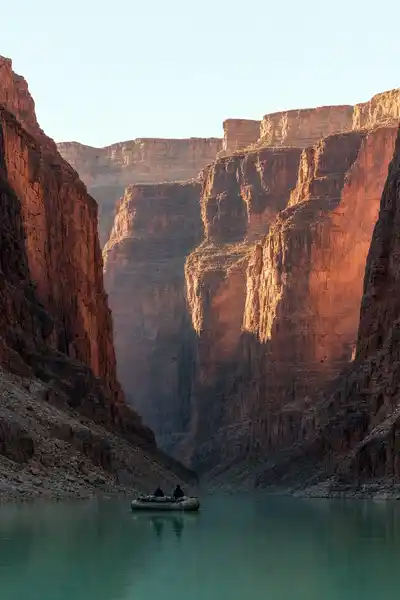
The third and most memorable encounter is on the water. McPhee puts Brower on a raft down the Colorado through the Grand Canyon with Floyd Dominy, commissioner of the Bureau of Reclamation, the man who had built Glen Canyon Dam and dreamed of dams within the Canyon itself. These two had already fought each other in public for years — Brower's Grand Canyon ad campaign had helped stop dams Dominy wanted — and now they were confined to the same small boat, running rapids together for days, drinking Dominy's beer, sleeping on the same sandbars.
Dominy is the fullest portrait in the book, and the most surprising. He is profane, funny, immensely capable, and utterly unrepentant. He believes that a river running uselessly to the sea is a waste, that a reservoir stores water and generates power and gives ordinary people a lake to boat on, and that Brower's reverence for wild rivers is a luxury paid for by people who already have enough. He is, in his way, a democrat of the reservoir. And he is right often enough to be dangerous to argue with.
05Conclusion
Brower ran the river with Dominy, walked the island with Fraser, climbed toward Glacier Peak with Park, and at the end of each trip his position was exactly what it had been at the start. Nobody was converted. What changed, over the course of the three encounters, was the reader's sense of what the disagreement is made of — not ignorance meeting knowledge, but conviction meeting conviction, each grounded in a real love of the country and a real idea of what it is for.