

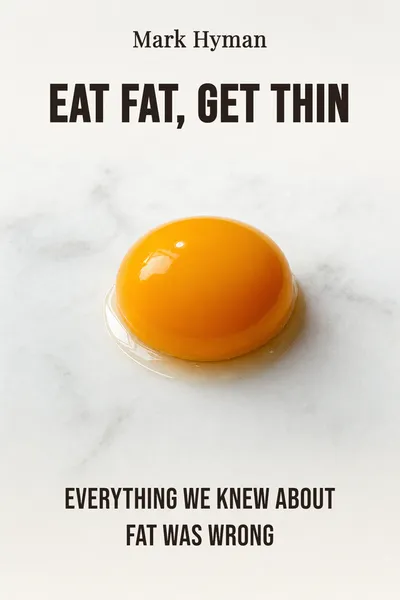
Eat Fat, Get Thin
Everything we knew about fat was wrong
Description
In 2014, a meta-analysis in the Annals of Internal Medicine — one of the most-cited challenges to the long-standing consensus, though it drew sharp criticism and a partial correction afterward — looked across decades of dietary studies and reached a conclusion that landed like a small earthquake in nutrition circles: the evidence did not clearly support the idea that saturated fat was the dietary villain everyone had assumed it was. For a generation raised on skim milk, dry chicken breast and the word "low-fat" stamped across cereal boxes, this was hard to absorb. Fat had been the enemy since the 1980s. We had built supermarkets, school lunches and entire personal identities around avoiding it. And now the science was quietly walking that back.
Mark Hyman, a physician who spent years running a functional-medicine practice, took that walk-back and turned it into a program. In "Eat Fat, Get Thin," he argues something that still sounds like a provocation: that the fat on our plates is not what makes us fat, and that eating more of the right fats is one of the most reliable routes to losing weight and feeling well. Avocados, olive oil, nuts, fatty fish, even the egg yolks we were once told to throw away — Hyman puts them back at the center of the table, and builds his case on the same scientific shift the Annals paper captured.
Consider the low-fat cookie: stripped of butter, loaded with sugar to keep it palatable, and sold for years as the virtuous choice. Hyman's book is built around what that swap did inside the body — why a generation that followed the rules, ate the dry food and skipped the fat ended up heavier and hungrier than when they started. The villain, in his telling, was never the nutrient we feared most.
The question we’re asking : If fat doesn't make us fat, what does — and why did we spend forty years believing otherwise?What we’ll see : How a nutrient became a villain, what that mistake cost us, and the surprisingly old-fashioned eating Hyman proposes in its place.
Table of contents
01Chapter 1 — The fat that got framed
The story Hyman tells begins, as most modern food stories do, with a hypothesis that got ahead of its evidence. In the middle of the twentieth century, as heart disease climbed in the United States, the physiologist Ancel Keys proposed that dietary fat — and saturated fat in particular — raised blood cholesterol and therefore caused heart attacks. The idea was intuitive. Fat is greasy, arteries get clogged with greasy-looking plaque, the line between the two felt almost self-evident. Keys's Seven Countries Study, launched in the late 1950s, became the data backbone of the argument.
Hyman's point is not that Keys was a fraud. It's that a plausible hypothesis hardened into official doctrine before the science was settled. By 1980, the first U.S. Dietary Guidelines told Americans to avoid too much fat, saturated fat and cholesterol — a message the public and the food industry quickly heard as a blanket order to cut fat. Manufacturers responded with breathtaking speed, stripping fat out of thousands of products. But fat carries flavor and texture, so when it left, something had to replace it. What replaced it, overwhelmingly, was sugar and refined starch. The low-fat cookie was born, and it was often more caloric and more metabolically disruptive than the thing it replaced.

02Chapter 2 — Why low-fat made us heavier
If cutting fat was supposed to make us lean, the results were a long, slow contradiction. The decades of low-fat advice coincided almost exactly with the steepest rise in obesity and type 2 diabetes the country had ever seen. Correlation isn't cause, and Hyman is careful here, but he uses the pattern to ask the obvious question: what if the advice itself was part of the engine? When fat came off the plate and sugar came on, something changed in the body's chemistry, not just its calorie count.
The mechanism Hyman leans on is insulin. Refined carbohydrates and sugar flood the bloodstream with glucose quickly, and the body answers with insulin to shuttle that glucose away. Insulin is, among other things, a fat-storage hormone — when it's high, the body is in storage mode and reluctant to burn its reserves. A diet built on low-fat, high-sugar food keeps insulin elevated through the day, which is, in Hyman's telling, close to the perfect recipe for storing fat and staying hungry. The calories-in-calories-out model, he argues, misses this entirely, because not all calories provoke the same hormonal response.
03Chapter 3 — The fat that does the work
So what does Hyman actually want on the plate? The answer is less exotic than the title suggests. His program centers on whole foods rich in fat that human beings have eaten for a very long time: extra-virgin olive oil, avocados, nuts and seeds, fatty fish like salmon and sardines, and yes, animal fats and egg yolks in their unprocessed form. Coconut oil and other sources of medium-chain fats get particular attention, because the body tends to use them quickly for energy rather than storing them. The unifying idea is that fat should come attached to real food, not extracted, hydrogenated and refined.
Just as important is what he wants off the plate, and here the program shows its real target. The villains in Hyman's account are sugar, refined flour, and the industrial trans fats and heavily processed vegetable oils that the low-fat era promoted as healthy. He is not arguing that we should drown everything in oil. He's arguing that once you remove the foods that spike insulin, fat stops being dangerous and starts being useful — a source of steady energy, a carrier of fat-soluble vitamins like A, D, E and K, and the raw material for cell membranes and hormones.
04Chapter 4 — Beyond the plate, the war on a nutrient
The war on fat that Hyman reconstructs is, underneath the meal plans, a case study in how nutrition science goes wrong at scale. The pattern is not unique to fat. A complicated biological reality — dozens of fats, behaving differently, in the context of whole diets and individual bodies — got compressed into a one-word enemy because a single word is what fits on a label, a guideline, and a public-health campaign. The compression was useful for communication and disastrous for accuracy. Once "fat is bad" became the message, every nuance that contradicted it had to fight uphill for decades.
This is what makes the book larger than a diet program. Hyman is describing the machinery by which dietary advice gets made: a hypothesis, an institution that adopts it, an industry that monetizes it, and a population that organizes its kitchen around it. Each layer reinforces the others, and each makes the original idea harder to revise even as evidence accumulates against it. The low-fat era wasn't a simple error; it was a system that kept regenerating the error, because too much had been built on top of it to easily tear down.
05Conclusion
The 2014 reassessment of saturated fat didn't settle every argument, and the debates have continued in the years since. But it marked the moment when a once-unquestionable rule became a question again. Hyman's contribution is to take that opening and turn it into something a person can actually do at dinner: put the olive oil back, eat the whole egg, drop the sugar that quietly replaced the fat we were told to fear. The promise of the title is that this is not deprivation dressed up as virtue but a different mechanism altogether — fat as the thing that finally lets the body stop storing and stop craving.