
Dress in the Age of Jane Austen
How Austen's world dressed
Description
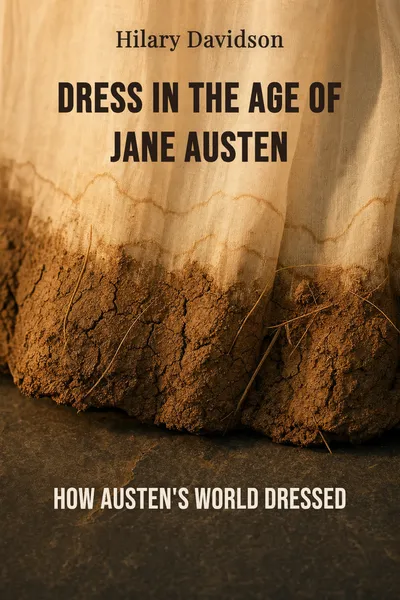
When Elizabeth Bennet walks three miles across muddy fields to Netherfield and arrives with her petticoat six inches deep in mud, the Bingley sisters are appalled — and every reader since 1813 has understood exactly why that detail stings, without ever being told what that petticoat was made of, how it fastened, or how long it took to launder. Jane Austen assumed her readers could see the clothes. We mostly can't anymore. The muslin gowns and tailored coats that filled her world have thinned in our imagination into a vague sense of bonnets and empire waists, a costume-drama blur.
Hilary Davidson, a dress historian who has handled the surviving garments and read the surviving bills, set out to put the fabric back. Her book covers what she calls the long Regency, roughly 1795 to 1825 — three decades in which Britain lurched into something recognisably modern, and in which what people wore lurched with it. Austen lived and wrote across almost exactly this span. Her novels, and even more her letters to her sister Cassandra, turn out to be full of hems, ribbons, gowns turned and re-trimmed, caps debated, muslins bought.
Davidson uses that observant, sharp-eyed writer as a way in. Not to illustrate Austen with pretty pictures, but to read a whole material culture through the eye of someone who missed nothing and had, like most women of her class, to make her modest wardrobe stretch. The clothes turn out to hold the period's economics, its class anxieties, its global reach and its intimate routines — all the things a well-cut sentence leaves implied.
The question we’re asking : What did people actually wear in Jane Austen's world, and what does putting the fabric back let us see?What we’ll see : How dress moves outward from the skin to the whole world, and why Austen wrote clothing the way she did.
Table of contents
01Chapter 1 — The body underneath the muslin
Davidson starts where getting dressed starts: at the skin. The Regency silhouette we recognise — that high waist, the column of pale fabric falling straight from just under the bust — did not simply happen. It was built, layer by layer, from the inside out, and the layer that mattered most was the one nobody saw. The shift, a plain washable linen or cotton undergarment, sat next to the body and absorbed sweat and oil. It was what got laundered; the gown on top mostly did not. Cleanliness in this period was less about bathing than about the frequency of clean linen against the skin, and a woman's stock of shifts was a real measure of her means.
On top of the shift came the stays — not the crushing corset of Victorian caricature, but a shorter, lighter garment that lifted and supported the bust to create that fashionable high line. Davidson is careful here, because the myth of Regency women abandoning structure for free-flowing Grecian drapery is largely that, a myth. Most women were still shaped by stays; the shape had simply changed. The neoclassical look prized a body that appeared natural and statuesque, and a good deal of construction went into producing that appearance of no construction at all.

02Chapter 2 — Getting dressed as a daily negotiation
Owning clothes in the Regency was not like owning clothes now. Ready-made garments barely existed for the well-off; almost everything was made, altered, mended and remade, often several times over a garment's life. Fabric was expensive and labour comparatively cheap, which inverts our instincts entirely. A gown was an investment. You bought the cloth, engaged a dressmaker or sewed it yourself, and expected to keep it in service for years by turning it, re-trimming it, cutting it down, dyeing it, or handing it on.
Austen's letters are Davidson's richest seam here. Jane writes to Cassandra about the price of muslin, about a gown being unpicked and made over, about the exact placement of trimming, about whether a cap is becoming. This is not idle chatter; it is the ordinary accounting of a woman of limited income keeping up appearances on a tight budget. The Austens were gentry but not rich, and the labour of dressing respectably — the calculating, the economising, the needlework done at home — was a constant, absorbing task for the women of the household.
03Chapter 3 — From the village to the whole world
Having dressed the body, Davidson widens the frame outward — from the intimate self to the home, the village, the countryside, the city, and finally the globe. Where you were shaped what you wore. Country dress was more practical, more durable, cut for weather and mud and walking; the fashionable extremes lived in town. A trip to Bath or London meant an encounter with newer styles, more shops, more scrutiny, and the pressure to update a wardrobe that passed muster in the village.
Men's dress belongs squarely in this chapter, and Davidson gives it real attention. The Regency was when men's clothing quietly abandoned the embroidered silks and bright colours of the eighteenth century for the sober tailoring — dark coats, pale breeches or trousers, clean white linen — that would eventually become the modern suit. This restraint, often associated with Beau Brummell's cult of impeccable understatement, was its own kind of display: fit, cut and spotless linen mattered more than ornament. Austen's men are read through it, the difference between a well-turned-out gentleman and a flashy one legible at a glance.
04Chapter 4 — When clothes carry what words leave out
Stepping back, what Davidson is really doing is teaching us to read a language Austen wrote in but never had to explain. Dress, in these novels, is a second register running under the dialogue — precise, economical, and fully legible to the original audience. When Austen tells us what a character wears, or notices, or spends on clothes, she is telling us about their income, their taste, their self-command, their moral seriousness. The information was never decorative. It was characterisation by other means.
This is why the book insists on the actual objects — the surviving gowns, the fashion plates, the paintings, many reproduced here for the first time. You cannot decode the language without the vocabulary. Once you know what a turned gown signified, or why clean white muslin read as it did, or what separated a walking dress from an evening dress, Austen's clipped material asides stop being background and become argument. Davidson gives readers the referents that Austen could assume and we had lost.
05Conclusion
Return to Elizabeth's muddy petticoat. After Davidson's book, the scene reads differently — not just as a spirited girl defying decorum, but as a collision of everything dress carried: the labour of laundering white cotton, the class code that made a soiled hem shocking, the imported muslin behind it, the household economy that made every gown count. Austen wrote one sentence and trusted her readers to see all of it. We can see it again now, because the fabric has been put back.
Related books