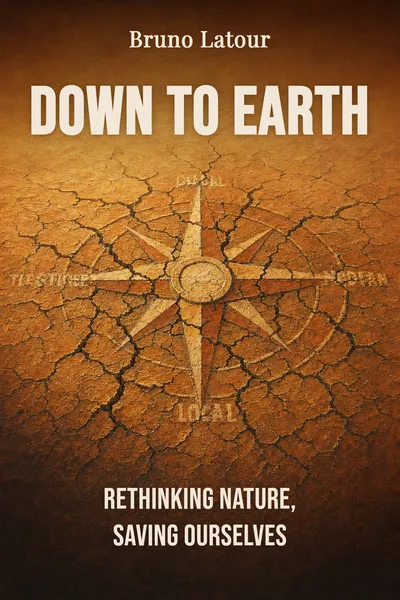
Down to Earth
Rethinking nature, saving ourselves
Description
In 2017, a French philosopher and sociologist named Bruno Latour published a short, urgent book with a title that reads like an instruction: Down to Earth. He had spent decades studying how scientists actually make knowledge, how facts get built in laboratories, how nothing we call "nature" arrives without a crowd of instruments, people and negotiations behind it. Now, in his early seventies, he turned that lifetime of work toward a single question that felt suddenly concrete. Why does the world seem to be coming apart at exactly the same moment — climate breaking down, inequality widening, migrations rising, and a strange new denial spreading across the wealthy democracies?
Latour's wager is that these are not three separate crises. They are one. And they line up too neatly to be coincidence. Somewhere, he suspects, a small number of very powerful people concluded that there was no longer enough planet to go around for everyone — that the modern dream of endless development for all was over — and decided, quietly, to secure the future for themselves while pretending in public that the problem did not exist. Denying the climate, in this reading, is not ignorance. It is a strategy.
That is a heavy claim, and Latour knows it. What makes the book more than an alarm is that he refuses to stop at diagnosis. He argues that the tools we use to think about politics — the left-right axis, the very idea of progress, the clean line between nature and society — were built for a world that no longer exists, and that clinging to them is why we feel lost. The way out, he insists, starts with getting our bearings again on solid ground.
The question we’re asking : What if climate denial, rising inequality and the migration crisis are not three problems but one, and our political map is simply too old to see it?What we’ll see : How a thinker who spent his life watching science get made turned that lens on the ground beneath our feet, and redrew the political compass around it.
Table of contents
01 Chapter 1 — Three signs that point to one thing
Latour starts with a knot most of us feel but rarely tie together. Something shifted in the 1980s and 1990s, and it accelerated after 2016. Borders that seemed to be dissolving under globalization suddenly hardened. The word "migrant" became a threat. Inequality, which the postwar decades had narrowed, opened back up with striking speed. And across the richest countries, a peculiar refusal took hold — the insistence, against all the measurements, that the climate was not really changing, or not because of us, or not enough to matter.
Taken one at a time, each has its own experts and its own explanations. Latour's move is to ask what they look like placed side by side. His answer is uncomfortable. He proposes that the global elites who benefit most from the current order have understood something the rest of us have been slower to admit: the Earth cannot sustain, for eight billion people, the standard of consumption that modernization promised. There is not enough. And faced with that limit, they made a choice.

02 Chapter 2 — The old compass no longer works
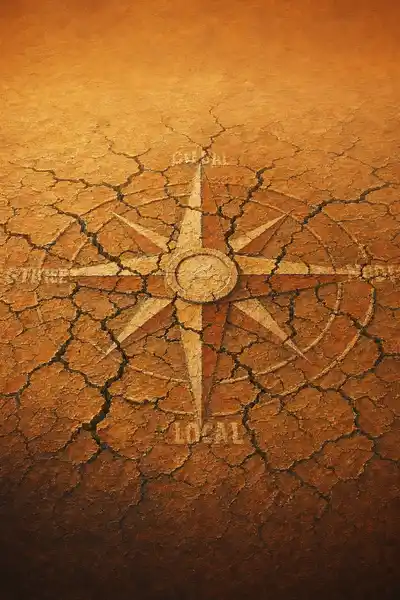
If the diagnosis is right, why can't we act on it? Latour's answer is that our political instruments are broken — not corrupt, but obsolete. For two centuries, he argues, politics ran along a single axis he calls modernization. On one end sat the Local: attachment to soil, tradition, borders, the past. On the other sat the Global: openness, markets, universal progress, the future. Every serious movement pulled toward one pole or the other. Conservatives defended the Local, progressives marched toward the Global, and everyone agreed on the direction of the arrow even when they fought over the speed.
The trouble is that both poles have quietly emptied out. The Global that modernization pointed toward — a single planet of frictionless growth for all — was never actually available. It was a horizon, and the horizon turned out to be a mirage. Meanwhile the Local, the return to some rooted authentic homeland, is equally fictional: no such stable, sealed territory ever existed to go back to. So we are left oscillating between two destinations, neither of which is real, which is why the whole political field feels increasingly deranged.
03 Chapter 3 — The Terrestrial and its allies
If the old axis is finished, Latour proposes a new pole to reorient by, and he gives it a name: the Terrestrial. It is not the Local — not a retreat behind borders — and not the Global — not the flight into abstract universal markets. The Terrestrial is a third attractor, standing off the old axis entirely, pulling us toward the actual, thin, living film of the planet that makes existence possible. He also calls it the Critical Zone: the few kilometers between bedrock and upper atmosphere where all known life crowds together. That, and not the whole abstract globe, is what we truly inhabit.
The Terrestrial has a crucial feature. It is populated not only by humans but by an immense crowd of other actors — bacteria, forests, rivers, fungi, the carbon cycle, insects. Latour, true to his earlier work, refuses to treat these as mere resources or scenery. They act. They make the atmosphere breathable, hold the soil together, regulate the water. To be Terrestrial is to recognize that we are one dependent party among many in a network none of us controls, and that our politics has to make room for these non-human allies rather than treating them as a silent backdrop to be exploited.
04 Chapter 4 — Class struggle, on a shifting ground
Step back and Down to Earth is doing something bolder than proposing another green manifesto. It is trying to rebuild the very field on which politics happens. For two centuries, Latour argues, our conflicts assumed a fixed stage — nature as backdrop — and fought over how to distribute the fruits of production across human classes. What changes with the Terrestrial is that the ground itself enters the fight. The struggle is no longer only about who gets what, but about which world we are equipping ourselves to live in at all, and with which allies.
That is why he speaks, deliberately, of a new geo-social class conflict. The line no longer runs cleanly between labor and capital. It runs between those who accept that we all share one thin, limited, reactive planet and must organize around that fact, and those who have concluded there is not enough and have chosen private escape — walls, bunkers, denial. Naming that division, for Latour, is more clarifying than the exhausted left-right split, because it explains why so much recent politics feels like sheer disorientation: people are fighting over territories they cannot yet describe.
05 Conclusion
Latour began by lining up three symptoms — denial, inequality, migration — that most commentators keep in separate files, and he ended by handing us a different compass. The wealthy retreat from the shared world, the collapse of the progress narrative, and the sudden intrusion of a planet that reacts turn out, in his telling, to be facets of one event. The reason it feels unbearable is that we are trying to navigate it with a map drawn for a world that assumed the ground would stay still. It will not, and it never really did.
Related books