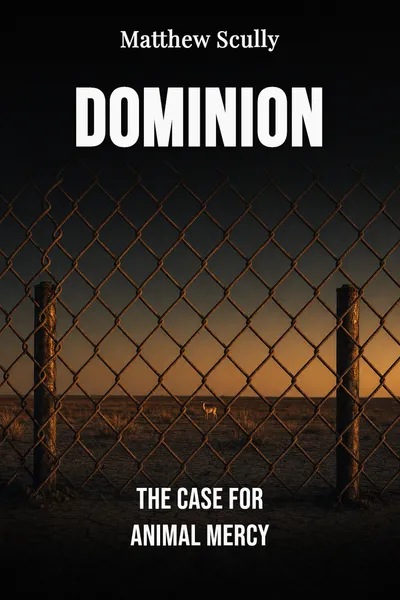
Dominion
The case for animal mercy
Description
In the fall of 1998, a speechwriter for the political right — a man who had worked for the first President Bush and would later draft lines for the second — spent a day on a hunting ranch in Texas, watching men pay to shoot animals that had nowhere to run. Matthew Scully was not there as an activist. He was a conservative Catholic, a lifelong Republican, someone whose colleagues assumed the whole subject of animal welfare belonged to people they disagreed with about everything else. And yet what he saw stayed with him, and four years later it became a book: "Dominion," published in 2002, a long, unhurried, deliberately unfashionable argument that cruelty to animals is a moral failure we have quietly agreed not to look at.
The book was strange precisely because of who wrote it. Animal welfare, in American public life, had long been coded as a cause of the left — of PETA, of vegans, of people the political right liked to caricature. Scully wrote from inside the tradition that usually rolled its eyes. He kept his faith, his conservatism, his suspicion of sentimentality. And he used all of it to build a case that factory farms, trophy hunts, and industrial slaughter are not defensible, and that the men who run them have talked themselves into something ugly. He was not asking readers to feel more. He was asking them to look.
The title comes from Genesis — the passage where humanity is given dominion over the fish, the birds, and every living thing. That single word has done a lot of work over the centuries, most of it in favor of doing whatever we like. Scully wanted to ask what the word actually demands of us, and whether we have been reading it as a grant of power or a grant of permission.
The question we’re asking : If humans hold dominion over the animals, does that word license us to use them however we please — or does it bind us to something harder?What we’ll see : A conservative's uneasy tour through the industries built on animal suffering, and the older idea he reaches for to name what is wrong with them.
Table of contents
01Chapter 1 — The word we inherited
Scully starts with language, because language is where the trouble began. The Genesis grant of dominion — repeated, quoted, embroidered on the West's sense of itself — has almost always been read as ownership. Man at the top, everything else arranged below for his convenience. Scully doesn't reject the word. He accepts it fully. His argument is that we have read it backward: dominion, in the older sense, is what a good king holds over his subjects, not what a butcher holds over meat. Power carries obligation. To rule is to answer for what you rule.
He traces how Western thought hardened around the convenient reading. Aristotle placed animals below humans in a fixed hierarchy of purpose. Descartes, centuries later, went further and decided animals were essentially machines — that the yelp of a beaten dog was mechanical noise, not pain, since a creature without a soul could not truly suffer. That idea was enormously useful. It let vivisectionists cut into living animals and hear only the squeak of a poorly oiled device. Scully treats this not as neutral philosophy but as an alibi, dressed up in reason.

02Chapter 2 — Inside the industrial farm
The center of the book is not philosophy but a place: a modern hog operation in North Carolina, which Scully visits and describes at length, without hysteria, in the flat register of a man writing down what he sees. The pigs live indoors, thousands of them, in metal buildings the size of warehouses. Breeding sows spend most of their lives in gestation crates so narrow they cannot turn around. They chew the bars. They develop sores. The animals never feel sun or earth. The operation is legal, efficient, and profitable, and it produces cheap pork that most of us eat without a second thought.
What strikes Scully is the ordinariness of it. No one on the farm is a villain. The managers are decent men doing a job, insulated by paperwork and euphemism from what the job actually is. The industry has its own vocabulary — units, inventory, depopulation — that keeps the living animal out of view. This is Descartes's machine argument returned in corporate form: the pig is not a creature that suffers but a production input to be optimized. The cruelty is not sadistic. It is systematic, and systems don't feel guilt.
03Chapter 3 — A mind behind the eyes
If the industrial argument rests on the animal being a mere machine, Scully spends much of the book dismantling that premise — not with laboratory jargon but with attention. He draws on his own encounters, on the observations of naturalists, on the accumulating scientific record, to insist that animals have inner lives we have chosen to ignore. Elephants mourn their dead, returning to bones, standing over them. Whales sing and travel in bonded families. Pigs, the very creatures in those crates, are intelligent, curious, capable of boredom and distress. The evidence is not sentimental. It is observational, and it keeps arriving.
He is wary, though, of the trap that catches many animal advocates: making the case rest entirely on intelligence. If we only owe mercy to the clever animals — the dolphins, the great apes — we license cruelty to the rest. Scully's point is subtler. The morally relevant fact is not that animals can reason but that they can suffer. A creature that feels pain, fear, the desire to keep living, makes a claim on us regardless of whether it can pass a mirror test. Jeremy Bentham had said it two centuries earlier: the question is not, can they reason, but can they suffer.
04Chapter 4 — Mercy as the higher power
Step back from the crates and the trophy ranches and Scully's real subject comes into focus. "Dominion" is not finally a book about animals. It is a book about power, and about what the powerful owe to the powerless simply because they are powerless. Animals are the clearest case because they can never argue back, never vote, never organize, never shame us into decency. They are entirely at our mercy — and mercy, for Scully, is precisely the word.
Mercy is not the same as rights, and not the same as pity. Rights are claimed by the claimant; mercy is extended by the strong. It is a decision made freely by whoever holds the power, which is what makes it a moral act rather than a transaction. A creature has no way to demand mercy. That is exactly why granting it says something about us and nothing about the creature's leverage. Scully's conservatism surfaces here in an unexpected place: he trusts the old aristocratic idea that nobility is measured by how one treats those who cannot retaliate.
05Conclusion
Scully ends more or less where he began, with a conservative asking his own side to notice something they would rather not. He wrote "Dominion" without becoming what he distrusted — he stayed skeptical of grand theory, wary of sentiment, loyal to his faith and his politics. What changed was only that he had looked, at the hog barn and the hunting ranch, and could not unlook. The book asks the same of its reader: not a conversion, not a new ideology, just the refusal of the purchased distance that lets suffering happen out past the interstate where no one has to see it.
Related books