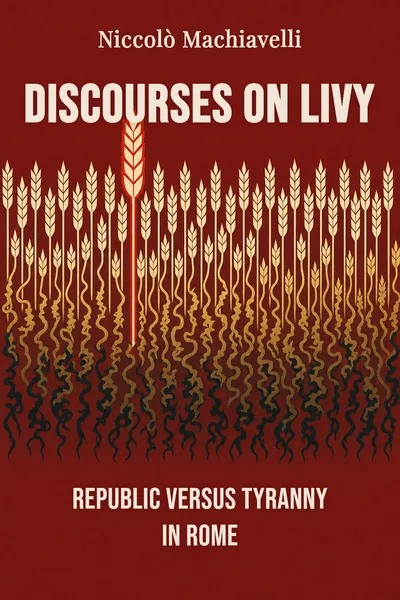
Discourses on Livy
Republic versus tyranny in Rome
Description
Around 1517, in the enforced idle of a farm outside Florence, Niccolò Machiavelli sat down each evening, changed out of his mud-caked work clothes, and — by his own account in a letter to a friend — entered the company of the ancients. He was writing two books at once. One was short, cold, and would make his name a synonym for calculated cruelty: The Prince. The other was long, sprawling, and argued something almost opposite. Its full working title pointed at a dead Roman historian: Discourses on the First Ten Books of Titus Livy. The Prince told a single ruler how to seize and hold power. The Discourses asked a stranger question — how a whole people might govern themselves, and keep their freedom, for centuries.
The two books have been quarreling ever since. Both were published only after Machiavelli's death in 1527, the Discourses first, The Prince a year later. Readers who knew him for the tyrant's handbook opened the longer work and found a man praising popular government, defending the right of citizens to resist, insisting that a republic outlasts and outperforms any prince. Some concluded the two texts contradict each other. Others decided they are two halves of one argument — that founding a state and keeping it free demand the same hard methods, just aimed at different ends.
What is not in doubt is the method. Machiavelli does not theorize in the abstract. He reads Livy's account of early Rome — its kings, its expulsion of the Tarquins, its plebeians and patricians fighting in the streets — and treats it as a laboratory. Rome is the experiment that worked, the one free state that grew instead of collapsing, and Machiavelli wants to know exactly why.
The question we’re asking : How did Rome manage to stay free and strong for so long, and what does its example demand of anyone who wants to keep a republic alive?What we’ll see : How Machiavelli reads a Roman historian to build a whole philosophy of freedom, force, and the slow rot that eventually takes every free state.
Table of contents
01Chapter 1 — The other book Machiavelli wrote
The Discourses are built as a running commentary, but they are anything but a summary of Livy. Machiavelli takes the first ten books of Ab urbe condita — Rome from its founding through the early Republic — and mines them for lessons that a Renaissance politician could actually use. The result is a hundred and forty-two short chapters, loosely grouped into three books, ranging over founding, expansion, and the internal struggles that either strengthen or ruin a state. He jumps from a story about a Roman consul to a jab at contemporary Italy, from military discipline to the uses of religion, without much apology for the leaps.
The tone is the first surprise for anyone arriving from The Prince. Here Machiavelli is a republican, and openly. He argues that a people is wiser and more constant than a single ruler, that a state governed by many lasts longer than one governed by one, and that the free cities of the ancient world grew rich and powerful precisely because their citizens had something of their own to fight for. Where The Prince coaches a lone operator, the Discourses assume a body of citizens who share the burden and the reward of governing.

02Chapter 2 — Why conflict keeps a republic alive
The most startling claim in the book is about disorder. Rome, Machiavelli notes, was famous for its internal fights — the plebeians and the patrician nobility clashing constantly, walking out of the city, forcing concessions, agitating for a share of power. Most writers treated this as Rome's weakness, a flaw to be regretted. Machiavelli turns the judgment upside down. Those very tumults, he argues, were the cause of Rome's freedom and its strength. The friction between the two classes produced laws that protected liberty, and kept either side from swallowing the other.
The mechanism matters. When the plebeians pushed, they won institutions — above all the tribunes, officials whose job was to guard the people against the nobility. Each round of conflict, provided it stopped short of blood and settled into law, left the republic with a better constitution than before. A state with no way to vent its internal disagreements, by contrast, bottles up resentment until it explodes. Machiavelli would rather have loud, ordered quarrels than a false and brittle peace. Harmony that comes from silencing one class is not harmony; it is a slow-loading gun.
03Chapter 3 — The prince Rome could not do without
For all his republicanism, Machiavelli hands one crucial job to a single man: founding. A republic, he argues, cannot be created by a committee. At the origin, and again at moments of near-total collapse, a state needs one person with the authority and the nerve to shape its institutions from scratch. He points to Romulus, who — in the legend Livy passes down — killed his brother Remus and later consented to a co-ruler's death in the course of building Rome. Machiavelli does not flinch. The founder may be excused the violence, he writes, if the result is a lasting common good and if he does not keep that power for himself.
This is the moment where the Discourses and The Prince clearly touch. The extraordinary individual, willing to act outside ordinary morality for the sake of the state, appears in both. The difference is the destination. In The Prince the strongman may found a personal dynasty; in the Discourses the founder's real glory lies in building something that no longer needs him — laws and offices that let the many govern after the one is gone. The prince who becomes unnecessary has done the higher work.
04Chapter 4 — When a free state forgets what made it free
Step back from the Roman detail and the Discourses reveal their deepest preoccupation: not how states begin, but how they die. Machiavelli is haunted by decay. Every political order, however well founded, tends over time toward corruption — not merely bribery, but a broader softening in which citizens stop caring for the common good and start pursuing private advantage. Rome fascinates him precisely because it postponed this fate for so long, and he wants to isolate the ingredients that bought those centuries.
The key ingredient he keeps returning to is what he calls virtù — not virtue in the Christian sense, but a mix of energy, courage, discipline, and public spirit. As long as Rome's citizens had it, the institutions worked and the wars were won. When wealth and empire eroded it, the same institutions became empty shells, and the tumults that once produced laws began producing warlords instead. A constitution, Machiavelli suggests, is only as good as the character of the people living under it. Paper cannot save a corrupted citizenry.
05Conclusion
Machiavelli died in 1527 without seeing either book in print, and without settling the argument between them for his readers. The Discourses came out first, the following year, and The Prince the year after that, and scholars have been holding them up against each other ever since. Read together, they stop looking like a contradiction. The Prince is what a state does in crisis; the Discourses are what the crisis is meant to preserve — a free people, governing itself through argument and law, using strong hands when it must and dismissing them when it can.
Related books