
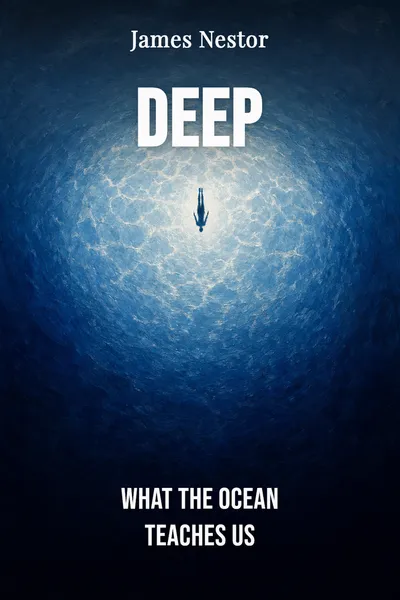
Deep
What the ocean teaches us
Description
In 2011, a magazine sent James Nestor to Kalamata, in southern Greece, to cover the world freediving championship. The sport is simple to describe and terrible to watch: competitors fill their lungs with a single breath and swim straight down, past a hundred meters, past the point where the pressure crushes the chest, and then swim back up before they pass out. Some don't make it back in time. Nestor watched divers surface with blood running from their noses, watched safety teams haul limp bodies to the surface, watched a Greek diver come up unconscious. He was, by his own account, horrified. He had come to file a piece and leave. He did not leave.
What kept him there was a suspicion that the freedivers themselves kept repeating: that they weren't fighting their bodies but tuning into something the body already knew how to do. The deeper they went, they claimed, the calmer they became. The ocean, at depth, did something to them. Nestor, a skeptic with a notebook, started to wonder whether the horror show he was watching was actually a demonstration of a hidden human capacity — one that most of us carry around unused, from birth to death, without ever suspecting it exists.
So he kept going down, both literally and into the reporting. He trained his own body to hold a breath and sink. He climbed aboard research boats with scientists working outside the institutions, chasing whales and sharks with jury-rigged equipment. The book that came out of it, Deep, is a descent — surface to trench — and at each layer he finds that the strange feats of marine animals are not so alien after all. They rhyme, uncomfortably, with abilities buried in us.
The question we’re asking : What does the ocean reveal about the human body, once we stop treating ourselves as visitors and start treating ourselves as returning residents?What we’ll see : A reporter follows freedivers and renegade scientists from the surface downward, and keeps finding the sea's marvels echoed inside us.
Table of contents
01Chapter 1 — A journalist watches people drown on purpose
Nestor did not set out to write a book about the ocean. He set out to write a short article about a fringe sport, and he arrived at it the way most of us would — repelled. Competitive freediving, in its most extreme form, asks athletes to descend as far as the body will tolerate on one lungful of air, guided by a weighted line, with no scuba tank and no way back if something goes wrong. The record holders reach past two hundred meters. At those depths the lungs shrink to the size of fists and the risk of blacking out on the ascent is constant. Safety divers wait near the surface precisely because losing consciousness is routine, not exceptional.
In Kalamata he watched it happen up close, and the images stuck: nosebleeds, seizures on the surface, divers who had to be revived. His first instinct was that this was a death cult dressed up as sport, a spectacle of people pushing past the point any sane body would stop. He wrote that reaction down. But the divers he interviewed didn't talk like adrenaline junkies. They talked about depth the way monks talk about silence — as a place of extraordinary stillness, where the heart slows and the mind clears.

02Chapter 2 — The switch we forgot we had
The physiological key to the book is a cluster of automatic responses biologists call the mammalian dive reflex, sometimes the master switch of life. Put a human face in cold water and the body begins to change without being asked. The heart rate drops — sometimes dramatically, in trained divers by half or more. Blood vessels in the arms and legs constrict, shunting blood toward the core and the brain, the organs that most need oxygen. This isn't a trick freedivers invented. It's present in newborns, who instinctively hold their breath and paddle when submerged, and it's shared across marine mammals, from seals to dolphins to whales.
As a diver goes deeper, the reflex escalates. At extreme depth the body permits blood plasma to seep into the chest cavity, filling the shrinking space around the lungs so they don't collapse under pressure. This is called the blood shift, and for a long time physiologists assumed the human body simply couldn't survive the depths freedivers were reaching. The divers proved otherwise by reaching them. The equipment, it turned out, had been installed all along; almost nobody was using it.
03Chapter 3 — The animals doing the impossible in the dark
The deeper Nestor goes in the book, the stranger the company. He falls in with researchers working outside the mainstream — people running experiments off small boats with homemade gear, often self-funded, often dismissed by the institutions. What they're chasing are marine abilities that sound like science fiction until you sit with the data. Sperm whales, for instance, produce clicks loud enough to be among the most powerful sounds any animal makes, and they appear to communicate across enormous distances of open ocean, coordinating across miles of black water where no light reaches.
Then there is orientation. Sharks travel in unnervingly straight lines through the deep, holding a heading across featureless dark where there are no landmarks and no sun. The likeliest explanation is that they read the planet's magnetic field, sensing direction through an organ we don't share in any obvious way. Nestor collects case after case of animals navigating, hunting, and speaking in an environment that should, by every human standard, be disorienting and mute. The ocean below the sunlit layer is the largest habitat on Earth and among the least understood, and the creatures living there operate by senses we're only beginning to map.
04Chapter 4 — What the body remembers
Step back from the whales and the record depths, and the wager underneath Deep comes into focus. Nestor is not really writing a nature book about a place we visit. He's arguing that the ocean is where we came from, and that our bodies still carry the receipts. The dive reflex, the blood shift, the flicker of echolocation and magnetic sense — these read, in his telling, as traces of an amphibious inheritance we've spent a long time forgetting. The sea is less an alien frontier than an old address.
This reframes the freedivers and the fringe researchers as the same kind of person: people willing to go to the edge to find out what's actually there, rather than trusting the received map. The institutions had declared certain depths lethal, certain abilities impossible, certain animal behaviors too fantastic to credit — and in case after case the edge held more than the map allowed. What unites Nestor's cast is a refusal to accept that the known limits are the real ones.
05Conclusion
The book ends more or less where it began, with Nestor in the water, except that he is no longer only watching. He has learned to sink, to let the heart slow, to feel the switch flip. The reporter who arrived in Greece appalled by the sight of people descending on a single breath has become one of them — not a champion, but someone who has felt, from the inside, the calm the divers kept trying to describe. The horror never fully leaves the story; the risk is real and the deaths are real. But it now sits beside something else, a demonstration that the body carries more than we ask of it.