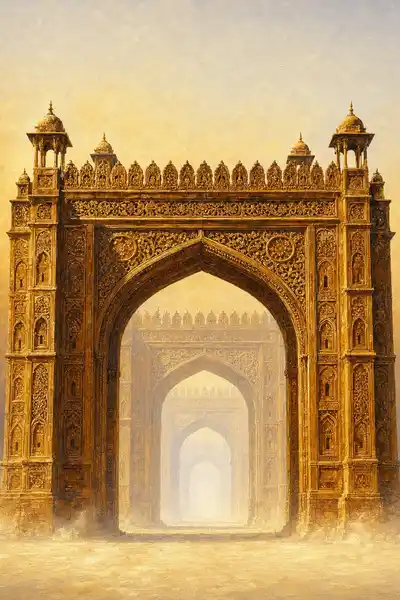
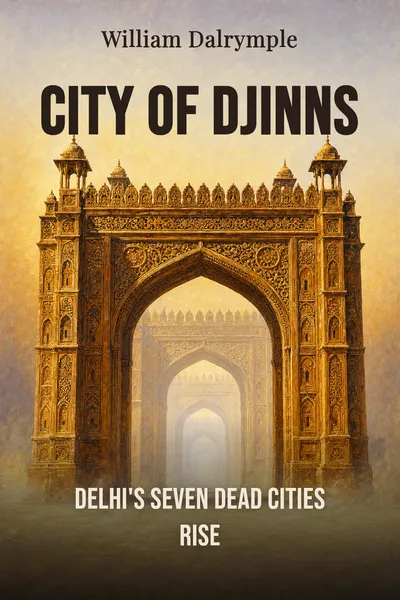
City of Djinns
Delhi's seven dead cities rise
Description
In the late 1980s a young Scottish writer and his wife arrived in Delhi and rented the top floor of a house in a quiet colony, watched over by a taxi driver named Balvinder Singh and a fierce landlady, Mrs Puri. William Dalrymple had come to India already fascinated, but what he found in Delhi was not one city. It was many, stacked on top of each other like sediment. Every ruined tomb, every crumbling gateway, every dusty lane seemed to open onto another century, and the people he met — Sufi mystics, retired civil servants, calligraphers, eunuchs — carried those centuries around with them as casually as pocket change.
The book he wrote, City of Djinns, published in 1993, took its title from a piece of local folklore. Delhi, people told him, has been destroyed and rebuilt seven times over — sacked by invaders, abandoned by emperors, burned, looted, emptied. Yet it always rises again. The reason, the old storytellers insisted, is the djinns: fire-born spirits who love the place and will not let it die. Whatever razes the city, the djinns bring it back. It is a legend, of course. It is also, as Dalrymple slowly discovered, an oddly precise description of how the place actually behaves.
What follows is part travelogue, part detective story, part accidental history of one of the oldest continuously inhabited spots on earth. Dalrymple does not lecture. He wanders, he asks, he gets things wonderfully wrong, he listens. And the city he assembles is less a set of monuments than a living organism with a very long memory.
The question we’re asking : How does a city die seven times and still keep breathing, and what does its refusal to stay dead reveal about the way places hold their past?What we’ll see : A year spent chasing Delhi backwards through its people, its ruins and its ghosts, guided by a legend that turns out to be almost true.
Table of contents
01Chapter 1 — A year in a city that keeps ending
The book begins not with kings but with a rented flat. Dalrymple and his wife Olivia settle into their perch above Mrs Puri, and the daily comedy of the household becomes the frame for everything else. Balvinder Singh drives his battered Ambassador with suicidal cheer through streets where cows, scooters and Mughal walls compete for the same few feet. This is the eighth city — the one people actually live in — and Dalrymple treats it with the same curiosity he brings to the buried seven. The point is set early: in Delhi the past is not behind glass. It is leaking into the present everywhere you look.
The structure of the book is loosely a single year, moving through the seasons of one long, punishing, exhilarating Delhi summer, monsoon and winter. But within that year Dalrymple travels the wrong way through time. He starts among the newest ruins and works steadily backwards, layer by layer, toward the oldest. It is a deliberate reversal of the usual history-book march from ancient to modern, and it mirrors how a newcomer actually experiences the place — you notice the recent scars first, then slowly learn to read what lies beneath them.

02Chapter 2 — The living memory of the eunuchs and the Moguls
Dalrymple's real gift is for people, and City of Djinns is crowded with unforgettable ones. He seeks out the hijras — the eunuchs of Delhi — a community that once held power and privilege in the Mughal court and now survives on the margins, singing and dancing at weddings and births, feared and mocked in equal measure. He listens to their history without sensationalism, tracing a line from the guardians of the imperial harem to the figures who now haunt the modern city's edges. In their long, humiliated persistence he finds a small mirror of Delhi itself: reduced, dishonoured, but very much not gone.
He also goes looking for the Moguls, or what remains of them. The descendants of the emperors who once ruled the subcontinent from the Red Fort now live, when he finds them, in reduced and sometimes pitiful circumstances — a bloodline that once commanded armies dwindled to genteel poverty and faded photographs. The contrast between the imperial grandeur of the monuments and the ordinary lives of the heirs is one of the book's quiet aches. Empires do not simply vanish. They subside into their own descendants, thinning with each generation.
03Chapter 3 — Digging down through seven ruined capitals
Beneath the human portraits runs the archaeological spine of the book. Delhi, Dalrymple explains, is not one settlement but a shifting series of capitals, each raised by a different dynasty on a slightly different patch of the same plain. Successive sultans and emperors built and abandoned cities — Lal Kot, Siri, Tughlaqabad, Jahanpanah, Firozabad, Purana Qila, Shahjahanabad — until the ground itself became a graveyard of former capitals. The famous count of seven is a rough poetic tally rather than a precise inventory, but the pattern it names is real: build, flourish, fall, move on, build again.
Dalrymple wanders these sites the way he wanders the modern lanes, half historian and half tomb-raider. He climbs the vast, brooding walls of Tughlaqabad, the fortress-city that Muhammad bin Tughluq raised and then, in a famous act of imperial folly, effectively abandoned when he ordered the entire population to relocate hundreds of miles south to a new capital. The ruin still carries the Sufi curse said to have doomed it: may it be inhabited only by shepherds. Standing among the empty ramparts, Dalrymple finds the curse looking uncomfortably like prophecy.
04Chapter 4 — The city that refuses to die
Step back from the tombs and the eunuchs and the taxi rides, and City of Djinns is really an argument about how places hold time. Most histories treat a city as a story of replacement: one order gives way to the next, the old cleared away to make room for the new. Delhi, as Dalrymple assembles it, works the other way. Nothing is ever fully cleared. The Mughal court survives in the eunuchs' songs, the sultans in the ruins, the Raj in the bungalows, Partition in the memories of the old. The city does not move on from its pasts. It accumulates them.
This is why the djinn legend keeps returning, and why Dalrymple treats it as more than superstition. The fire-spirits who supposedly love Delhi and resurrect it are a folk explanation for something he can see with his own eyes: a place with an almost biological refusal to end. Sack it, empty it, partition it, and within a generation it is dense with life again, carrying its wounds forward rather than healing them over. The Phoenix is the wrong image, because the Phoenix is reborn clean. Delhi is reborn scarred, and keeps every scar.
05Conclusion
Dalrymple leaves Delhi at the end of his year much as he arrived it — in Balvinder Singh's Ambassador, weaving through the traffic, past the tombs and the flyovers and the shrines. But the city he now sees is unrecognisable from the one he first rented a flat in. Where there was a busy modern capital, he now perceives a translucent stack of capitals, each visible through the last, populated by the living and the remembered in roughly equal measure. The eunuchs, the Mughal heirs, the Sufis, the ruined fortresses have all become legible to him as chapters of a single, ongoing sentence.
Related books