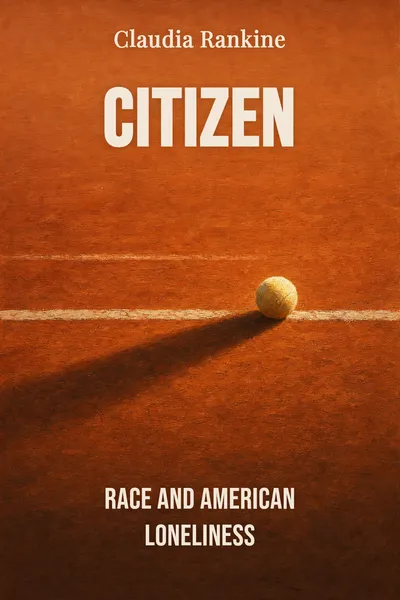
Citizen
Race and American loneliness
Description
In 2014, a poet named Claudia Rankine published a slim book called Citizen: An American Lyric. It won awards that year and the next, sold well past what any book of poems is expected to sell, and turned up on university syllabi almost immediately. But calling it a book of poems undersells the strangeness of the thing. Citizen is part prose, part verse, part visual art — photographs, paintings, film stills set between passages of writing. It reads less like a collection than like a room you walk through, one image and one sentence at a time. And most of it is written in the second person, addressed to a "you" who moves through ordinary American days and keeps getting cut, quietly, by other people.
The cuts are small. A friend calls you by the name of her other black friend. A colleague says, in a meeting, that he didn't know black women could get cancer. A stranger in a pharmacy line steps in front of you as if you weren't there. None of these is an assault. None would hold up as a story you could tell at dinner without sounding thin-skinned. That is exactly Rankine's subject: the accumulation of moments too small to name, and what they do to a person who has to absorb them, day after day, and keep functioning as though nothing happened.
Rankine had done something adjacent before, in her 2004 book Don't Let Me Be Lonely, which sat with American grief and medication and the numbing hum of the news. Citizen extends that project into the territory of race, and it does so without the usual vocabulary of argument. There is no thesis to underline, no villain to point at. What there is instead is a strange word in the title, sitting over all of it, asking to be reconsidered.
The question we’re asking : What does it mean to be a citizen of a country that keeps failing to see you, and why does Rankine reach for the language of loneliness to describe it?What we’ll see : How a book made of small wounds, borrowed forms, and worn-down bodies redraws what racism does to a person — and why it lands on solitude.
Table of contents
01Chapter 1 — The small ones that keep coming
The first thing Citizen does is refuse the big example. Rankine does not open with a lynching or a police shooting, though those appear later. She opens with the incidents that never make it into the record — the ones that happen in classrooms, in cars, at dinner tables, in the checkout line. A teacher who lets a white student cheat off you because she assumes you must need the help. A man who apologizes for swearing in front of you, then adds that he forgot you weren't a real black person. A therapist you've never met who, when you arrive for your appointment, screams at you to get off her property.
These are what psychologists have taken to calling microaggressions, and Rankine borrows the term without leaning on it. What interests her is not the label but the texture: the way each incident arrives too fast to answer, the way it leaves you replaying it for hours, composing the response you didn't give. The wound is small and the aftermath is long. And because each one is so minor, the person carrying it has no place to put it. Say something and you're difficult. Say nothing and it lodges in the body, unspoken.

02Chapter 2 — A book that refuses its own shape
Citizen carries a subtitle, An American Lyric, and the word lyric matters. A lyric is traditionally a short poem in a single voice, the form we associate with private feeling. Rankine takes that intimate form and stretches it across a national subject, which is part of why the book feels unclassifiable. It moves between prose paragraphs that read like memoir, verse that reads like grief, and long passages written to accompany video works she made with her collaborator John Lucas. The form keeps shifting because the experience it describes has no single shape.
The images are not decoration. A photograph of a lynching with the bodies removed. J.M.W. Turner's painting of a slave ship throwing its dying overboard, with a small horrifying detail cropped and enlarged. A still from the tennis courts where Serena Williams stands accused of an anger no white player is asked to answer for. Rankine devotes a long section to Serena, to the years of bad calls and the composure demanded of her and the moment the composure finally broke — reading it as a public lesson in what happens when a black body refuses to keep absorbing.
03Chapter 3 — The body that has to keep going
For all its formal restlessness, Citizen keeps returning to something physical: the body that has to carry the accumulation. Rankine writes about sighs, about the way a person exhales when the moment is over, about tension held in the jaw and the shoulders. The incidents may be verbal or social, but they register in flesh. There is a recurring sense of a body braced against something, and of the cost of that bracing over years.
Much of this cost comes from what cannot be said. When the incident happens, there is rarely a right response available. Answer sharply and you confirm every stereotype about your anger. Let it pass and you swallow it. Rankine sits inside that impossible arithmetic, the split-second calculation of whether this one is worth the fight, and the residue that stays either way. The book keeps circling the moment just after — the drive home, the replay, the sentence that finally arrives too late to be useful.
04Chapter 4 — What loneliness has to do with race
Rankine's title is doing something quietly radical. We usually think of racism through the vocabulary of rights, law, economics, violence — the machinery of exclusion. Citizen adds a different register: solitude. The word citizen names belonging, membership, the state of being counted among others. What Rankine documents, incident by incident, is the experience of holding that status on paper while being denied it in every ordinary encounter. You are a citizen and you are, repeatedly, unseen. That gap is where the loneliness lives.
This is the through-line from her earlier book, Don't Let Me Be Lonely, and the reason the two titles rhyme. Loneliness, in Rankine's hands, is not a private mood to be fixed with company. It is a structural condition — the state of being surrounded by people who fail to register you accurately, of moving through a shared world that keeps sliding you out of its field of vision. A person can be lonely in a crowded room, in a friendship, in a country whose founding documents claim to include them. Racism, seen this way, is not only what is done to a body but what is withheld from it: recognition.
05Conclusion
Citizen ends the way it moves throughout — not with resolution but with the accumulated weight of everything it has gathered. Rankine gives us no program, no list of things to do, no closing reassurance that the seeing will improve. She has assembled a room of small wounds and borrowed forms and worn-down bodies, and she leaves us standing inside it, holding the strange word she put over the door.
Related books