
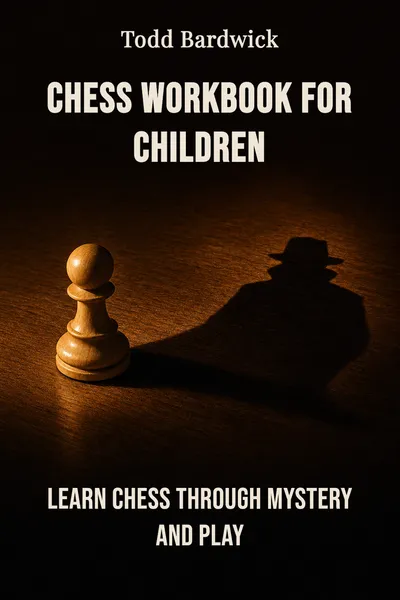
Chess Workbook for Children
Learn chess through mystery and play
Description
Somewhere in the pages of a slim workbook, a chess detective is waiting. He has a case to crack, and he needs a partner — a child holding a pencil, staring at a board of thirty-two carved shapes that mean nothing yet. This is how Todd Bardwick, a chess teacher from Colorado who has spent years coaching kids, chose to open the door to a game that intimidates most adults. Not with a lecture on the Sicilian Defense. With a mystery, and an invitation to help solve it.
Chess has a reputation problem with beginners, and especially with young ones. It looks like a subject you study, not a game you play — dense with notation, opening theory, and the quiet dread of doing something wrong in front of someone who knows more. Bardwick's Chess Workbook for Children takes the opposite tack. It assumes the reader knows nothing, treats that as an advantage rather than a deficit, and builds understanding one small puzzle at a time. Each piece arrives as a character with a habit. Each rule shows up as a clue. The child isn't told chess; the child is walked into it.
What makes the book worth pausing on isn't that it explains the moves — plenty of books do that. It's the shape of the teaching: a detective's premise, a workbook's exercises, and a wager that a beginner learns faster when they're solving something than when they're being told something. The royal game, it turns out, opens more easily through play than through instruction.
The question we’re asking : How does Bardwick turn a famously forbidding game into a first step a child actually wants to take?What we’ll see : A workbook built like a case file, where every piece, rule, and tactic arrives as a clue to crack.
Table of contents
01Chapter 1 — A detective walks a child onto the board
The framing device does most of the quiet work. Rather than a teacher standing at a whiteboard, Bardwick gives the reader a chess detective — a companion who poses questions, drops hints, and never quite finishes the child's thinking for them. It's a small trick of tone, but it changes the emotional temperature of the whole book. A detective doesn't grade you. A detective recruits you. The child reading the workbook isn't a student being examined; they're an investigator being trusted with a case, and that shift in role turns out to matter more than any single rule on the page.
The board itself is introduced as a place with its own logic before a single piece moves. Bardwick spends time on the eight-by-eight grid, the light and dark squares, the way ranks and files give every square a name and an address. A beginner who understands that the board is a coordinate system — a map — has something to stand on before the complexity arrives. The detective premise makes this feel less like geography homework and more like learning the layout of the streets where the case will unfold.

02Chapter 2 — The pieces, learned one clue at a time
Each piece enters the story as a character with a fixed personality, and Bardwick lets those personalities carry the learning. The rook moves in straight lines, plain and powerful. The bishop keeps to one color of square for its whole life on the board — a quirk that sticks in a child's memory precisely because it's odd. The queen combines both and becomes the strongest piece, while the king, for all his importance, shuffles just one square at a time. Turning movement rules into traits means the child remembers how a piece behaves by remembering who it is.
The knight gets special treatment, as it should. Its L-shaped hop is the one move that trips up nearly every beginner, because it doesn't travel in a straight line and can leap over other pieces. Bardwick doesn't rush it. He gives the knight room, repeats its pattern through several small exercises, and lets the child practice the jump until the strangeness wears off. This is the workbook's patience showing: the piece that confuses people most is the one that gets the most reps, not the least.
03Chapter 3 — From knowing the rules to seeing the game
Knowing how the pieces move is not the same as knowing how to play, and Bardwick draws that line clearly. A child who has finished the first half of the workbook can make legal moves. The second half is about making good ones — beginning with the single idea that organizes all of chess for a beginner: the goal is to trap the enemy king. Check, checkmate, and stalemate get careful, separate treatment, because the difference between winning, drawing, and blundering into a draw is exactly the kind of thing beginners get wrong for years without noticing.
From there the workbook introduces the basic tactics that turn random moves into purposeful ones. The child learns to spot when a piece is under attack and undefended, to see a simple threat coming, and to weigh a trade — is giving up a bishop worth capturing a rook? Bardwick keeps the vocabulary of value simple, assigning rough point values to the pieces so a beginner has a way to answer "was that a good trade?" without needing a coach in the room. It's a scaffold, not a law, and it does what scaffolds do: it holds the child up until they can stand alone.
04Chapter 4 — Why a puzzle teaches better than a lecture
Step back from the knights and the castling, and Bardwick's workbook is quietly making an argument about how children learn hard things at all. The conventional model is transmission: an expert explains, the beginner absorbs, comprehension is tested afterward. The detective model inverts it. The child acts first — looks, guesses, marks the square — and understanding arrives as the residue of having done something. Bardwick trusts that a solved puzzle teaches more durably than a clear explanation, and the design of every page bets on that trust.
The reason this works has to do with agency. A lecture positions the child as a container to be filled; a puzzle positions them as an agent with a problem to solve. Chess is unusually well-suited to this because it's honest — the board doesn't flatter you, and it doesn't lie. When a child finds the right move, they know it's right because they can see why on the sixty-four squares in front of them. The authority isn't the teacher's say-so. It's the position itself, and that makes the confidence earned rather than granted.
05Conclusion
The detective, it turns out, was never really solving a chess mystery. He was solving the beginner's problem — the gap between a game that looks forbidding and a child who might love it if only someone made the first move easy. Bardwick's workbook closes that gap one filled-in blank at a time, handing over the rules, the pieces, and the basic tactics in the guise of clues a child gets to crack themselves. By the last page, the reader can sit down at a board and play a real game, which is exactly as far as a first book should carry anyone.
Related books