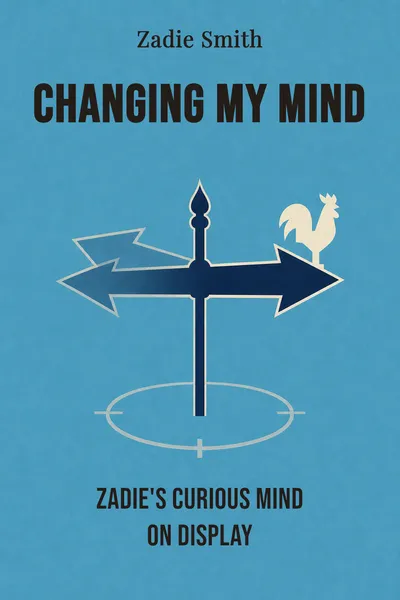
Changing My Mind
Zadie's curious mind on display
Description
In 2009, Zadie Smith gathered ten years of scattered writing into a single volume and called it Changing My Mind. The pieces had appeared in places that don't usually speak to each other — literary quarterlies, film magazines, the pages of the Guardian, the eulogy she gave for her father. There was a long essay on E.M. Forster, a report from the Liberian film industry, a defence of two rival visions of the novel, a piece about David Foster Wallace's most difficult book, and a set of reflections on her own comedy watching. She had not set out to write a book of essays. In her own foreword she admits as much: the collection was, she wrote, accidental, assembled from work done for money, for love, or because someone asked.
That admission is the first honest thing about the book, and it turns out to be the organizing one. Smith was already famous for her novels — White Teeth had made her a literary event at twenty-four — and readers came to the essays expecting the same voice. What they found was something looser and more searching, a writer thinking out loud, correcting herself in real time, unembarrassed to say that she no longer believed what she had believed a few years earlier. The title is not a pose. It is a description of method.
The temptation with a collection this varied is to treat it as a grab-bag, a famous novelist's off-cuts. But something holds the pieces together, and it isn't a theme. It's a temperament — curious, self-suspicious, allergic to the settled opinion. Reading it now, the question is less what Zadie Smith thinks about Forster or Kafka or Katharine Hepburn than how she thinks at all, and why she made changing her mind the whole point.
The question we’re asking : What holds together a collection of essays a famous novelist swears she never meant to write?What we’ll see : How Zadie Smith turned scattered occasional writing into a portrait of a mind that refuses to stay put.
Table of contents
01Chapter 1 — The book that was never a book
Changing My Mind is divided into five sections — Reading, Being, Seeing, Feeling, Remembering — but the divisions feel imposed after the fact, the way a parent tidies a child's room by shoving everything into labelled boxes. The pieces span roughly the decade after White Teeth, and they were written for reasons that had nothing to do with each other. Some were book reviews. Some were lectures. One was an obituary. Smith is upfront about this. She calls the collection the product of an unsystematic mind, and she means it as a warning as much as a boast.
What emerges from that disorder is a particular kind of honesty about how writing actually gets made. There is no grand project here, no thesis the essays were commissioned to prove. Instead there's a working writer taking the assignments that come, and following her curiosity wherever it happened to point that month — toward Zora Neale Hurston, toward the comedy of Katharine Hepburn, toward a film festival in a country recovering from civil war. The unity is biographical, not intellectual: this is simply what one person read, watched and thought about over ten years.

02Chapter 2 — Reading as an argument with yourself
The strongest essays in the book are about reading, and they treat it as anything but passive. For Smith, reading a novel well means arguing with it, and arguing with your own earlier readings of it. Her long piece on E.M. Forster is a case in point: she loves him and distrusts her love, worries that his gentleness is a kind of evasion, then defends the evasion as its own form of moral seriousness. She never lands on a verdict. The essay is the sound of a mind refusing to close the case.
This is where the fiction writer shows through. Smith reads the way a novelist reads — attentive to sentences, to the small decisions that reveal what a writer actually believes rather than what they claim to. Her essay on the novel's two competing ideals, one aiming at lyrical realism and the other at something stranger and more constructed, is really an argument she is having with her own instincts as a writer. She admits she has spent her career on one side and finds herself pulled toward the other. That confession, buried in a piece of criticism, is the most vulnerable thing in the book.
03Chapter 3 — The novelist grades her own tribe
When Smith turns to the craft of fiction directly, the essays get sharper and a little more anxious. She is, after all, grading her own tribe. In her lecture on the two paths a novel can take — the well-made realist novel she was trained to admire, and the more experimental, self-aware kind she suspects might be braver — she is measuring herself against a standard she isn't sure she meets. There's real unease in it. She names writers she envies, admits the limits of her own default mode, and declines to pretend she has resolved the tension.
This is where the sharp humor does quiet work. Smith is very funny about the pretensions of literary life, including her own, and the jokes are never merely decorative. They're a way of keeping herself honest, puncturing the moment an argument threatens to curdle into pronouncement. She can build a serious case about the responsibilities of the novelist and then undercut it with a line that reminds you she knows how absurd it is to speak with such confidence about anything.
04Chapter 4 — When the personal essay stops being confession
Step back from the individual pieces and Changing My Mind makes a quiet argument about what the essay is for. Most personal essays are built to arrive somewhere — a lesson, a reconciliation, a wound examined and then closed. Smith's are built to stay open. The form, in her hands, isn't confession leading to resolution; it's thinking performed in real time, with the revisions left in. The essay becomes the one place a writer is allowed to not know yet.
This matters because the culture around opinion has moved the opposite way. We are increasingly asked to have a position, to hold it firmly, to defend it against all comers. Changing your mind reads as weakness, as flip-flopping, as a sign you never really thought it through. Smith's book is a standing rebuke to that, not by arguing against it but by demonstrating something better: that the honest mind is the one still in motion, and that the willingness to revise is a discipline rather than a failure of nerve.
05Conclusion
The pieces in Changing My Mind were written for money, for love, and because someone asked — Smith says so herself, and the offhand honesty is the key to the whole book. She never meant to build a monument, and she didn't. What she assembled instead is a record of a decade spent reading, watching, mourning and arguing, with none of the false starts sanded away. The collection holds together not because the essays agree with each other but because one recognizable mind is at work in all of them, and that mind is more interested in the next question than in the last answer.
Related books