

Cent Éléphants sur un Brin D'Herbe
A Nobel voice on humanity
Description
In October 1989, the Norwegian Nobel Committee gave its Peace Prize to a man with no army, no state budget, and no country to govern from — Tenzin Gyatso, the fourteenth Dalai Lama, then living in exile in the Indian hill town of Dharamsala. He had fled Tibet thirty years earlier, in 1959, after a failed uprising against Chinese control, crossing the Himalayas on foot with a small party. The committee praised him for opposing the use of violence in a struggle that would have justified it a hundred times over. It was an odd portrait of power: a Buddhist monk, born to a farming family in a village called Taktser in 1935, recognized as the reincarnation of his predecessor at the age of two, and now honored by a European institution for refusing to fight.
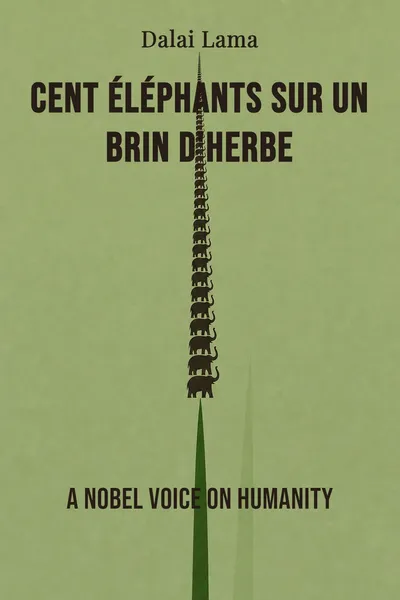
Cent Éléphants sur un Brin d'Herbe gathers what that man thinks about the rest of us — not about Tibet alone, but about the human animal in general. The book is not a memoir of the escape or a catalogue of grievances against Beijing. It is a set of reflections, patiently assembled, on what holds people together and what pulls them apart: the environment we are burning through, the institutions we build and distrust, the politics we practice, the religions we defend, and the daily traffic of ordinary emotions that runs underneath all of it. The title is an image of overwhelming weight balanced on almost nothing — the scale of what we ask of a fragile world.
What comes through is a voice that has spent a lifetime negotiating with an adversary far stronger than itself, and has concluded that the strongest available move is not the loudest one. The reflections read less like a spiritual doctrine than like a practical brief on living together, written by someone who lost his homeland and never lost the argument for kindness. That combination — the exile who keeps talking about compassion — is what gives the book its particular authority.
The question we’re asking : What does a stateless Nobel laureate, who lost a country without losing the case for non-violence, actually believe about the human project?What we’ll see : How a monk's reflections turn compassion into a method, extend it to the whole planet, and end by proposing an ethics that needs no religion at all.
Table of contents
01Chapter 1 — The monk who became a head of state
Tenzin Gyatso was not raised to think about global society. He was raised, from toddlerhood, inside the enclosed world of the Potala Palace in Lhasa, studying Buddhist philosophy, logic, and debate under tutors, groomed to be the spiritual and temporal leader of a country that had kept most of the twentieth century at arm's length. His childhood, as he tells it, was serious, isolated, and studious, punctuated by ordinary boyish curiosity about the machines and telescopes that reached him from the outside.
History interrupted the training. In 1950, when he was fifteen, Chinese troops entered eastern Tibet, and the young Dalai Lama was asked to assume full political authority years ahead of schedule. What followed was a decade of impossible negotiation — attempts to preserve some autonomy, growing pressure from Beijing, a population increasingly restive. In March 1959, with tension in Lhasa near breaking, he made the decision to leave, escaping to India, where the government of Jawaharlal Nehru granted him refuge. He has lived in exile ever since.

02Chapter 2 — Compassion as a working method, not a mood
The word that recurs across these pages is compassion, and the book works hard to strip it of its soft, greeting-card connotations. For the author, compassion is not a warm feeling that visits occasionally. It is closer to a skill — something trained, practiced, and applied, the way one might train attention or patience. It begins with a plain observation that no one seriously disputes: every person wants to be happy and wants to avoid suffering. From that shared starting point, he argues, concern for others is not sentimental but simply accurate, a recognition of a fact we all have in common.
What makes the treatment persuasive is that he keeps it self-interested in the honest sense. He does not ask us to love strangers heroically. He points out, repeatedly, that anger and hostility damage the person who carries them first — they wreck sleep, cloud judgment, and isolate the angry person long before they touch anyone else. A calmer mind, by contrast, sees situations more clearly and acts more effectively. Kindness, on this account, is not a sacrifice of self-interest; it is a more intelligent version of it.
03Chapter 3 — One planet, one family, no exceptions
From the individual mind the book widens to the whole inhabited world, and here the tone sharpens. The author writes about the environment with the directness of someone from a high, fragile place — Tibet's plateau feeds the great rivers of Asia — who has watched industrial civilization treat the planet as an inexhaustible warehouse. His argument is not primarily technical. It is that we have mistaken the earth for something we own rather than something we borrow, and that the mistake is now measurable in melting ice, poisoned water, and vanishing species.
What connects the ecology to the compassion is the idea of interdependence, which for a Buddhist is not a slogan but a description of how things actually are. Nothing exists on its own; everything arises in relation to everything else. Applied to the biosphere, this stops being metaphysics and becomes ordinary common sense: a country cannot pollute in isolation, an economy cannot grow forever inside a finite system, and no wall is high enough to keep a warming climate on the far side of it. The reflections treat the environmental crisis as, at bottom, a failure to feel this connection.
04Chapter 4 — Beyond the robes: an ethics without a creed
The most striking move in the book comes from the man least expected to make it. A Buddhist monk, a religious figure recognized as a reincarnation, argues at length that the ethics the world needs cannot rest on religion — because the world is not, and will never be, of one faith. Roughly a billion people, he notes, profess no religion at all, and even among believers, doctrine divides as often as it unites. An ethics that depends on shared belief is therefore an ethics that will never reach everyone. So he proposes a secular one, deliberately detached from any creed.
This is not a rejection of religion; he defends the value of the great traditions warmly and insists, against the grain of much interfaith talk, that their differences are real and worth respecting rather than blurred into a bland sameness. His point is narrower and more radical: compassion, honesty, and restraint do not require a god or a scripture to be justified. They can be grounded in something everyone shares regardless of belief — the plain wish to be happy, the plain fact of depending on others, the plain experience that kindness works better than cruelty.
05Conclusion
The man honored in Oslo in 1989 had no state to point to, and by 2011 he had voluntarily given up even the political leadership of his exiled community, keeping only the role of teacher. The book leaves him there: not a ruler making demands, but an old monk laying out, as plainly as he can, what he has concluded about the species he belongs to. Compassion trained like a skill, a planet held as a shared inheritance, an ethics built low enough for everyone to stand on — these are offered not as commandments but as observations from a long life spent testing them against the worst circumstances.