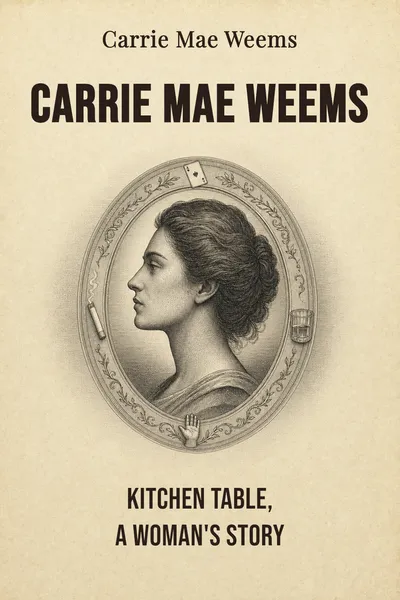
Carrie Mae Weems
Kitchen table, a woman's story
Description
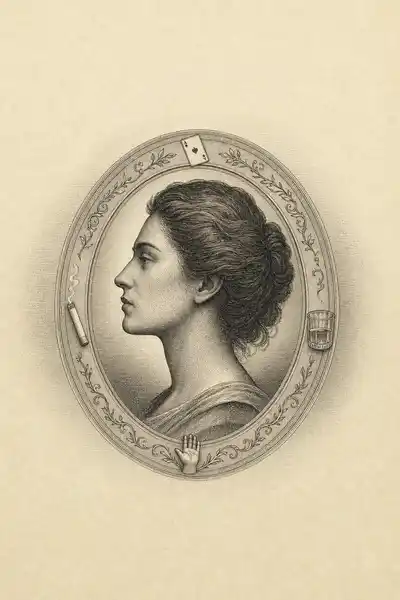
A kitchen table, a bare bulb hanging low over it, a woman seated in the pool of light. That is the whole set. Between 1989 and 1990, the American artist Carrie Mae Weems built a body of work out of almost nothing: one table, one lamp, a few props that come and go, and herself in front of the lens. Twenty black-and-white photographs, fourteen panels of text. No exteriors, no crowd scenes, no travel. Everything happens at the same table, under the same light, and yet across those frames an entire life unfolds — lovers arriving and leaving, children growing, friends passing through, and long stretches where the woman sits alone.
The setting is not incidental. The kitchen is one of the oldest stages of domestic life, the room a certain script has always assigned to women. Weems takes that assignment and turns it into a theater. She casts herself as the protagonist, but the woman at the table is not a self-portrait in the usual sense — she is an archetype, a figure meant to hold more than one life. Weems has said the work is about the battle around the family, around monogamy, between the sexes. It is also, in her own words, about unrequited love, which is a quieter and more unsettling thing to build a series around.
Kitchen Table Series became one of the defining works of late-twentieth-century American photography, and this book is the first publication given over to it alone. What makes it worth sitting with is not just the elegance of the constraint but what that constraint releases: a woman allowed to be strong and vulnerable, tender and remote, without being reduced to a lesson.
The question we’re asking : How does one woman at one kitchen table become a story large enough to hold a whole life — and a whole argument about who gets to be seen?What we’ll see : How Weems built a life from a single set, split between what the pictures show and what the words insist on.
Table of contents
01Chapter 1 — One table, one woman, twenty frames
The premise is almost austere. Weems fixed her camera on a rectangular wooden table lit from above by a single bare bulb and kept it there. The vantage point barely shifts across twenty images. What changes is who sits at the table, what is on it, and how the woman at its center holds herself. From that near-total constraint she draws an unusually full narrative, closer to a novel or a play than to a typical photographic series.
The story moves in recognizable phases. A man appears; there is courtship, closeness, the easy intimacy of two people leaning toward each other over coffee. Then the frames begin to register strain — a turned back, a distance across the tabletop, a cigarette burning in silence. Children enter the picture, a daughter mirroring her mother's gestures at the mirror, and the room fills with the ordinary traffic of family life. Friends gather for cards and laughter. And then, in image after image, the woman is by herself again — reading, thinking, at rest or on guard.

02Chapter 2 — The photographs: what the camera holds still
Look closely and the discipline of the pictures becomes clear. The overhead bulb does most of the emotional work: it pools light on the table and the faces, throws the edges of the room into shadow, and gives every frame the feel of a small lit stage surrounded by dark. Nothing competes for attention. The woman, whoever is with her, and the few objects on the table are all we are permitted to see, so we read them with the attention we would give actors under a spotlight.
The props are sparse and they matter. A bottle and glasses, a deck of cards, a mirror, a birdcage, a cigarette. Each carries a charge without being spelled out. The mirror scene, where the woman applies makeup beside a little girl copying her exactly, says more about inheritance between mother and daughter than any caption could. Weems trusts these objects to hold meaning and trusts us to feel it rather than be told.
03Chapter 3 — The text panels: a voice that answers back
The photographs are only half the work. Interleaved among them are fourteen text panels, and they change everything about how the series reads. Where the images observe the woman quietly from the outside, the words give her an interior — a voice, an unnamed narrator who speaks in and around her life. The panels borrow from blues lyrics, folklore, and everyday talk, moving between tenderness, humor, exhaustion, and defiance.
The text does not simply caption the pictures. It runs alongside them, sometimes echoing what we see and sometimes pulling against it. The voice recounts the arrivals and departures of men, the demands and small betrayals of love, the pull between wanting a partner and wanting to be left alone. It names what the photographs can only imply: the negotiations of monogamy, the weariness of being needed, the ache Weems calls unrequited love. Reading the panels, we stop watching the woman and start listening to her.
04Chapter 4 — An archetype under a single hanging bulb
Step back from the individual frames and the larger ambition of Kitchen Table Series comes into view. Weems chose the kitchen precisely because it is the room a certain history has always handed to women — the traditional domain of domestic labor and confinement. Rather than reject that space, she occupies and reclaims it, turning the site of expectation into a stage for a full and complicated human life. The kitchen stops being where a woman is kept and becomes where a woman is finally seen.
The move from self-portrait to archetype is what widens the work beyond one biography. Weems is the woman at the table, but she is not asking us to learn about Carrie Mae Weems. She is offering a figure capacious enough to hold many lives — a woman navigating love and its failures, motherhood, friendship, and the long stretches of being alone. By placing herself in that role, a Black woman at the center of the frame directing her own image, Weems does something the history of photography had rarely allowed. The woman here is subject, not spectacle; author, not illustration.
05Conclusion
We return to where we began: one table, one bulb, one woman in the light. Across twenty photographs and fourteen text panels, Weems built a life from that single set — courtship and its collapse, a daughter learning her mother's gestures, friends around the cards, and the long solitary hours that bracket it all. The constraint was the method. By refusing to leave the kitchen, she made every feeling register at the same worn surface, and by writing a voice for the woman she watched, she let her subject answer the way she was being seen.
Related books