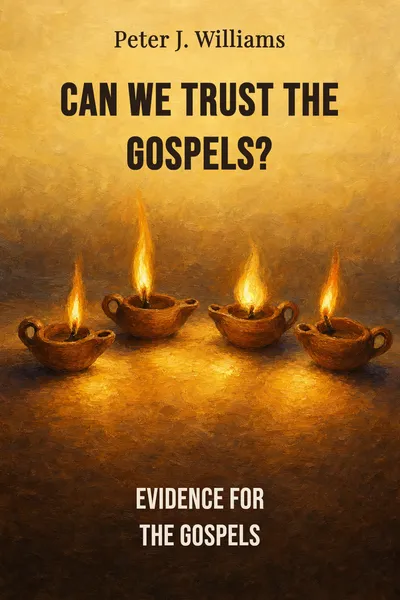
Can We Trust the Gospels?
Evidence for the Gospels
Description
Four short books sit at the front of the New Testament — Matthew, Mark, Luke, John — and between them they carry almost everything the world claims to know about the life and words of a first-century Galilean named Jesus. They have been read as scripture for nearly two thousand years, which is precisely what makes them hard to read as anything else. We tend to sort them into a box marked belief, where the only relevant question is whether we're in or out, and where evidence feels beside the point. The New Testament scholar Peter Williams thinks that instinct skips a step. Before the box of belief, there's a plainer question that anyone can ask: as documents about the past, are these four any good?
That's a different question from whether the miracles happened. It's the question a historian would put to any old text — who wrote it, how close were they to the events, do they know the terrain and the names and the customs of the place they describe, do independent sources back any of it up, and has the wording survived the long journey down to us more or less intact. Williams, who runs Tyndale House in Cambridge and works on ancient manuscripts for a living, spends his short book Can We Trust the Gospels? running exactly those tests, one after another, the way you'd vet any witness.
What comes out is not a proof and doesn't pretend to be one. It's a case — the accumulated weight of small, checkable things that are surprisingly hard to fake and easy to get wrong. The interesting part is how ordinary the tools are. No leap of faith required to follow the argument, only a willingness to treat four ancient books as ancient books first.
The question we’re asking : When we put the four Gospels through the ordinary tests a historian uses on any old text, how well do they actually hold up?What we’ll see : A New Testament scholar's case built not on faith but on outside witnesses, buried local detail, awkward agreements, and the paper trail of the manuscripts.
Table of contents
01Chapter 1 — What the outsiders wrote
The first test Williams applies is the one skeptics usually ask for: does anyone outside the Christian circle even mention this man? If Jesus were purely a later invention, the silence of hostile or indifferent observers would be telling. It isn't silent. Around 116, the Roman historian Tacitus, no friend of the new sect, records that Christians took their name from Christus, executed under Pontius Pilate during the reign of Tiberius. He calls the movement a pernicious superstition — hardly a friendly source, which is exactly what makes the reference useful. He isn't repeating what believers wished were true.
Pliny the Younger, governing in what is now northern Turkey around 112, wrote to the emperor Trajan asking how to handle Christians who met before dawn and sang hymns to Christ as to a god. Suetonius mentions disturbances in Rome stirred up by someone he garbles as Chrestus. The Jewish historian Josephus, writing in the 90s, refers to Jesus twice, including a passage that later Christian copyists clearly touched up — but even the skeptical reconstruction leaves a real man, a teacher, executed under Pilate, with a brother named James.

02Chapter 2 — The world the writers knew by heart
The second test is harder to spoof, and it's where Williams's own manuscript work sharpens the case. Ancient forgers and late legend-spinners tend to get the local texture wrong, because texture is invisible to insiders and impossible to reconstruct from a distance. So the question becomes: do the Gospels know first-century Palestine the way a native knows a neighborhood, or the way a foreigner knows a guidebook?
Take names. Studies of Jewish names from the period — drawn from inscriptions, ossuaries, and documents — show a very particular popularity ranking: Simon and Joseph at the top, then Judas, Lazarus, and a cluster of others, with a striking concentration where a handful of names cover most of the male population. The Gospels match this distribution closely. That matters because a writer inventing characters generations later, or in a different country, would almost certainly get the frequencies wrong. You can't guess a name-market you never lived in. The Gospels also disambiguate common names the way locals do — Simon the leper, Simon of Cyrene — because in a crowd of Simons you have to.
03Chapter 3 — Four accounts, one awkward honesty
Having four Gospels instead of one is often treated as a liability — surely the contradictions between them undo the whole thing. Williams argues nearly the reverse. The relationship between the four has the fingerprints of independent testimony rather than a coordinated script. They overlap heavily, yet each preserves details the others lack, and their differences are the kind real witnesses produce, not the kind copyists invent.
His most elegant example is what scholars call undesigned coincidences — places where one Gospel raises a question it never answers, and a different Gospel supplies the missing piece without appearing to notice. One account has Jesus asking Philip where to buy bread for a crowd, oddly, since Philip isn't otherwise central; another mentions, in a completely different setting, that Philip came from a nearby town. Neither writer flags the connection. The detail only makes sense when you lay the two side by side — which is exactly how genuine, unrehearsed reports interlock, and exactly what a fabricator coordinating a story would have smoothed over.
04Chapter 4 — How the words survived the trip
A reliable original is worthless if what reaches us is a corrupted copy of a copy of a copy. So the last test is transmission: between the first century and the printing press, could the text have drifted so far that we no longer have what the writers wrote? This is Williams's home turf, and his answer leans on hard numbers. The Gospels survive in an enormous quantity of Greek manuscripts, plus early translations into Latin, Syriac, and Coptic, and thousands of quotations by early Christian writers. No other work of ancient literature is attested anything like as richly.
The comparison does the arguing. Most classical texts — the histories of Tacitus, the works of Plato, the poems we teach as bedrock — survive in a handful of medieval copies made a thousand years or more after composition, and we read them without anxiety. The Gospels have earlier and vastly more numerous witnesses. That abundance, counterintuitively, is a feature, not a bug: with so many independent copies, an error introduced in one line of transmission is exposed by all the others. You can triangulate back toward the original precisely because no single scribe controlled the whole tradition.
05Conclusion
The four books at the front of the New Testament turn out to survive the ordinary examination remarkably well. Outsiders who had no reason to help confirm the bare facts. The local detail runs too deep and too casual to be the work of distant inventors. The four accounts interlock the way real testimony does, awkward moments and all, rather than the way a coordinated fiction would. And the manuscript trail is richer than for almost anything else we've inherited from the ancient world. None of that settles the question the Gospels themselves care most about. But it clears away the idea that the whole thing floats free of evidence.
Related books