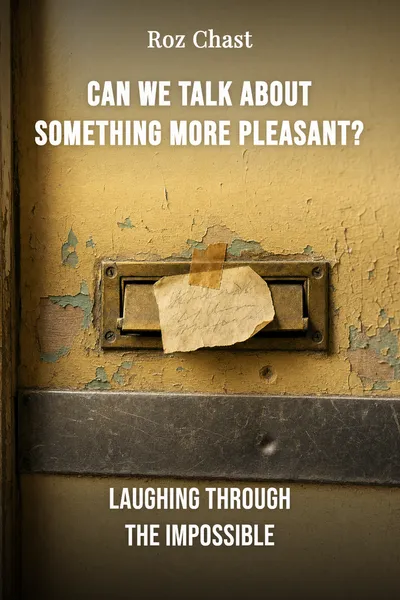
Can We Talk About Something More Pleasant?
Laughing through the impossible
Description
Roz Chast had been drawing cartoons for The New Yorker since 1978, filling the magazine's pages with anxious, scribbly people worrying about the wrong things in overfurnished rooms. She was, by any measure, one of the most recognizable comic voices in America. And yet for years there was one subject she could not draw her way toward: her own parents, George and Elizabeth, growing very old in the same Brooklyn apartment they had lived in for decades, refusing to move, refusing to plan, refusing — above all — to discuss it. When they were both in their nineties and their independence started to visibly crumble, Chast did the thing she knew how to do. She began keeping notes, snapping photographs, and eventually drawing.
The result, published in 2014, was "Can We Talk About Something More Pleasant?" — a graphic memoir of watching two parents decline, and a book whose title is a direct quotation from her mother, the line Elizabeth used to shut down any conversation that drifted toward wills, funerals, or the future. It won the National Book Critics Circle Award and became a surprise bestseller, which is remarkable for a book that is, at bottom, about incontinence, dementia, nursing-home bills, and death. What makes it strange is not the subject. It is the tone. Chast is funny about it, and the humor does not soften the sadness so much as sit right next to it.
The book arrived at a moment when a whole generation was quietly living the same thing without a language for it. Millions of adult children were becoming the parents of their parents, sorting through medications and paperwork and denial, and mostly saying nothing about it to anyone. Chast said it, in ink and watercolor and family snapshots, with the door left open on all the parts we usually keep shut.
The question we’re asking : How does a comic strip manage to hold both the comedy and the grief of watching parents die, without cheapening either?What we’ll see : A memoir built from cartoons, photographs and documents, following two very old people and the daughter caught between love, exasperation and dread.
Table of contents
01Chapter 1 — The Brooklyn apartment nobody was allowed to leave
George and Elizabeth Chast had lived in the same apartment in Flatbush, Brooklyn, since 1959. By the time their daughter started documenting their decline, they were in their nineties, and the apartment had become a kind of sealed museum of their marriage: decades of accumulated objects, drawers stuffed with old bank statements and jar lids, closets that had not been opened in years. Chast draws it all with an inventory-taker's eye — the ancient appliances, the Chock full o'Nuts cans repurposed for storage, the sheer archaeology of two people who threw nothing away.
Her parents had been together since high school and were, in her telling, almost pathologically inseparable. George was gentle, anxious, hopeless with anything mechanical or practical. Elizabeth was the assistant principal of an elementary school, sharp-tongued, proud, and firmly in charge. They were also, by the time the book opens, in denial of an almost heroic scale. The idea that they might one day need help, or a different place to live, or a plan, was not a conversation Elizabeth would permit. Her line — "Can we talk about something more pleasant?" — was the door slamming.

02Chapter 2 — Drawing what could not be said out loud
The book's real invention is its form. Most of it is comic strips — Chast's loose, nervous line, her speech balloons crammed with the exact cadences of her parents' voices. But she breaks the cartoons open with other material: actual photographs of the apartment, scans of her parents' handwriting, a will, a page from a nursing-home price list, and near the end, a series of stark pencil drawings she made of her mother in her final days. The mix is not decorative. It is how the book tells the truth from several angles at once.
Comedy is the load-bearing wall. Chast is very funny about the indignities — the argument over a jar of ancient, calcified food her parents refuse to throw out; George's terror of the ATM; the way Elizabeth wields her superiority like a weapon even from a hospital bed. The jokes are not a way of looking away. They are the texture of the actual relationship, the way this family always talked, and to sand them off would be a bigger lie than the tears.
03Chapter 3 — The long slow business of an ending
Death, in this book, is not an event but a process, and a maddeningly uneven one. George goes first, more quietly, his mind loosening its grip while his body lingers. Elizabeth, older and tougher, holds on far longer than anyone expects, outliving her husband and continuing to preside over her own decline with the same imperious will she brought to everything else. Chast tracks the whole thing across several years, and the passage of time is one of the book's quiet subjects: how long dying can take, and how ordinary the days inside it become.
She is honest about the parts nobody talks about. The exhaustion of managing appointments and caregivers from another state. The strange bureaucracy of the assisted-living facility, "The Place," with its activities and its smells and its careful cheerfulness. The way an aide named Goodie ends up giving her mother a tenderness Chast herself cannot quite summon. The guilt of hiring that love, and the relief of it. None of this is presented as a lesson. It is just what the days were made of.
04Chapter 4 — What a cartoonist knows about dying
What Chast really did was drag eldercare out of the closet where most of us keep it. For decades the deaths of parents have been treated as a private ordeal — sad, expensive, faintly shameful, and not to be discussed in polite company, exactly the way Elizabeth wanted. By building a bestseller out of it, and by refusing to make it noble, Chast gave a whole generation permission to admit that this was happening to them too, and that it was ugly and boring and heartbreaking and sometimes darkly funny all at once.
The choice of the comic strip is not incidental to that. We tend to assume that serious subjects demand a serious form — the solemn essay, the hushed documentary, the memoir that treats death with hushed reverence. Chast's book argues the opposite. The cartoon, precisely because it is unpretentious and a little absurd, can look directly at things the reverent forms flinch from. A drawing can put a punchline and a corpse on the same page. Reverence keeps its distance; the cartoon leans in.
05Conclusion
The title is a joke that turns out to be the whole thesis. Elizabeth used "Can we talk about something more pleasant?" to end conversations, to keep the future sealed off, to preserve the fiction that nothing was ending. Chast took that exact refusal and made it the name of a four-hundred-page book that talks about nothing else — the decline, the money, the diapers, the pencil sketches of a dying woman's face. The book is, in a sense, the conversation her mother would never have.
Related books