
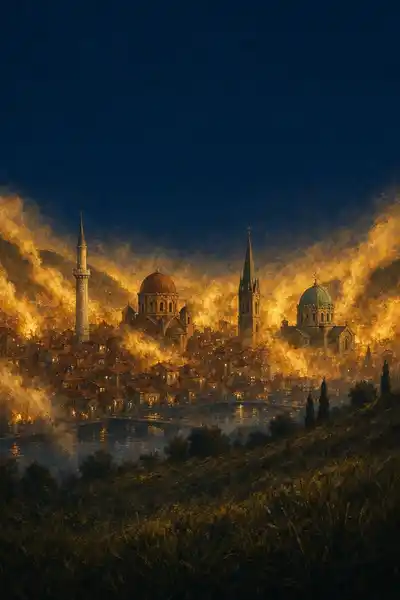
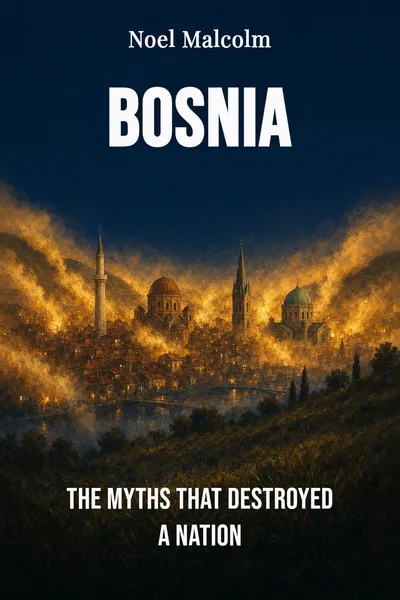
Bosnia
The myths that destroyed a nation
Description
For most of the twentieth century, Bosnia was the kind of place a traveller passed through rather than the kind a scholar wrote about. Then, in 1992 and 1993, it became the opposite: a name in every headline, a shorthand for a certain modern horror, a country apparently disintegrating along lines drawn centuries earlier. Sarajevo, a city where mosque, synagogue, Catholic and Orthodox church stood within a few streets of one another, was surrounded and shelled from the hills. The word that attached itself to what was happening was "ancient" — ancient rivalries, ancient hatreds, blood feuds older than memory finally boiling over.
Noel Malcolm, a historian of the Balkans, wrote his short history of Bosnia against exactly that word. His argument is that the phrase explains nothing, and that it was doing real work — soothing Western consciences, excusing inaction, and quietly endorsing the version of the past that the men bombarding Sarajevo wanted the world to accept. A land that had spent a thousand years absorbing empires and faiths without dissolving into permanent war was being described as if slaughter were its natural condition.
So the book does two things at once. It tells the long story of a country that Rome, Byzantium, the Ottomans and the Habsburgs all passed through and marked, and it clears away the myths that had settled over that story like fog. What emerges is a place far stranger and more durable than the newsreels suggested — and a catastrophe whose causes lay less in Bosnia's past than in decisions taken elsewhere, and quite recently.
The question we’re asking : If Bosnia was not destroyed by ancient hatreds, then what actually destroyed it?What we’ll see : We follow a thousand years of overlapping empires and faiths, then watch how a convenient story about that past was manufactured, weaponised, and finally believed by the very people who might have stopped the killing.
Table of contents
01Chapter 1 — A crossroads, not a fault line
The oldest myth about Bosnia is that it sits on a line — the great seam where East meets West, Christendom meets Islam, one civilisation grinds against another. Malcolm's history begins by dismantling that image. Bosnia was never a border so much as a meeting-ground, a mountainous stretch of the western Balkans where empires arrived, layered themselves over what was already there, and moved on without ever fully erasing their predecessors. The Roman world reached it; so did the successors of Charlemagne, in influence if not in rule. Byzantium pulled at it from the east.
In the medieval period Bosnia was a kingdom in its own right, with its own church and its own peculiar reputation for religious independence — a reputation later inflated into the legend of a heretical "Bogomil" faith, which Malcolm treats with considerable scepticism. What matters is that the country had a political existence long before the modern era invented reasons to deny it one. When the Ottomans conquered it in the fifteenth century, they did not import a foreign population; they governed the people already living there, many of whom, over generations, converted to Islam.

02Chapter 2 — The invention of ancient hatred
If Bosnians had lived together for centuries, where did the idea of eternal enmity come from? Malcolm's answer is that it was largely built in the nineteenth and twentieth centuries, and much of it was built outside Bosnia altogether. Nationalism in the Balkans arrived as an import, a European fashion for organising peoples into distinct nations with historic destinies. In the hands of Serbian and Croatian nation-builders, the mixed population of Bosnia became a problem to be sorted: its Orthodox inhabitants reclassified as Serbs, its Catholics as Croats, its Muslims as an anomaly to be claimed, converted, or explained away.
The past was raided for ammunition. The medieval Serbian empire, the great defeat at Kosovo in 1389, became not history but sacred grievance, a wound to be avenged in each generation. Muslims were recast as the descendants of traitors and Turks, an alien presence on Serbian or Croatian soil. None of this described how people actually lived; it described how ambitious politicians needed them to be seen. The point of the myth was never accuracy. It was mobilisation.
03Chapter 3 — The war made in Belgrade
The destruction of Bosnia, in Malcolm's account, was not a spontaneous eruption but a strategy. As Yugoslavia came apart at the end of the 1980s, the Serbian leadership under Slobodan Milošević pursued a project of gathering all Serbs into a single enlarged state. Bosnia, mixed as it was, stood squarely in the way. A country where no group held a clear majority could not simply be partitioned along clean lines — which meant that the lines would have to be created by force, by removing the people who lived on the wrong side of them.
The instrument was the euphemism the war made infamous: ethnic cleansing. When Bosnia declared independence in 1992, after a referendum boycotted by most Serbs, forces armed and directed largely from Belgrade moved to carve out territory. Villages were emptied, populations expelled, towns besieged. The aim was not to win a battle in the old sense but to make coexistence impossible — to render the mixed society ungovernable so that separation would appear to be the only remedy. The camps, the mass expulsions, the shelling of Sarajevo were means to that end.
04Chapter 4 — The West that misread the map
Here the book turns its argument outward, and this is where its charge becomes uncomfortable. The myth of ancient hatred was not only a Serbian propaganda tool; it was adopted, more or less wholesale, by the Western politicians and diplomats who might have acted to stop the war. If the conflict was the latest chapter in a thousand-year cycle of tribal bloodletting, then it was nobody's fault and nobody's responsibility — a natural disaster, regrettable but beyond outside remedy. The story that excused the aggressors also excused the bystanders.
Malcolm's indictment is that this misreading shaped policy. Western governments treated all sides as roughly equivalent, imposed an arms embargo that in practice hurt the poorly armed Bosnian government most, and pursued negotiations whose logic — dividing the country into ethnic blocs — quietly ratified the very cleansing that had produced the blocs. To accept the map the gunmen were drawing was to reward the method. A history that could have been argued about was instead surrendered to the simplest and most fatalistic version available.
05Conclusion
The country that was shelled from the hills in 1992 and 1993 had a past far older and far richer than the war that consumed it. For a thousand years it had absorbed Rome and Byzantium, the Ottomans and the Habsburgs, four faiths and countless languages, and had gone on being recognisably Bosnia. That achievement was not an accident of geography or a fragile lull between massacres. It was a way of living, and it was destroyed not by the weight of its own history but by a decision to erase it.