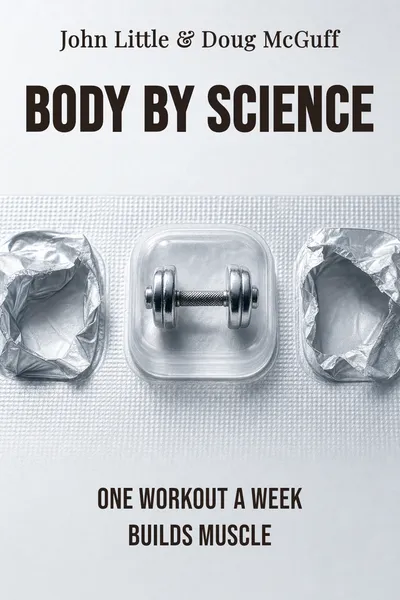
Body by Science
One workout a week builds muscle
Description
Doug McGuff is an emergency-room physician in Seneca, South Carolina, and John Little is a strength writer who spent years working through the archives of the old Nautilus training experiments. In 2009 they put their names to a book called Body by Science, and the claim on its cover reads like a provocation aimed straight at everyone who has ever felt guilty about a skipped workout. Twelve minutes. Once a week. That, they argue, is enough to build muscle, improve markers of health, and get most of what people are chasing when they buy a gym membership they use three times and then abandon around February.
The idea sounds like the kind of thing sold on late-night television, and the authors know it. So the book does something the fitness industry rarely bothers with: it goes to the physiology. McGuff writes as a doctor who spends his shifts watching bodies under stress, and he treats a workout the way he'd treat a dose of medication — something with a right amount, a wrong amount, and a mechanism you can actually describe. The five-day-a-week grind, in this telling, isn't dedication. It's a dosing error, repeated until it does more harm than good.
What makes the book more than a shortcut pitch is that it refuses to flatter. It doesn't promise the workout will be pleasant. In fact it promises the opposite — that twelve minutes done properly will be among the hardest twelve minutes we've ever spent. The trade is brutal effort for almost all of our week back. Whether that trade holds up is the whole argument, and it runs deeper than a stopwatch.
The question we’re asking : Can twelve minutes of training, done once a week, really build muscle and improve health the way hours in the gym are supposed to?What we’ll see : How McGuff and Little rebuild the logic of exercise from the muscle fiber up, and why their answer looks nothing like the gym calendar.
Table of contents
01 Chapter 1 — The twelve minutes that undo the gym calendar
The workout at the center of the book is almost comically short. McGuff and Little call it the Big Five: five compound machine exercises — a seated row, a chest press, a pulldown, an overhead press, and a leg press — done one after another, with no rest and no second sets. Each exercise is a single set carried to the point where the muscle simply can no longer move the weight, no matter how hard we try. That endpoint has a name in the book: momentary muscular failure. It is not the polite fatigue of a normal gym session. It is the moment the bar stops moving and stays stopped.
The counterintuitive part is the tempo. Instead of the quick, bouncing reps most people do, the authors ask for painfully slow movement — roughly ten seconds up, ten seconds down. Slowing everything removes momentum, which means the muscle never gets a rest at the top or bottom of the lift. There's nowhere to hide. A set that would take a normal lifter twenty seconds of jerky effort now stretches to ninety seconds or more of continuous, deepening burn, and it ends when the body genuinely quits rather than when we decide we've had enough.

02 Chapter 2 — Why one hard set does what five easy ones can't
The mechanism McGuff leans on is the way muscle fibers get recruited. Muscles don't fire all their fibers at once; they call them up in order, easiest first. Light effort uses only the slow, endurance-oriented fibers. As the effort mounts and those fibers tire, the body reaches for progressively stronger, faster fibers — the ones with the greatest capacity to grow. The catch is that those high-threshold fibers are the last to be summoned, and they only get summoned when the easier ones have run out of gas.
This is why a set carried to failure matters so much in the book's logic. Stopping when it merely gets hard leaves the strongest fibers untouched, dozing, never asked to work. Pushing all the way to the point where the weight won't move is the only way to march up the entire ladder of fibers and reach the ones at the top. One set that arrives there, the authors argue, has already done the recruiting job that five submaximal sets keep failing to finish. Doing more sets after that point isn't adding stimulus — it's just adding damage.
03 Chapter 3 — The recovery nobody schedules
If the workout is the smallest part of the book, recovery is the largest. McGuff and Little insist that the training session doesn't build a single fiber of muscle. It only issues the order. The actual building happens afterward, over days, while we're doing nothing that looks like exercise at all. The workout is the stimulus; growth is the body's slow reply. And that reply takes far longer than most training schedules allow.
This is where the once-a-week frequency comes from, and it isn't arbitrary. The authors argue that a properly brutal session digs such a deep hole that the body needs the better part of a week — sometimes longer — first to repair the damage and only then to add new tissue on top. Train again before repair is finished and we interrupt the process, restarting the debt before it's paid. In that framing, the person training five days a week isn't accelerating anything. They're standing in their own way, never letting the reply arrive.
04 Chapter 4 — What the body was doing all along
Step back from the machines and the stopwatch and the book's real move comes into view. McGuff and Little aren't offering a smarter gym routine so much as refusing the category of gym routine altogether. Exercise, in Body by Science, is not a sport, a hobby, or a lifestyle. It's a medical intervention — a dose delivered to the body to trigger a specific biological response, no different in kind from a drug that has a correct amount and a threshold past which more becomes harmful.
That reframing is what gives the twelve-minute claim its logic. Nobody argues that taking a medication five times as often makes it five times as effective; past a point it just poisons. The authors ask why we assume exercise works differently — why effort alone, piled higher and higher, should keep paying returns. Their answer is that it doesn't, and that the whole culture of more is a category error dressed up as discipline. Once exercise is understood as a stimulus with a dose, the short, hard, infrequent protocol stops looking like a shortcut and starts looking like the obvious prescription.
05 Conclusion
McGuff and Little end more or less where the cover promised: twelve minutes, once a week, taken to the point where the weight won't move and then followed by real rest. The program is small enough to sound trivial and hard enough that few who try it properly want to repeat it casually. That tension is the point. The book asks for almost none of our time and almost all of our effort in the moments it does claim — the inverse of the bargain the fitness industry usually offers.
Related books