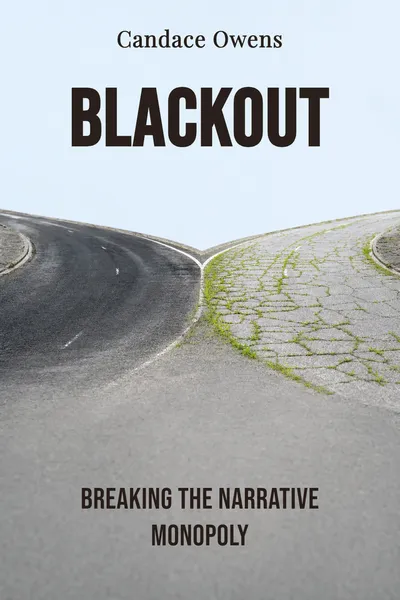
Blackout
Breaking the narrative monopoly
Description
In 2015, a woman in her mid-twenties launched a crowdfunding campaign for a website meant to fight online harassment. Candace Owens had grown up in Stamford, Connecticut, and by her own account she was, at that point, no conservative — if anything the opposite. The project drew attention from parts of the internet she hadn't expected, the funding collapsed, and within a few years she had reinvented herself entirely: as one of the loudest, most divisive Black conservative voices in American public life. "Blackout," published in 2020, is where she tries to explain the turn.
The book's argument is blunt and it is meant to sting. Owens claims that Black Americans have handed roughly ninety percent of their votes to the Democratic Party for decades and gotten too little in return — and that a set of stories about victimhood, dependency and grievance keeps that loyalty locked in place. She writes as a convert, someone who once believed the narrative and now wants to dismantle it. Whether one nods along or throws the book across the room, the provocation is deliberate.
What makes "Blackout" worth reading closely isn't the applause it gets on one side or the fury it gets on the other. It's the underlying bet: that a community becomes weaker, not stronger, when almost everyone inside it votes the same way and stops arguing among themselves. Owens builds the whole book on that claim, and it's the claim that outlasts the culture-war noise around her name.
The question we’re asking : What does Owens actually argue when she says Black America has surrendered its political leverage, and does the case hold up?What we’ll see : How a self-described former progressive turned a personal reversal into a full-throated attack on the idea of a single, agreed-upon story.
Table of contents
01Chapter 1 — The number that started an argument
Owens opens where the whole book lives: a single statistic. In American presidential elections going back to the 1960s, Black voters have given the Democratic Party somewhere around ninety percent of their support, election after election, with remarkable consistency. In 2012, Barack Obama took roughly ninety-three percent of the Black vote. The figure barely moves regardless of candidate, platform or decade. For most commentators this is simply a fact of political life. For Owens it is the scandal the rest of the book is built to expose.
Her reasoning runs like this. In a democracy, leverage comes from being persuadable. A bloc of voters that might swing either way forces both parties to compete for it, to make promises and then deliver on them. A bloc whose vote is a foregone conclusion gets courted with rhetoric and little else, because neither side has a real incentive to work for it — one party assumes it, the other writes it off. Owens argues that Black Americans, by voting as a near-unanimous bloc, have handed away exactly the bargaining power that would make politicians answer to them.

02Chapter 2 — From progressive to something else
Much of the book's authority, in Owens's own framing, rests on the fact that she didn't start here. She describes a younger self who assumed, more or less by default, that being Black meant being on the political left — an assumption she says she never really chose so much as absorbed from school, media and the people around her. "Blackout" is partly a memoir of unlearning that default, and the personal chapters are where the argument gets its emotional charge.
She returns often to a formative episode from her teenage years. In 2007, as a high-school student in Stamford, she received threatening, racist voicemails, an incident that drew local news coverage and, eventually, a legal settlement. At the time, she writes, she understood it entirely through the lens of racism as an all-explaining force. Years later she reframes it — not as proof that racism doesn't exist, but as an example of how a single narrative can crowd out every other way of making sense of one's own life. That reframing, she suggests, was the beginning of her turn.
03Chapter 3 — The case against the single story
The heart of "Blackout" is an attack on what Owens calls the dominant narrative — the interlocking set of ideas she says the media, politicians and celebrities keep in circulation about Black life in America. Its central move, as she describes it, is to locate the source of every difficulty outside the individual: in structures, in history, in other people's racism. She doesn't deny that any of those forces exist. Her objection is to their being made the whole explanation, because an explanation that leaves you no agency also leaves you no way out.
Against that, she puts the older, less fashionable virtues she wants to rehabilitate: personal responsibility, entrepreneurship, education, the two-parent family. She marshals historical anecdotes and statistics to argue that Black communities showed striking economic and social resilience in earlier, harsher decades, and she treats certain later policies — welfare structures she believes weakened family formation among them — as having done real damage under the banner of help. This is contested territory, and Owens states her readings with more confidence than the underlying data always supports.
04Chapter 4 — When a community stops arguing with itself
Step back from Owens's specific claims — many of which reasonable people will reject — and a broader question sits underneath the whole book. What happens to any group when its political allegiance becomes a settled fact rather than a live decision? This is the argument in "Blackout" that doesn't depend on agreeing with her about welfare policy or family structure, and it's the one most worth taking seriously.
The logic is not unique to race, which is part of its force. Any constituency that votes as a near-unanimous bloc — a region, a union, a religious community — trades away a certain kind of power. It gains solidarity and the comfort of a shared identity, but it loses the leverage that comes from being genuinely up for grabs. Owens's insight, stripped of its provocations, is that safe votes are cheap votes. The people you can count on are the people you can afford to ignore.
05Conclusion
"Blackout" ends where it began, with that stubborn ninety percent — the number Owens can't stop returning to because, for her, it's a symbol of something surrendered rather than won. Her wager across the book is that political freedom starts with the freedom to defect, to say the thing your community doesn't expect and pay whatever social price follows. Whether readers find her a truth-teller or a provocateur trading outrage for attention, that wager is the spine of everything she writes.
Related books