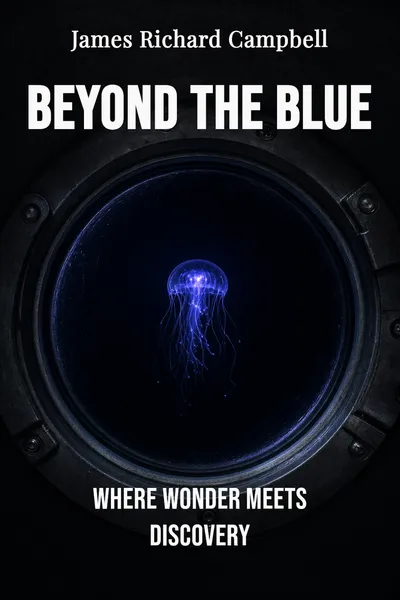
Beyond the Blue
Where wonder meets discovery
Description
There is a particular feeling that comes from standing at the edge of open water and looking out. The horizon looks like a line, a boundary, the place where the world runs out. It isn't, of course. Sail toward it and it retreats, always the same distance away, a promise that never quite delivers. James Richard Campbell builds his book "Beyond the Blue" on exactly that gesture — the old human habit of staring past the familiar edge and wondering what sits on the other side. His subject is the space where wonder and discovery meet, the ocean and the sky and everything we still haven't managed to name.
What Campbell is after is not a catalog of facts about the natural world, though the facts are there. It's the impulse underneath them. Why do we keep going out to the edge? Why does a species that could reasonably have stayed home, warm and fed, keep building boats and instruments and telescopes to look at things it cannot yet use? The blue of the title is the whole unmapped remainder — the deep sea, the far sky, the parts of the planet that have absorbed our attention precisely because they refuse to hand themselves over easily.
The book moves between the very large and the very small, between the sweep of exploration and the quiet, patient work that actually produces knowledge. It treats discovery less as a series of triumphant arrivals and more as a long conversation with a world that answers slowly, if at all. That framing is what gives the book its shape, and it's where we'll spend our time.
The question we’re asking : why do we keep pushing past the familiar horizon, and what does the world beyond it actually give back?What we’ll see : how Campbell turns the old pull of the unknown into a working portrait of curiosity, patience, and the questions that don't resolve.
Table of contents
01Chapter 1 — The horizon that keeps moving
Campbell opens where most of us have stood at least once: at the shoreline, or on a night clear enough to make the sky look crowded. The pull he describes is not dramatic. It's a low, steady curiosity — the sense that the visible world is a small clearing in a much larger dark. He's careful not to romanticize it. The urge to see beyond the horizon has driven a great deal of human effort, and not all of it noble. But stripped of the conquest, something honest remains: we are a species that finds the edge of its knowledge intolerable, and interesting, at the same time.
The book leans on a simple observation about horizons. They are always relative to where you stand. Climb higher and the line pushes out; the more you can see, the more you realize there is left to see. Campbell uses this as more than a metaphor. Each expansion of what we can observe — a better hull, a deeper dive, a sharper lens — does not shrink the unknown. It enlarges it. Every answer opens a wider field of questions, which is a strange kind of progress, and one we rarely account for honestly.

02Chapter 2 — What the deep water refuses to give up
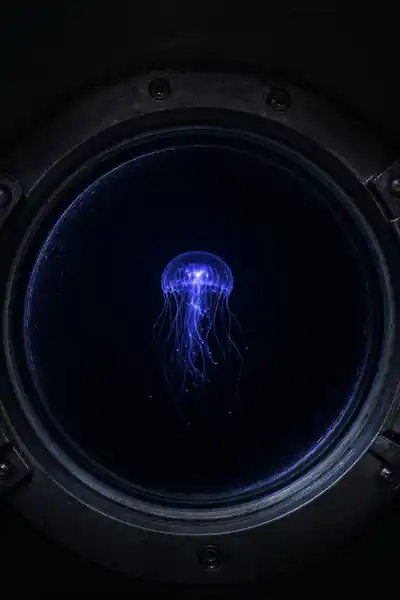
The ocean is the book's central character, and Campbell treats it as the closest thing on Earth to genuine wilderness. The numbers he draws on make the point without needing embellishment: the sea covers most of the planet's surface, and the overwhelming majority of it lies below the reach of sunlight, in a cold, high-pressure dark that humans have barely entered. We have detailed maps of the Moon and Mars. The floor of our own oceans remains, in large part, sketched rather than known.
What interests Campbell is why. It isn't lack of curiosity. It's that the deep is physically hostile in a way that punishes carelessness. Pressure crushes equipment. Salt water corrodes it. Light does not travel far, and neither do radio signals, so the tools that let us explore the sky — beams, waves, distant observation — mostly fail underwater. To go down, you have to send something down, and building a machine that survives the descent is a slow, expensive, iterative business. The deep gives up its secrets grudgingly, one dive at a time.
03Chapter 3 — Curiosity is a method, not a mood
If the first half of the book is about where we look, the second half is about how. Campbell spends real time correcting a popular picture of discovery — the flash of insight, the lone genius, the sudden breakthrough. Most of what we know about the world beyond the familiar arrived slowly, he argues, through repetition, measurement, error, and correction. Curiosity, in his telling, is not a feeling you either have or don't. It's a discipline: the willingness to keep asking after the excitement has worn off.
He illustrates this with the unglamorous machinery of real science. The instrument that has to be rebuilt after it floods on its first dive. The measurement taken a thousand times to be sure of it once. The long stretches where nothing seems to move, punctuated by the occasional result that reorders everything. Campbell has clear affection for this rhythm. He treats the patience it demands not as a cost of discovery but as its actual substance — the part that separates real knowledge from a good guess.
04Chapter 4 — The world is bigger than the map of it
Campbell's larger point is not really about the ocean, or the sky, or any particular frontier. It's about the gap between what we know and what we don't, and how we choose to hold it. Most of us are uncomfortable with that gap. We want the map finished, the question answered, the mystery resolved into fact. "Beyond the Blue" makes a quiet case for the opposite instinct — for keeping the gap open, for treating the unknown as a permanent and even welcome feature of living in a world this large.
The temptation, especially in an age that can look up almost anything, is to believe the exploring is mostly done. Campbell pushes hard against that. The deep sea alone remains largely unmapped; the questions raised by vent ecosystems and the possibility of life elsewhere are wide open; the sky beyond our own patch is barely sampled. The sense of a finished world is an illusion produced by the smallness of the clearing we stand in. Step to the edge and the dark is still there, as vast as it ever was.
05Conclusion
Campbell ends more or less where he began, at the edge of the water, looking out. But the horizon reads differently by the last page. It's no longer a boundary that discovery will one day erase. It's a working relationship with the unknown, the same one that sent the first boats out and still sends instruments into the dark of the deep sea. The blue of the title turns out to be less a destination than a discipline — the patience to keep asking, and the honesty to admit that each answer opens a wider question than the one it closed.
Related books