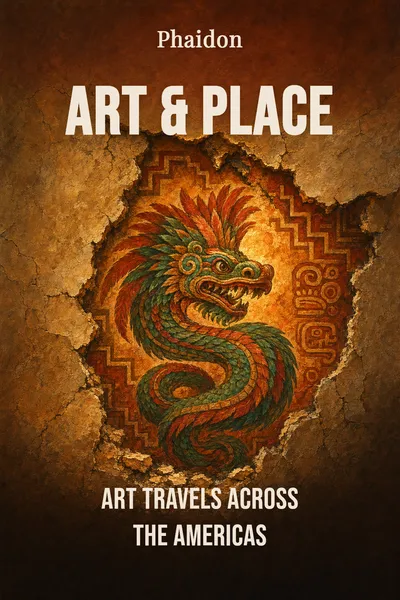
Art & Place
Art travels across the Americas
Description
Phaidon's books tend to be heavy in the literal sense — the kind you need both hands to lift off a shelf. Art & Place is one of those: a thick survey of site-specific art across the Americas, running from Albuquerque to Boston, from Baja California down to Rio de Janeiro, sixty cities in all. What sets it apart from the usual coffee-table art tome is the premise hiding in the title. It is not organized by artist, by movement, or by date. It is organized by where the work physically is.
That choice sounds small and turns out to be the whole point. A painting in a gallery can travel; it can hang in Paris one year and Tokyo the next, and it remains the same painting. The works gathered here cannot move. A mural is welded to its wall, a sculpture to its plaza, an earthwork to its desert. To see them you have to go to them, which is why the book reads less like a catalogue and more like an atlas — or, if we are honest about how anyone actually uses it, a bucket list. Hundreds of works, mapped to the ground they sit on.
Underneath the guidebook function, though, something quieter is at work. By sorting art geographically rather than chronologically, the book makes a claim about what these works are: that the place is not a backdrop to the art but part of it. A Diego Rivera mural in Mexico City and a Robert Smithson earthwork in the Utah salt flats have almost nothing in common as objects. As things rooted to a spot, they belong to the same conversation.
The question we’re asking : When a book sorts art by where it stands instead of who made it, what does that quietly say about the art itself?What we’ll see : How a survey of site-specific work across the Americas turns geography into the organizing idea, and what that does to the way we read a whole continent.
Table of contents
01Chapter 1 — A book that refuses the museum
Most art books carry an unspoken assumption: the natural home of art is the museum, and reproduction is the next best thing to standing in front of the original. Art & Place quietly declines that frame. The works it gathers were not made for white-walled rooms and could not be relocated into one without ceasing to be themselves. A site-specific work is, by definition, married to its location. Pry it loose and you do not move it — you destroy it.
That single constraint reshapes everything about how the book is built. There is no march through periods, no chapter on Impressionism followed by a chapter on abstraction. Instead the reader moves geographically, city by city, region by region, the way you would on a long trip. The structure mimics travel because the subject demands travel. You cannot summon these works to you; you have to arrive where they are.

02Chapter 2 — Where the work and the ground are the same thing
The clearest way to feel what site-specific means is to imagine taking the site away. A portrait survives being moved; a desert earthwork does not survive being lifted out of its desert. The ground is not the frame around the work — it is a material the artist used, as much as paint or steel. Art & Place returns to this again and again, and it is what gives the book its argument underneath the travel-guide surface.
Some of the works it features make the point almost literally. An artist carves into living rock, paints directly onto a building that a city actually uses, or arranges stone and earth across a landscape so large it can only be grasped from the air. In each case the place is doing part of the expressive work. Change the location and the meaning drains out. A spiral of rock in a salt lake means something because of that lake — the color of the water, the crust of salt, the emptiness around it.
03Chapter 3 — From the muralists to the land artists
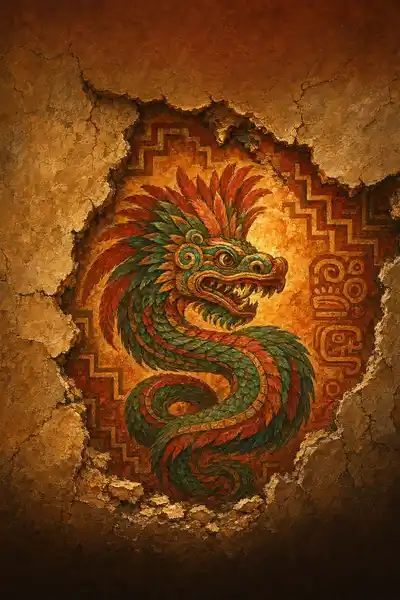
The Americas turn out to be unusually rich ground for art bound to place, and Art & Place threads two great traditions through its pages without ever lining them up as a tidy timeline. The first is the public mural, above all the Mexican muralists of the twentieth century — Diego Rivera, José Clemente Orozco, David Alfaro Siqueiros — who painted enormous works onto the walls of government buildings, schools, and palaces. These were never meant to be portable. They were meant to be encountered by people walking through public space, in the specific buildings whose walls they cover.
The mural tradition makes the book's premise vivid because it is so explicitly tied to its setting. A Rivera fresco in a Mexican stairwell is about that building, that nation, that public. Move it and you would sever it from the civic body it was painted to address. The book treats these works as destinations precisely because their location is inseparable from their meaning — they belong to the streets and institutions they live in.
04Chapter 4 — Art as a way of reading a continent
Step back from the individual works and Art & Place starts to look like more than a catalogue or a bucket list. By insisting that place is part of the medium, it quietly proposes that art can be a way of reading a continent — that if you map the works carefully enough, the map tells you something about the land and the people on it. The book's geography is not just an index. It is an argument that where art happens is itself meaningful.
Follow the logic and the Americas come into focus as a single connected terrain of made places. A desert earthwork and a city mural are not isolated curiosities; they are two ways the same hemisphere has marked itself, layered onto landscapes that already carried older marks. The book's willingness to include ancient sites alongside last decade's installations makes the point: people have been binding meaning to specific ground here for a very long time, and the impulse keeps renewing itself.
05Conclusion
Art & Place ends up doing two jobs at once, and doing both well. On the surface it is exactly what it appears to be: a generous, well-mapped guide to outstanding art across sixty cities of the Americas, the kind of book that quietly fills a list of places you now want to stand in. Albuquerque, Boston, Baja, Rio — the coordinates are there, the directions implied, the invitation open. As a travel companion for anyone who cares about art, it delivers.
Related books