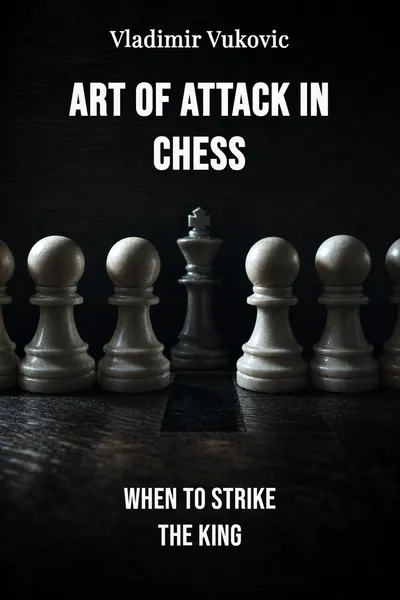
Art of Attack in Chess
When to strike the king
Description
Vladimir Vukovic was a Croatian master, editor and writer, not one of the towering champions whose games fill the anthologies. Yet the book he published in 1963, Napad u šahovskoj partiji — translated into English as The Art of Attack in Chess — became something few playing manuals ever manage to be: a permanent fixture. Grandmasters still name it when asked what taught them to attack. For a book about the most violent thing that can happen on a chessboard — the hunting-down of the enemy king — it is a strikingly patient piece of work, built less on flash than on classification.
What Vukovic set out to do sounds almost impossible. Attacking chess had always been treated as the domain of genius, a matter of vision and nerve you either had or you didn't. The romantic masters of the nineteenth century sacrificed queens and were admired the way a matador is admired — for style, for daring, for the beautiful risk. Vukovic refused that mystique. He believed the attack could be taken apart, named, and taught. Where others saw inspiration, he looked for conditions: the specific features of a position that make an assault on the king sound rather than reckless.
The result reads like a natural history of the mating attack. Vukovic catalogues the focal points, the sacrifices, the roles each piece plays when the guns are turned on the king, the difference between a king still in the centre and one tucked behind its pawns. Every category is anchored to a real game, most of them classics. The promise underneath it all is quietly radical: that knowing when to strike is a skill, not a gift.
The question we’re asking : How do we know when an attack on the king is genuinely sound rather than merely tempting?What we’ll see : How a single-minded book takes the most instinctive act in chess apart and rebuilds it as something a player can actually learn.
Table of contents
01Chapter 1 — The king was always the point
Chess has exactly one non-negotiable goal, and it is easy to lose sight of it behind the machinery of development, structure and endgame technique. The game is won when the enemy king cannot escape. Everything else — the pawns, the open files, the bishop pair — is means. Vukovic opens by pulling this fact back into the foreground. The attack on the king is not one strategy among many; it is the direct route to the only thing that ends the game, and every other plan is, in some sense, a preparation for it or a substitute when it isn't available.
From there he draws his first distinction, the one the whole book rests on. There is the mating attack, which aims straight at the king's life, and there is the attack that merely wins material or improves a position. They look similar over the board — pieces converging, threats multiplying — but they obey different logic. A material attack can be traded down, absorbed, recovered from. A mating attack, once it truly succeeds, ends everything at once. Knowing which kind we are conducting changes how much we are willing to spend to conduct it.

02Chapter 2 — The pieces that carry an attack
An attack is not an abstraction; it is carried out by specific pieces doing specific work, and Vukovic spends much of the book assigning them their roles. The queen is the obvious protagonist, but he is careful to show that she rarely wins alone. A queen arriving at the enemy king without support is often just a queen about to be chased away, losing tempo the defender badly needs. The lesson repeats throughout: force must be concentrated, and concentration means several pieces pointing at the same weakness at the same moment.
He gives particular attention to the minor pieces, because their contribution is the one beginners underrate. A bishop on a long diagonal aimed at the castled king is worth far more than its nominal value suggests — it does nothing visible for many moves, then suddenly it is the piece that makes the whole combination work. The knight, meanwhile, is the great intruder. Planted on a square near the king where no pawn can drive it away, it paralyses the defence and often delivers the decisive check. Vukovic shows knights doing quiet, ugly, indispensable work.
03Chapter 3 — Castled, uncastled, and the timing of the blow
The single most useful division in the book is between the king that has castled and the king still stranded in the centre. They are attacked in completely different ways, and Vukovic treats them as almost separate subjects. The uncastled king is the more urgent target. It sits on an open board with files liable to be ripped open, and the attacker's task is speed — to strike before the defender can hustle the king to safety. Here Vukovic preaches development and initiative: every tempo spent grabbing a pawn is a tempo the opponent uses to castle out of trouble.
The castled king is a slower, subtler problem. It has a pawn shelter, and that shelter is both protection and, potentially, a coffin. Vukovic examines how the very pawns that guard the king can become the targets that trap it. He compares the intact shelter, where a sacrifice is needed to break in, with the loosened or advanced shelter, where a single ill-considered pawn move — h6, g6 — has already created the hook the attacker needs. The defender's own hand, he shows again and again, often opens the door.
04Chapter 4 — Attack as the grammar of the game
Step back from the individual combinations and Vukovic's real ambition comes into view. He is not teaching a bag of tricks; he is arguing that attacking chess has a grammar, a set of rules governing when force may be committed and when it must wait. The whole book is a case against the idea that attack is temperament — that some players are born aggressive and others cautious. In Vukovic's account, the decision to attack is a reading of the position, available to anyone willing to learn the signs, and just as much a matter of judgement as the quietest positional manoeuvre.
This reframes what looks like the most emotional part of chess as its most disciplined. The sacrifice, the boldest gesture on the board, turns out to be the one that most demands calculation and the coldest assessment of whether the conditions hold. Vukovic's attacker is not a gambler but something closer to an engineer, checking that the load-bearing members are in place before demolishing the structure. Courage is not the point. Accuracy is the point, and courage without accuracy is just losing with style.
05Conclusion
Vukovic set out to strip the mystique from the most glamorous act in chess, and he succeeded so thoroughly that generations of players have learned to attack from a book by a man who was never world champion. His focal points, his catalogue of piece roles, his careful separation of the castled king from the stranded one — all of it serves a single claim made in the introduction and proved across every chapter: that knowing when to strike is a skill. The fireworks are real, but they are the last step of a process that can be understood and repeated.
Related books