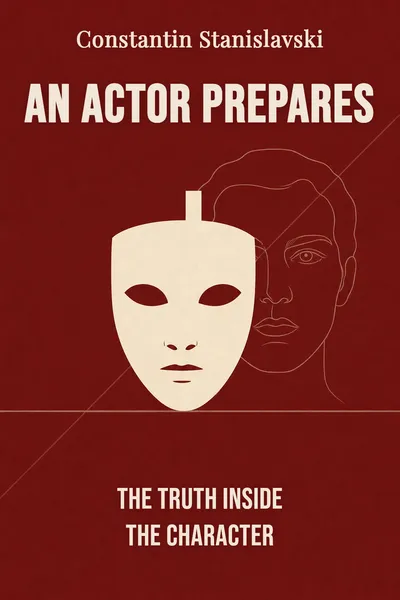
An Actor Prepares
The truth inside the character
Description
A young man named Kostya walks into his first day of drama school certain he already knows what acting is. He has seen great performers, he has felt the pull of the stage, and he assumes talent will carry him. Then his teacher, a quiet, watchful man called Tortsov, hands the class their first assignment — a short scene, no rules, just play it — and Kostya discovers something humiliating. The moment he steps in front of the others, his hands turn to lead, his voice goes false, and every gesture he makes is a copy of a gesture he once saw someone else make. He is not living. He is imitating living. That gap, between doing and pretending, is where Constantin Stanislavski begins.
Stanislavski built the Moscow Art Theatre and spent decades chasing one question: why is one performance dead and another alive, when the words are identical? He noticed that inspiration could not be ordered up on demand, that the best actors seemed to vanish inside their roles while the worst merely displayed emotions like items on a shelf. So instead of teaching results, he tried to reverse-engineer the process — to find the deliberate, trainable inner steps that make truthful feeling possible night after night, on cue, under a thousand watching eyes.
He wrote it as a diary rather than a manual. We follow Kostya through a year of lessons, watching him fail, resist, and slowly understand, because Stanislavski knew a doctrine explained from a lectern would land as theory, while a student's confusion would land as recognition. What emerges is less a set of tricks than a whole way of relating to one's own attention, memory, and imagination.
The question we’re asking : How does an actor produce real feeling on command, instead of merely showing the outward signs of it?What we’ll see : A student's year of lessons, from the first failed scene to the quiet machinery of attention, memory and imagination that makes a role come alive.
Table of contents
01Chapter 1 — A student who wanted to feel, not pretend
Kostya's first test scene is a disaster, and Tortsov's diagnosis is worse than the failure itself. The problem, he explains, is not nerves or inexperience. It is that Kostya was performing acting rather than doing anything. He had reached, instinctively, for the clichés of the stage — the noble pose, the trembling hand, the voice pitched for effect — because those were the visible signs of emotion he had stored up from watching others. Stanislavski calls this mechanical acting, and he is merciless about it. It is the actor showing the audience a rubber stamp of grief instead of grieving.
Against this, Tortsov sets a different ideal, which he names the art of living the part. The living actor does not demonstrate an emotion from the outside; he experiences something real, here and now, so that the feeling generates the gesture rather than the gesture faking the feeling. The distinction sounds simple until we try to obey it, and the whole book is really the story of how hard it is. Kostya keeps sliding back toward display, because display is easier and it flatters the ego. It looks like acting.

02Chapter 2 — The inner work before the first line
The early lessons never touch the emotions directly. Tortsov starts somewhere that seems almost trivial: attention. On stage, Kostya finds his mind splintered, half of it monitoring the audience, wondering how he looks, whether he is doing well. This self-watching is the enemy. It keeps the actor outside his own experience, forever a spectator of himself. So the students learn to build what Stanislavski calls circles of attention — to narrow their focus onto a single object, a small pool of the stage, and genuinely occupy it, until the vast dark auditorium stops existing.
This is harder than it sounds, and Stanislavski borrows an idea he sums up as public solitude: the trick of being fully alone with something even while hundreds watch. The actor who truly examines the object in his hands, who really listens to the person across from him, stops performing for the crowd because there is no attention left over to spend on them. Concentration, in this system, is not a preliminary nicety. It is the load-bearing wall.
03Chapter 3 — Emotion you can summon on command
Eventually the class arrives at the question that had haunted Kostya from the first scene: how do you actually feel something real, on schedule? Stanislavski's answer is one of the book's most influential and most argued-over ideas, and he calls it emotion memory. Every one of us carries a vast archive of past feelings — the fear from a childhood accident, a grief, a flush of joy — stored with the sensory details that surrounded them. The actor learns to reach back into that archive and reawaken a feeling that resembles the one the scene requires.
The mechanism, Tortsov insists, is not to chase the emotion head-on, because feelings flee when hunted. Instead the actor recalls the concrete circumstances — the light in the room, the smell, the small physical details — and the feeling arrives in their wake, quietly, like a scent triggering a memory. What appears on stage is not the original grief but a new, kindred emotion, close enough to be true and safe enough to repeat. This is why the same actor can weep truthfully at the same moment for two hundred nights: he is not faking, and he is not reliving trauma, but drawing on a renewable inner source.
04Chapter 4 — The self that never leaves the stage
Step back from the exercises and Stanislavski is circling something larger than theatre. His deepest claim is that you cannot install a character from the outside; you can only grow one out of your own living material. The actor never becomes someone else. He rearranges pieces of himself — his memories, his attention, his imagination — into a new configuration that behaves like another person. Every role, in the end, is played with the only instrument anyone has, which is the self. There is no borrowed soul available.
This is why the diary form matters so much, and why the book endures far beyond acting schools. What Kostya is really learning is a discipline of authenticity under pressure — how to be genuinely present and genuinely feeling in a situation that is, by definition, artificial and watched. That is not a problem unique to actors. It is the problem of anyone who has to be believably themselves while performing a role: in an interview, at a bedside, in front of a class, holding it together at a funeral. The magic if, the objective, the circle of attention — these are tools for occupying a false situation truthfully.
05Conclusion
By the end of the year, Kostya is no longer the young man who mistook a striking pose for acting. He has stopped asking how to look convincing and started asking what he is truly doing, wanting, and attending to in each moment. The failed first scene has become the measure of how far the work reaches: everything visible on stage now rests on invisible machinery — concentration, relaxation, the magic if, emotion memory, a chain of objectives climbing toward one desire. The performance is the tip; the preparation is the whole body of it.
Related books