
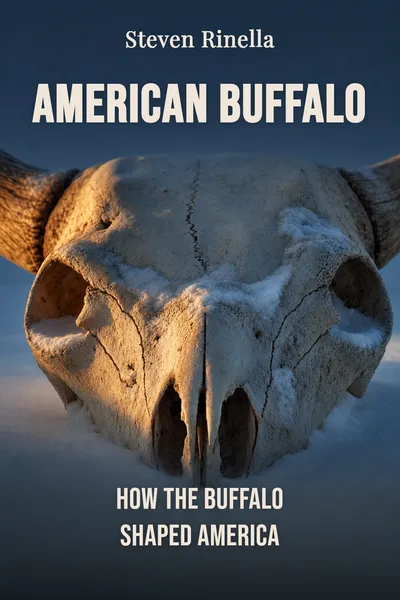
American Buffalo
How the buffalo shaped America
Description
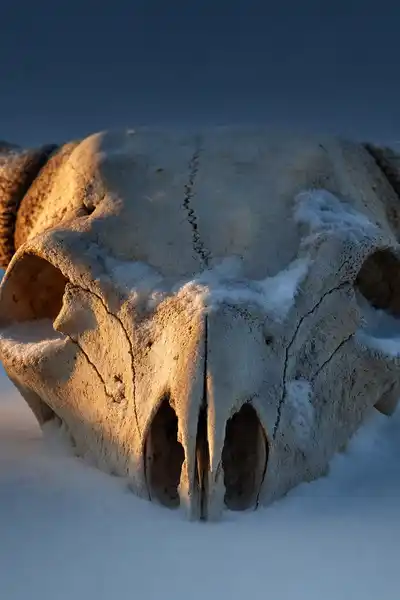
In the fall of 2005, Steven Rinella drew one of a handful of permits to hunt a wild buffalo in Alaska's Copper River basin. He had grown up obsessed with the animal — as a boy in Michigan he kept a buffalo skull he had found, read everything about the great hunts, treated the bison as something closer to a personal saint than a game animal. The permit was a long shot he never expected to win. When the letter came, he had to figure out how to walk into one of the last places on the continent where the thing he had idolized still lived wild, and kill one.
The hunt that follows in his book "American Buffalo" is not a clean trophy story. Rinella spends days in brutal terrain, second-guessing himself, hauling hundreds of pounds of meat across a frozen landscape, half-reverent and half-sick about what he is doing. But the hunt is really a frame. Around it he wraps the whole strange biography of the species: an animal that once moved across North America in herds so large they stopped trains and reshaped rivers, then collapsed within a single human lifetime to a few hundred survivors, then crawled back from the edge.
Rinella refuses the easy version of any of it — the noble-savage version, the greedy-white-hunter version, the pure-conservationist version. He wants the buffalo as it actually was: food, currency, religion, target, and finally a symbol so loaded that Americans put it on their coins while they were still finishing it off. The animal he hunts in Alaska is the descendant of that whole tangled story, and carrying its meat out of the snow becomes his way of asking what, exactly, he is part of.
The question we’re asking : Why did Americans nearly wipe out the animal they most admired, and what does it mean to want it back?What we’ll see : A modern hunt opens onto the long life of the buffalo — what it gave a continent, how fast it fell, and what its survival asks of us now.
Table of contents
01Chapter 1 — A skull in Montana and a tag in his pocket
Rinella's entry into the subject is not a thesis but a fixation. As a kid he found a buffalo skull and treated it like a relic. The animal sat in his imagination as the emblem of an America that existed before he did — wilder, bigger, more honest about the violence underneath its food. So when he wins a permit to hunt a genuinely wild bison in Alaska, the lottery feels less like luck than like a summons. He is being asked to put his hands on the thing he has worshipped from a distance his whole life.
The hunt itself is miserable in the way real hunting usually is. Rinella and a friend fly in, then slog through snow and tangled country with packs that get heavier as the days go. He finds a bull, takes the shot, and then confronts the part the romance never mentions: a dead animal the size of a small car, in the backcountry, that has to be turned into meat and carried out on human backs over many trips. He is exhausted, bloody, elated, and a little ashamed all at once.

02Chapter 2 — The animal that built a continent
Before the collapse, the buffalo was not just present in North America — it was, in a real sense, the engine of the place. Rinella reconstructs a continent shaped by the herds. Estimates run as high as thirty to sixty million animals moving across the grasslands, grazing and trampling and fertilizing on a scale that maintained the prairie ecosystem itself. The plains were not a backdrop the buffalo lived in. The plains were, in part, something the buffalo made.
For the Native peoples of the Great Plains, the animal was closer to an entire economy than to a food source. Rinella details how nearly every part was used: meat dried into provisions, hides for shelter and clothing, sinew for thread, bones for tools, horns for cups, even the stomach as a cooking vessel. Whole cultures organized their movement, their seasons, and their spiritual life around the herds. To call the buffalo important to these peoples understates it; it was the material basis of their world.
03Chapter 3 — Sixty million to a few hundred
The collapse came fast — within roughly two decades after the Civil War. Rinella resists pinning it on a single cause, because the truth is uglier and more tangled. The spread of railroads cut the herds and carried hunters and hides. A market opened for buffalo leather, useful for industrial belting back east, and suddenly a buffalo was worth money dead. Professional hide hunters arrived with powerful rifles and killed in numbers that read today like a kind of madness.
Layered onto the market was policy, sometimes explicit. Eliminating the buffalo was understood by some military and political figures as a way to break the Plains tribes who depended on it — starve the herds, starve the resistance. Rinella does not present this as a tidy conspiracy, but he does not let it off the hook either. Economic appetite and the desire to clear the West for settlement and cattle pointed in the same direction, and the animal was caught between them.
04Chapter 4 — What we owe the thing we almost erased
Step back from the snow and the bone fields, and the buffalo becomes a mirror for the whole American relationship to wild things. Rinella's deeper argument is that destruction and reverence in this story were never separate camps. The same culture that nearly erased the animal put it on the nickel and the state seals. People mourned it while they shot it. The buffalo did not fall to indifference; it fell to a kind of consuming love that could not stop itself in time.
That is why Rinella insists on staying inside the contradiction rather than resolving it. He hunts the animal he reveres because, to him, hunting is the most honest form of that love — it refuses the comfort of buying meat at a distance and pretending no animal died. His point is not that everyone should hunt, but that the clean separation between people who use nature and people who protect it is mostly a fiction we tell to feel innocent. The hide hunter and the conservationist were often, historically, the same man at different stages.
05Conclusion
The book ends where it began, with Rinella hauling meat across frozen ground, his own small reckoning standing in for a much larger one. The buffalo he carries out is descended from the few hundred animals that slipped through the slaughter, raised back into the millions only as a managed, fenced presence on a continent it once ran free across. He does not pretend the hunt redeems any of that history. He simply refuses to look away from his own place in it.