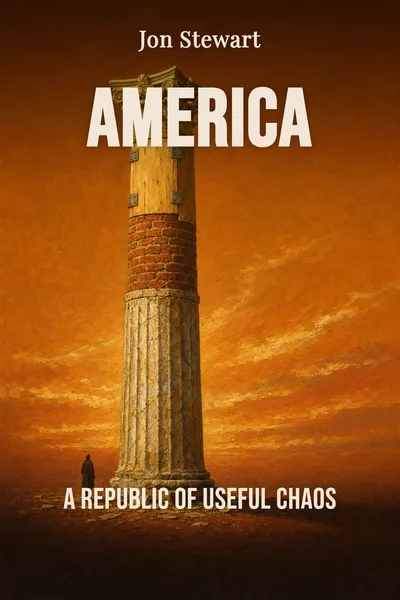
America
A republic of useful chaos
Description
In 2004, at the height of an election year, the team behind The Daily Show published a fat hardcover called America (The Book), subtitled A Citizen's Guide to Democracy Inaction. It looked exactly like the civics textbook we all half-remember from ninth grade — glossy spreads, discussion questions, timelines, a self-important preface. Except the preface was fake, the timelines were rigged, and the discussion questions were traps. Jon Stewart and his writers had built a working parody of the one book every American is supposed to have absorbed and almost nobody actually reads.
The joke, though, has a straight face underneath it. The book walks through the machinery of the republic — ancient precedents, the founding, the three branches, the electoral process, the press — and takes each one seriously enough to mock it accurately. You can't parody a system you don't understand, and the running argument of the whole thing is that the system was never as dignified, as settled, or as rational as the marble buildings imply. It was assembled by argumentative people, patched repeatedly, and it runs, to this day, on a kind of productive disorder.
That is the wager worth sitting with. A comedy book about democracy is making a claim about democracy: that the chaos isn't a malfunction we should be embarrassed by, but something closer to the operating principle. The gap between how the republic presents itself and how it actually behaves is where the jokes live — and, the book suggests, where the thing has always actually worked.
The question we’re asking : If American democracy is this messy, disputatious and self-contradicting, is the mess a failure of the design — or the design itself?What we’ll see : How a fake civics textbook uses the founders, the ancients and the modern press to argue that the republic runs on useful chaos.
Table of contents
01Chapter 1 — The textbook that refuses to sit still
The first thing to understand about America is the disguise. It commits, page after page, to the visual grammar of a high-school textbook: the two-column layout, the earnest photo captions, the little sidebar boxes, the chapter-ending review sections. This is not decoration. The form is the argument. By mimicking the object that is supposed to hand us democracy pre-digested and pre-approved, the book gets to expose how much that object leaves out, smooths over, and quietly lies about.
The method works because it never breaks character to explain the joke. A real textbook would tell us the Constitution was a triumph of enlightened reason; this one tells us the same thing in the same tone, then loads the surrounding material with enough contradiction that the reader does the deflating themselves. The discussion questions at the end of each chapter are the sharpest tool — earnest-sounding prompts that, read closely, are absurd, insulting, or impossible to answer, which is roughly the experience of actually thinking hard about civics.

02Chapter 2 — Democracy, invented by people who didn't much like each other
Before it gets to America, the book takes a detour through the ancients, because the joke needs a straight man and history obliges. Athens gets treated as the birthplace of direct democracy — and then quickly undercut, because Athenian democracy excluded women, enslaved people and most of the population, which is to say it was democracy for a small club that called itself everyone. The book lingers on this not to score an easy point but to establish a pattern it will follow all the way to the present: the ideals and the practice were never in the same room.
Rome does the heavier lifting, and it is Rome the founders actually admired. The book plays the republican inheritance for both awe and comedy — the senate, the balance of powers, the deep suspicion of any one person accumulating too much, the elaborate machinery built specifically because Romans assumed everyone in charge would try to grab more than their share. That assumption is the useful one. The Roman republic was engineered around distrust, on the theory that ambition could be set against ambition until it cancelled out into something like governance.
03Chapter 3 — The founders as a very human mess
When the book arrives at the American founding, it does the thing that makes the whole project land: it treats the founders as people rather than as faces on currency. The men who wrote the documents were brilliant, vain, hypocritical, frequently broke, and constantly at each other's throats. The book leans into the pettiness — the feuds, the pamphlet wars, the deals cut in back rooms, the sheer amount of the founding that came down to compromise between men who could not stand one another.
The Constitution, in this reading, is not a clean act of genius but a treaty among rivals. The book keeps pointing at the seams: the compromises over representation, the arithmetic that counted enslaved people as fractions of a person for the purpose of allocating power, the deliberate ambiguities left in because agreement was impossible and vagueness was the only way to get everyone to sign. What later generations enshrined as sacred scripture was, at the moment of creation, a document written by committee, hedged and fudged and passed because it was the best deal available.
04Chapter 4 — The media as the nervous system of the whole thing
The book saves its most personal chapter for the press, and no wonder — Stewart and his writers spent their working lives watching cable news up close. The portrait is not flattering. The modern media, in the book's account, has drifted from informing citizens to filling airtime, from reporting events to staging conflict, from checking power to performing the appearance of checking power. The twenty-four-hour cycle demands content whether or not anything has happened, and so it manufactures the sensation of news out of speculation, punditry and manufactured outrage.
But the book's step back is sharper than mere complaint. It positions the press as the nervous system of the republic — the thing that carries signal between the governed and the governing — and then asks what happens when that nervous system starts optimizing for stimulation over accuracy. A democracy runs on information the way a body runs on nerves. If the signal is noise, the whole organism twitches at phantoms and misses real pain. The chaos that was productive in the founding, in the ancient balance of ambitions, turns corrosive here, because a citizenry can only argue well about a shared reality it can actually see.
05Conclusion
The book ends the way it began, in the costume of the textbook it is impersonating — a final exam, a glossary, the exhausted institutional cheer of a volume trying to send its readers off as informed citizens. The disguise holds to the last page. But by then the reader has been walked through the ancients, the founding and the press and shown the same thing each time: a republic that was never dignified, never settled, never run by people who agreed. It was built by rivals, for rivals, out of compromise and distrust, and it has lurched forward on that friction ever since.
Related books