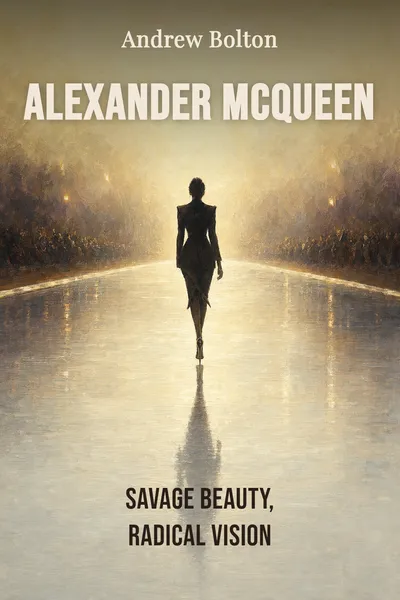
Alexander McQueen
Savage beauty, radical vision
Description
In March 1992, a graduate collection at Central Saint Martins in London caught the eye of Isabella Blow, a stylist with a famous nose for talent. The clothes were dark, sharp, and built around a theme the school found unsettling: the murders attributed to Jack the Ripper, told partly through the women he killed. Blow bought the entire collection, reportedly in instalments. The designer was a twenty-two-year-old from the East End named Lee Alexander McQueen, the son of a taxi driver, trained not in art-school theory but in the practical trade of cutting cloth.
Within a decade that same young cutter was running one of the most talked-about houses in fashion, designing for Givenchy in Paris, and turning runway shows into events people argued about for weeks. Models walked through rain, fire, simulated snowstorms and a glass box swarming with moths. Some viewers were thrilled. Some were appalled. Almost nobody was indifferent. By the time McQueen died in February 2010, at forty, he had built a body of work that the Metropolitan Museum of Art would treat the way it treats painting.
That museum treatment is the occasion here. Andrew Bolton, the curator behind the Met's landmark retrospective, lays out the full arc of the career and asks what held it together — how a man steeped in the discipline of Savile Row tailoring became the designer who could make a catwalk feel like an art installation, and why the clothes still feel charged years later. The answer is not about shock for its own sake.
The question we’re asking : How did a working-class tailor turn the fashion show into a stage for ideas, and what was he actually trying to say?What we’ll see : From the cutting table to the most extravagant runways in fashion, the craft and the provocations that made McQueen impossible to ignore.
Table of contents
01Chapter 1 — The cutter from Savile Row
Before the moths and the fire, there was the seam. McQueen left school at sixteen and took an apprenticeship at Anderson & Sheppard, one of the old Savile Row tailoring houses, then moved to Gieves & Hawkes and on to the theatrical costumiers Angels. This is an unusual education for a fashion designer. Most arrive through art schools and mood boards; McQueen arrived through the disciplined, almost surgical craft of building a man's jacket by hand. He learned where a sleeve should sit, how a shoulder is constructed, how cloth behaves when it is forced into a precise shape. That knowledge never left him.
Bolton's argument is that this technical grounding is the secret engine of everything that came later. The infamous "bumster" trousers, cut shockingly low at the back, were not just provocation — they were a tailor's joke about proportion, a deliberate redrawing of where the human silhouette begins. When McQueen later worked with the codes of haute couture in Paris, he treated its specialized techniques the same way he treated tailoring: as a vocabulary to be mastered first, then bent. He could do the orthodox version flawlessly, which is precisely what gave him the authority to break it.

02Chapter 2 — The runway as theatre
For most houses, the fashion show is a sales mechanism: clothes walk, buyers watch, orders follow. McQueen treated the show as a form in its own right, closer to performance art or avant-garde installation than to a sales presentation. The clothes mattered enormously, but they lived inside a staged world that told a story, and that story often did the emotional heavy lifting.
The examples became legend. In one show a model stood on a turntable in a plain white dress while two industrial robots, the kind used on car assembly lines, sprayed her with black and yellow paint as she shielded herself. In another, a hologram of Kate Moss appeared to float and dissolve inside a glass pyramid, summoned and then gone. There were shows staged in the rain, behind a wall of glass, on a chessboard, inside a circle of fire. The environments were not decoration; they framed how the clothes were meant to be read.
03Chapter 3 — Beauty that refuses to be pretty
The retrospective took its title from a phrase McQueen liked: savage beauty. The pairing is the key to the whole sensibility. He was not interested in the pretty, the flattering, the merely tasteful. He wanted beauty that carried an edge of danger, decay, or wildness — beauty that unsettled even as it seduced. A dress could be exquisite and frightening at once, and for McQueen that tension was the point, not a problem to be smoothed away.
You can see the idea worked out in the materials and motifs. He returned again and again to the natural world, but not its gentle side: predators, skeletons, feathers, shells, antlers, the imagery of the hunt. Skulls became almost a signature. He drew on the Romantic tradition, on Gothic imagery, on Scottish history and his own Highland ancestry, and on a fascination with the relationship between the human and the animal, the living and the dead. The clothes asked the wearer to inhabit something larger and stranger than themselves.
04Chapter 4 — What a McQueen show was really arguing
Step back from any single garment and a larger ambition comes into view. McQueen used fashion as a medium for ideas — about race, class, sexuality, religion, and increasingly the environment — in a way the industry had rarely seen. The runway was his place to think out loud, and the subjects he chose were not the usual fare of glamour.
Class ran through everything, partly because it was his own story. The taxi driver's son who learned to cut suits for the rich never lost his awareness of the gap between the East End and the salons of Mayfair, and his work kept staging encounters between high craft and the raw, the broken, the working body. His Highland collections returned to the violence of Scottish history and the way England had treated the Scots, turning a personal heritage into a statement about power and dispossession. Other shows engaged with colonial history, with religious iconography, with gender and the male and female body, refusing to present any of them as settled or safe.
05Conclusion
The young cutter Isabella Blow spotted in 1992 became, by common consent, the most imaginative and provocative designer of his generation. The path ran from the apprentice benches of Savile Row, through the rigour of Paris couture, to runways that swarmed with moths and burned with fire — and the through-line was always there. The craft made the visions possible; the visions gave the craft a reason to exist. Beauty, for McQueen, was never meant to reassure.
Related books