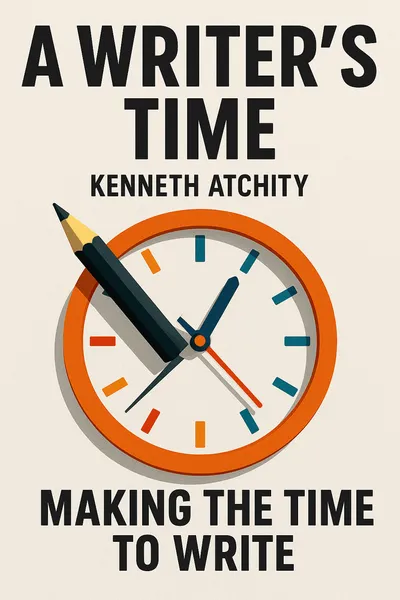
A Writer's Time
Making the Time to Write
Description
Kenneth Atchity presents a comprehensive examination of temporal organization within creative practice, drawing upon his dual expertise in classical literary theory and contemporary publishing industry dynamics. This work emerges from a growing need to address the perceived contradiction between artistic spontaneity and systematic productivity, particularly within an increasingly commercialized literary landscape that demands both quality and efficiency from professional writers.
The central research question examined is: How can writers reconcile the inherently unpredictable nature of creative work with the systematic time management required for sustainable professional practice? Atchity's defended thesis argues that effective writing productivity emerges through structured temporal frameworks that accommodate rather than suppress creative incubation processes. The main stake of this work involves demonstrating that disciplined time management enhances rather than constrains artistic creativity.
Ateity constructs a coherent framework demonstrating that effective time management for writers requires integrating systematic organizational approaches with respect for the distinctive characteristics of creative work. His argument successfully bridges theoretical understanding of creativity with practical implementation strategies, offering a nuanced alternative to both purely romantic and purely mechanistic approaches to writing practice. The work's intellectual contribution lies in its systematic examination of temporal dimensions in creative labor, providing empirically grounded strategies while acknowledging the irreducible complexities of artistic production.
Table of contents
01The Temporality of Creative Labor
Atchity's conceptual framework fundamentally challenges the romantic notion of artistic creation as purely spontaneous inspiration. His analysis reveals how creative work operates within specific temporal rhythms that can be systematically understood and optimized. The author employs organizational psychology principles to demonstrate that creative incubation requires structured periods of both focused engagement and deliberate disengagement.

02Systematic Approaches to Creative Productivity
The examination of systematic methodologies reveals Atchity's attempt to establish writing as a legitimate professional practice requiring specific managerial competencies. His analysis of goal-setting, project planning, and habit formation positions creative work within broader frameworks of professional development and career management. This approach significantly impacts traditional conceptions of authorship by emphasizing the writer's role as both artist and entrepreneur.
03Environmental and Spatial Dimensions of Creative Practice
Atchity's exploration of creative environments reveals underlying tensions between the individual writer's needs and external social demands. His analysis of workspace optimization, distraction management, and environmental design exposes how creative work intersects with broader socioeconomic conditions affecting intellectual labor. The emphasis on dedicated creative spaces reflects contemporary concerns about work-life boundaries in an era of increasing professional flexibility and home-based work arrangements.
04Sustainability and the Ethics of Creative Production
The focus on long-term sustainability introduces ethical dimensions regarding the commodification of creative practice and its impact on artistic integrity. Atchity's emphasis on work-life balance and stress management reflects broader concerns about the psychological costs of treating creativity as industrial production. His approach to motivation and resilience reveals tensions between personal artistic fulfillment and market-driven productivity demands.
05Critical Analysis and Future Directions
The work's limitations emerge primarily from its individualistic focus, which inadequately addresses structural inequalities affecting writers' access to time and resources. Atchity's framework assumes a level of professional autonomy that may not reflect the economic realities facing many contemporary writers. The analysis lacks sufficient attention to how gender, class, and racial factors influence both time availability and creative practice conditions. Additionally, the emphasis on productivity optimization risks reinforcing market-driven conceptions of literary value that may compromise artistic exploration and experimentation.
Related books