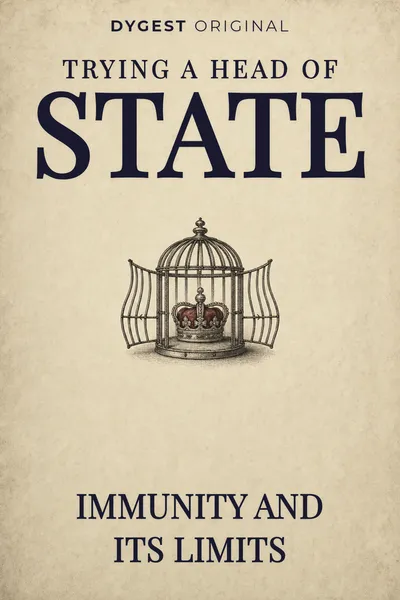
Trying a Head of State
Immunity and its limits
Description
On September 2, 1998, a courtroom in Arusha, a Tanzanian town at the foot of Mount Meru, handed down a sentence that had no real precedent. Jean Kambanda, who had served as prime minister of Rwanda during the 1994 genocide, became the first head of government anywhere to be convicted of genocide by an international court. He had pleaded guilty. He was sentenced to life. For most of recorded history, a man in his former position would have been untouchable — not because his acts were smaller, but because the office he held was supposed to place him beyond the reach of any judge.
That intuition runs deep. The person who writes the laws, commands the army, and appoints the judges is, almost by definition, the hardest person in a country to put in a dock. Sovereign power and the power to prosecute tend to sit in the same set of hands. For centuries the arrangement was treated not as a loophole but as a principle: a ruler could not be tried by the institutions he himself embodied. The sovereign was the source of law, and the source of law could not be its defendant.
And yet leaders do end up on trial — former presidents, sitting prime ministers, dictators pulled from spider holes and palaces. The arrangement that once looked absolute has been chipped at from several directions, by domestic courts, by revolutions, and by a set of tribunals built explicitly to reach the people national law was too weak or too complicit to touch. How that happened, and what it still cannot do, is a story about the exact shape of a protection most of us assume is simply there.
The question we’re asking : When power and the courts belong to the same hands, how does anyone ever manage to try the person at the top?What we’ll see : How the ancient shield around rulers was built, where it cracked, and the long effort to place someone to judge them above the state itself.
Table of contents
01 Chapter 1 — The king who could do no wrong
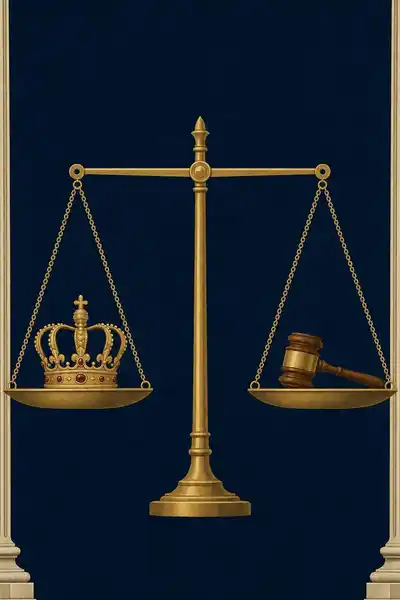
The oldest version of the rule is the bluntest. In English common law it was stated as a maxim: the king can do no wrong. This did not mean monarchs were saintly. It meant that the monarch was the fountain of justice, the person in whose name every court sat, and that no court could therefore summon him as a defendant. To try the king you would have needed a higher authority than the king, and in a monarchy there was, by design, none.
The idea long outlived kings. When monarchies gave way to republics, the protection migrated into the doctrine of sovereign immunity and, later, into the immunities attached to high office. A sitting head of state carries a functional shield: for the acts of the office, the office answers, not the person. The reasoning is partly practical. A president who could be sued or charged at will, by anyone, would be paralyzed — dragged into courts by rivals, foreign and domestic, the moment a decision displeased someone.

02 Chapter 2 — The crack in the shield
The first crack came from inside. If no higher power existed to try a sovereign, a people could manufacture one — by removing him first. In January 1649, the English Parliament did exactly that, putting Charles I on trial before a specially created High Court of Justice. Charles refused to plead, on impeccably traditional grounds: no court in the land had authority over the man from whom all courts drew their authority. He was logically correct and politically doomed. He was convicted and beheaded, and the event announced something new — that a ruler's immunity could be voided by declaring him no longer the ruler.
That template recurs. Louis XVI was tried by the National Convention in 1792 and executed the following year. Revolutions and coups strip the office away, and a former office-holder is just a person, exposed like anyone else. This is the crudest route to accountability and also the least lawful: it works by overthrow, not by procedure, and the court that follows is usually the court of the winners.
03 Chapter 3 — From Nuremberg to The Hague
The idea that someone above the nation could judge its leaders is young. Its founding moment was Nuremberg, where from 1945 the Allied powers tried senior figures of the Nazi regime. The tribunal's charter rejected, head-on, the oldest defences. Acting in an official capacity was no longer a shield, and following superior orders was no longer an excuse. The principle established was that individuals — not just abstract states — could be held criminally responsible for aggression, war crimes, and crimes against humanity.
Nuremberg was victors' justice, and its critics said so at the time. But it planted a concept that outgrew its origins: certain acts are so grave that the authority to punish them cannot be left solely to the state that committed them. Decades later, that concept was revived in response to the atrocities in the former Yugoslavia and in Rwanda. The United Nations created two ad hoc tribunals in the early 1990s, and it was one of them that convicted Jean Kambanda in Arusha. The other, in The Hague, indicted Slobodan Milosevic, the first sitting head of state charged by an international court; he died in 2006 before a verdict.
04 Chapter 4 — Jurisdiction has to live somewhere
Step back from the individual trials and a single tension organizes all of them: the authority to judge a head of state has to live somewhere, and every candidate location is compromised. Inside the state, the leader controls the courts. Above the state, the international body has the mandate but not the muscle. The whole history of trying rulers is the history of trying to park this authority in a place where it is neither captured nor powerless — and never quite finding one.
Sovereignty is not a bug in this story; it is the thing being argued with. The international order is built on sovereign equality, the same principle that produced immunity in the first place. A permanent court that overrides a leader's protection is, in effect, asking sovereign states to agree to a power above their own sovereignty. Many sign. Several of the most powerful — the United States, China, Russia — have not accepted the Court's jurisdiction, which means the very leaders most able to commit mass crimes are often the least reachable. The reach of international justice maps, uncomfortably, onto the weakness of the accused.
05 Conclusion
The sentence handed down in Arusha in 1998 closed a loop that had been open since the days of the king who could do no wrong. For the first time, a man who had stood at the summit of a state was held personally answerable, by a court above that state, for what he had done from the top. It did not happen because the old logic of immunity was wrong — that logic still protects leaders every day — but because a narrow, hard-won exception had finally been carved into it for the gravest crimes.
Related books