The Bystander Effect
Why crowds fail to intervene
Description
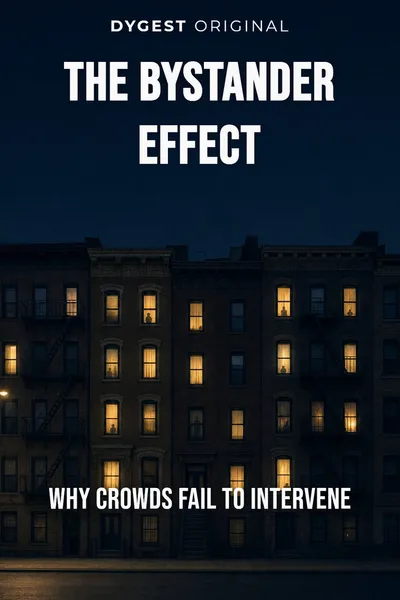
On the night of March 13, 1964, a twenty-eight-year-old woman named Kitty Genovese was attacked and killed near her apartment in the Kew Gardens neighborhood of Queens, New York. Two weeks later, the New York Times ran a story claiming that thirty-eight respectable, law-abiding citizens had watched the attack from their windows and done nothing — not one of them so much as phoning the police until it was over. The number, the neighbors, the silence: it landed like an indictment of an entire city, and then of modern life itself. How could so many people watch someone die and simply turn away?
Much of that famous account has since fallen apart. Later reporting showed the thirty-eight figure was inflated, that several people did hear something without understanding what it was, and that at least one neighbor did call. The tidy morality tale was messier than the headline. But the story had already done something the facts couldn't undo: it sent two young social psychologists, John Darley and Bibb Latané, into the lab to ask a question the newspaper had answered too quickly. What if the neighbors stayed silent not despite the crowd, but because of it?
That reframing turned an urban horror story into one of the most studied findings in social psychology. It suggested that the failure to help wasn't a symptom of cold hearts or a callous era. It was closer to a structural effect — something that happens to ordinary, decent people when they find themselves in a particular kind of situation. And once we see how the mechanism works, the usual explanations we reach for start to look like the wrong ones.
The question we’re asking : Why do people who would help without hesitation on their own do nothing at all when they're part of a crowd?What we’ll see : How a misremembered murder became a laboratory question, what the experiments actually measured, and what the answer says about responsibility itself.
Table of contents
01 Chapter 1 — A murder that started a science
Darley and Latané met at a New York dinner party not long after the Genovese killing, when everyone at the table was still trading theories about the thirty-eight witnesses. The explanations on offer were the familiar ones: city people are alienated, television has numbed us, human nature is uglier than we like to admit. The two psychologists found all of this unsatisfying — not wrong, exactly, but untestable. Alienation and cruelty are traits you attribute after the fact. They wanted to know whether the situation itself was doing the work.
So they built a scenario that stripped away everything except the presence of other people. In their best-known study, published in 1968, they brought subjects into a room to fill out questionnaires and then piped smoke in through a vent. When a subject sat alone, most reported the smoke within minutes. When they sat with two other people who were secretly instructed to ignore it, the great majority said nothing at all — some sat there filling out forms as the room filled with haze. The crowd didn't just slow them down. It rewrote what they thought was happening.

02 Chapter 2 — The number that changes everyone
The core of the finding has a clean, almost mathematical shape. When you are the only person who could help, all of the responsibility rests on you. There is no ambiguity about whose job it is. But add other capable people to the scene, and that responsibility doesn't multiply — it divides. With ten witnesses, each carries a fraction of the obligation, and the fraction can feel small enough to slip out from under. Darley and Latané called this diffusion of responsibility, and it turned out to be one of the most reliable effects in the field.
The mechanism isn't laziness, and it usually isn't conscious. What people report afterward is a genuine confusion about their role. Someone else is surely better placed, or already handling it, or would look foolish if they overreacted and it turned out to be nothing. Each of these thoughts is reasonable on its own. Stacked together, in a crowd, they add up to a room full of people all privately reasoning their way into inaction, each waiting for a signal that never comes.
03 Chapter 3 — Why the crowd freezes
It helps to slow down and watch what actually happens inside a person in those seconds, because the bystander effect is less a decision than a sequence of small failures. Latané and Darley mapped it as a chain: to help, we first have to notice something is happening, then interpret it as an emergency, then decide it's our responsibility, then figure out what to do, and finally act. Drop out at any link and no help follows. A crowd puts pressure on almost every link at once.
Noticing is easy to miss when we're absorbed in our own business, and cities train us to be absorbed. Interpreting is where pluralistic ignorance bites — we glance around, see composed faces, and downgrade the alarm. Assuming responsibility is where diffusion does its damage. And even someone who clears all of those hurdles can freeze at the last two: not knowing whether to call, or push in, or shout, and fearing the social cost of being the one who made a scene over nothing.
04 Chapter 4 — What responsibility actually is
Step back from the smoke-filled rooms and the intercom seizures, and the bystander effect says something larger than "crowds are bad in emergencies." It suggests that responsibility is not mainly a property of people. We tend to think of it as a trait — some are responsible, others aren't — and to judge the Kew Gardens neighbors accordingly. The experiments quietly dismantle that view. The same person who freezes in a crowd will act instantly when alone. What changed wasn't their character. It was how the situation assigned the obligation.
This is the part that unsettles, because it strips away the comfortable distance between us and those thirty-eight windows. Most of us assume we would have run downstairs, called the police, done something. The research suggests that confidence is misplaced — not because we're worse than we think, but because responsibility, left undivided among a crowd, tends to evaporate for everyone at once. Decency isn't enough. The situation has to hand the job to someone in particular, or nobody feels it as theirs.
05 Conclusion
The version of the Genovese story that shocked New York in 1964 turned out to be partly a legend — the numbers wrong, the silence exaggerated, the tidy verdict unearned. But the question it accidentally raised outlived its own inaccuracies. Darley and Latané took a headline about thirty-eight cold-hearted neighbors and turned it into a mechanism anyone can be caught inside: the more of us there are, the more each of us assumes someone else will act, until the obligation belongs to no one.
Related books