The Brain
An organ built by evolution
Description
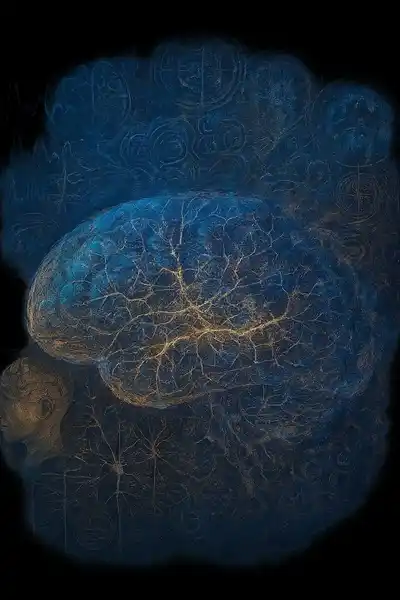
There is a moment, usually somewhere in a hospital corridor or a late documentary, when we look at a photograph of a human brain and feel a small letdown. It weighs about 1.4 kilograms. It has the color and consistency of firm tofu. It sits in the skull looking less like a supercomputer than like something you would find washed up on a beach. And yet this pale, folded object writes symphonies, holds grudges for decades, and is currently reading this sentence and deciding, quietly, whether it agrees.
The strangeness deepens once we stop treating the brain as a single thing. It is not one machine but a stack of them, added over hundreds of millions of years, none of the old parts ever quite thrown out. The structures that keep the heart beating are far older than the ones that do arithmetic, and they share the same three pounds of tissue without much of a chain of command. Evolution does not design; it tinkers with what it already has, and the brain is its most elaborate piece of tinkering — a device assembled from spare parts that happens, most of the time, to hold together as a person.
Because it was built this way, the brain resists the tidy diagrams we like to draw of it. We inherited a folklore of neat halves, hidden reserves and animal instincts lurking below the civilized surface — most of it wrong, all of it stubborn. Before we can talk about what the organ actually does, we have to walk through what it is made of, floor by floor, and see how little of it matches the story we tell about ourselves.
The question we’re asking : What is the brain actually made of, and why does the real map contradict almost everything we think we know about it?What we’ll see : A tour up through the organ's evolutionary floors, and a reckoning with the tidy stories that survive despite the anatomy.
Table of contents
01 Chapter 1 — The oldest parts run the show
Start at the bottom, where the spinal cord swells into the skull. This is the brainstem, and it is the oldest neighborhood in the building. It handles the things we never think about because thinking about them was never the point: breathing, heart rate, blood pressure, the swallow reflex, the shift between sleep and waking. Damage here is rarely survivable, which is the anatomy's blunt way of saying this is the part that keeps us alive. It looks almost identical in a human and in a lizard, because in a real sense it is the same equipment, conserved across an enormous stretch of evolutionary time.
Perched behind the brainstem is the cerebellum, the "little brain," a densely folded lump that holds more than half of all the neurons in the entire head despite taking up a fraction of the space. For a long time we filed it under movement — balance, coordination, the smoothness of a reach for a cup. That job is real. When it fails, walking becomes a drunken negotiation. But the cerebellum turns out to fine-tune more than muscles; it seems to smooth out thought and attention too, quietly correcting our mental aim the way it corrects our physical one.

02 Chapter 2 — The wrinkled sheet on top
Now the part everyone pictures: the cerebral cortex, the deeply grooved outer layer that gives the brain its walnut look. Unfolded, it would spread out to roughly the size of a large dinner napkin, a sheet only a few millimeters thick crammed into the skull by being crumpled. Those wrinkles are not decoration. They are a packing solution — a way to fit an enormous surface area into a limited box, so that more cortex can travel with a head that still has to fit through a birth canal.
The cortex is where the recent, distinctly human capacities live, though "live" is too tidy a word. It is organized into rough regions with rough specialties: an area near the back that processes vision, a strip that handles touch, a band that plans movement, patches devoted to sound and language. Map these carefully enough and you can predict, with surprising accuracy, what a small lesion will disrupt. But the boundaries are fuzzy, the regions cooperate constantly, and the same patch can be recruited for more than one job depending on what the person is doing.
03 Chapter 3 — Nothing works alone
Draw the brain as a set of labeled boxes and you have already misled yourself. The regions are real, but the map's most important feature is the wiring between them. Beneath the folded cortex lies white matter — great cables of insulated fibers connecting distant areas — and the brain's true business happens in the traffic across those cables, not inside any single station. A thought, a memory, a decision is not stored in a place. It is a pattern of activity flickering across a network, gone the instant the activity stops.
This is why the search for the brain's "center" keeps coming up empty. There is no headquarters, no small room where the self sits reading reports from the departments. When we recognize a friend's face, regions handling vision, memory, name-retrieval and emotional tone all light up in near-simultaneous conversation, and the recognition is the conversation. Pull out any one participant and the whole thing degrades in strange, partial ways — people who can see a face perfectly but cannot feel that it belongs to someone they love.
04 Chapter 4 — The map that keeps getting redrawn
An organ assembled by tinkering, running on distributed traffic, was never going to fit the clean stories we prefer. Yet the folklore survives, and it is worth naming what the anatomy actually says. Take the left-brain/right-brain personality split — the logical hemisphere versus the creative one. The hemispheres are genuinely a bit specialized, and language does lean left for most people. But nobody is "left-brained" the way they are left-handed. Both halves are busy for nearly every real task, chattering across the thick bundle of fibers that joins them. The personality version is astrology in a lab coat.
Then there is the claim that we use only ten percent of our brains, that vast reserves sit dark and waiting to be unlocked. Brain scans show activity essentially everywhere, across a full day if not every second, and evolution does not maintain an organ this metabolically expensive — it burns roughly a fifth of our energy — only to leave most of it idle. There is no dormant ninety percent. There is no secret cache of genius one meditation retreat away.
05 Conclusion
Go back to that pale, unimpressive object in the photograph. Its lack of grandeur is exactly the point. It was not designed to be understood; it was assembled, floor by floor, to keep a body alive and then to do a great deal more with the parts left lying around. The brainstem still breathes for us, the cerebellum still steadies our reach, the cortex still takes the credit — and none of them consulted a blueprint, because there wasn't one.
Related books