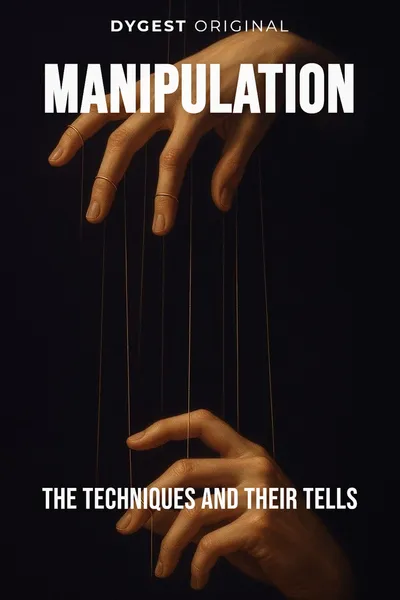
Manipulation
The techniques and their tells
Description
A car salesman shakes your hand, offers you a coffee, walks you through the lot, and by the time you sit down to talk numbers, you already feel like you owe him something. You don't. He knows you don't. He also knows the feeling will do most of his work for him. This small, almost invisible transaction — a favor extended, a debt quietly created — is one of the oldest levers in the influence business, and it operates below the level where we usually think our decisions get made. We tell ourselves we weigh options and choose. Often we don't. We respond.
Robert Cialdini, the psychologist who spent three years in the early 1980s taking sales jobs, going undercover in fundraising offices and telemarketing rooms to watch professionals up close, came back with a short list of principles that kept reappearing wherever people persuaded people for a living. Reciprocity, commitment, social proof, scarcity, authority, liking — the vocabulary has since leaked into marketing decks and negotiation seminars everywhere. The uncomfortable part isn't that these techniques exist. It's that they work on people who know they exist, because they were built to bypass the part of us that knows things.
What makes the subject worth sitting with is not the catalog of tricks — those are easy enough to name. It's that each one leaves a trace, a small internal signal we can learn to feel before we act on it. A flush of obligation. A pull toward consistency. A quickening of the pulse when something seems about to slip away. The techniques are quiet, but they are not silent.
The question we’re asking : How do influence techniques actually get past our defenses, and what does each one feel like from the inside?What we’ll see : A tour through the main levers of persuasion, the small internal tells that give each one away, and where our real defense against them lives.
Table of contents
01 Chapter 1 — The favor that isn't free
The strongest lever in persuasion is also the most respectable-looking, because it wears the clothes of generosity. Give someone something — a sample, a compliment, a small concession, a coffee on the lot — and you create a debt they feel obliged to settle. Cialdini called it reciprocity, and it's less a manners rule than a deep social reflex: across cultures, people who receive feel pressure to give back, and that pressure is strong enough to override whether they wanted the original gift at all.
The Hare Krishna fundraisers of the 1970s built an entire operation on this. Instead of asking for donations, they first pressed a flower into a traveler's hand at the airport — a gift, they insisted, keep it. Many people didn't even want the flower; some dropped it in the nearest trash can. It didn't matter. The unsolicited gift had already done its work, and donations climbed. The debt was manufactured out of nothing, and it still collected.

02 Chapter 2 — How yes becomes a habit
We like to think of ourselves as consistent, and persuaders love us for it. Once we commit to something — say it out loud, write it down, take a small first step — we come under quiet pressure to keep acting in line with that commitment, even when the situation shifts. The initial yes becomes a foundation the next yes gets built on, and the ones after that.
The classic demonstration came from two researchers, Freedman and Fraser, in the mid-1960s. They asked California homeowners to put a small sticker in a window supporting safe driving. Two weeks later, a different group came back and asked to plant a large, ugly billboard reading DRIVE CAREFULLY on the front lawn. Among people who'd agreed to the tiny sticker, acceptance of the eyesore jumped dramatically compared with those approached cold. The small commitment had rewired how they saw themselves — as the kind of person who acts on this cause — and the big request simply followed the new self-image.
03 Chapter 3 — The clock that isn't real
Scarcity turns the ordinary into the urgent. Tell someone an offer ends at midnight, that only three seats remain, that this is the last of its kind, and the object doesn't change — but its pull does. We are wired to want more of what we can have less of, and the fear of losing something reliably moves us harder than the prospect of gaining the same thing. Persuaders know this asymmetry and build clocks around it.
Retail runs on it. The flash sale, the countdown timer ticking on a checkout page, the airline seat listed as "2 left at this price" — many of these deadlines are cosmetic, resettable, or simply invented. Their function is not to inform but to compress. A compressed decision is a shallow one, made before the slower, comparing part of the mind gets a chance to weigh in. The scarcer the window feels, the less we deliberate, which is exactly the point.
04 Chapter 4 — The mind that watches itself
Step back from the catalog and the techniques stop looking like six separate tricks. They look like six doors into the same room. Every one of them — the manufactured debt, the escalating yes, the invented deadline, the borrowed authority, the crowd that supposedly agrees — targets the same feature of the mind: the shortcut. We cannot deliberate over every choice, so we run most of life on automatic responses, small rules of thumb that usually serve us well. A gift usually should be returned. A crowd is often right. An expert usually knows more than we do. These heuristics are not flaws. They're what makes daily life possible.
Manipulation is simply the art of triggering the shortcut when the shortcut doesn't apply — of making a fake expert wear a real lab coat, a fake deadline tick like a real one, a fake favor feel like a real debt. This is why knowing the techniques by name protects us far less than we'd hope. Recognizing reciprocity in the abstract does nothing when the coffee is warm in your hand and the salesman is smiling. The reflex fires below the level where the name lives.
05 Conclusion
Come back to the lot, the warm coffee, the handshake. The salesman hasn't done anything sinister — he's offered a small kindness and let a very old reflex take it from there. The debt we feel is real even though the generosity was strategic, and that's the whole quiet genius of it. None of the levers in this repertoire require deception in the usual sense. They require only that we keep running on automatic while someone else steers.
Related books