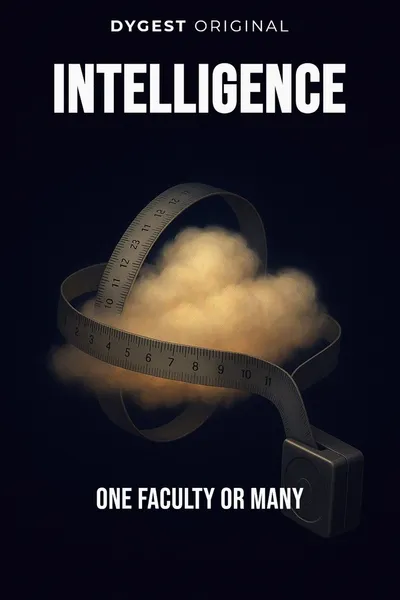
Intelligence
One faculty or many
Description
In 1904, the French government handed a psychologist named Alfred Binet a narrow, practical problem. Paris had just made schooling compulsory, and teachers needed a way to spot children who would struggle in an ordinary classroom, so they could be given extra help. Binet, working with the physician Théodore Simon, built a set of small tasks — copying a drawing, repeating digits, defining a word, following a chain of instructions. He ranked them by the age at which most children could manage them. A child who solved the tasks typical of a ten-year-old was said to have a mental age of ten. That was the whole idea: a rough, useful comparison, meant to catch kids before they fell behind.
Binet was careful about what his scale did not mean. He warned that it measured a child at a moment, not a fixed ceiling, and he disliked the notion that some single quantity of cleverness could be read off a person the way you read a height. Within twenty years, his caution had been almost entirely discarded. The scale crossed the Atlantic, got a single number bolted onto it, and became the IQ — a figure that would be used to sort army recruits, restrict immigration, stream schoolchildren, and settle arguments about who deserved what. A diagnostic tool for helping the struggling had become a ranking device for everyone.
Ever since, the same fight has run underneath the numbers. On one side sits the intuition that intelligence is one thing — a general sharpness that shows up whether we are doing arithmetic, reading a map, or arguing a point. On the other sits the equally stubborn feeling that the word covers many different things that have little to do with each other. Both camps have data, decades of it, and neither has quite won.
The question we’re asking : Is intelligence a single underlying faculty, or a loose bundle of different abilities we happen to file under one word?What we’ll see : How a modest classroom scale became a verdict, the statistics that turned it into a single quantity, the rival maps of the mind, and what a score genuinely tells us.
Table of contents
01 Chapter 1 — A number born in a Paris classroom
Binet's scale was built for a specific job and framed in modest terms. He did not think he was capturing the essence of the mind. He was trying to identify, quickly and fairly, which children needed a different kind of teaching — and he assumed that with the right teaching, a child's performance could move. The whole point was intervention, not classification. He treated a low score as a starting condition to be worked on, not a fact about a person to be filed away.
The scale traveled fast. In the United States, the psychologist Lewis Terman at Stanford revised it into what became the Stanford-Binet test, published in 1916. Terman added the piece that would prove most consequential: a single ratio. Mental age divided by actual age, multiplied by a hundred, produced the intelligence quotient. A number. Clean, portable, and easy to compare across thousands of people at once, it invited exactly the kind of ranking Binet had warned against.

02 Chapter 2 — The general factor, and the men who reified it
The case for one thing came from statistics. In 1904, the British psychologist Charles Spearman noticed something regular in schoolchildren's marks: a pupil who did well in one subject tended to do well in the others, even in subjects that seemed unrelated. Ability in Latin predicted ability in music more than chance allowed. Spearman argued that a hidden common factor was doing the work across all of them, and he named it g — general intelligence. It was not something you could point to. It was a statistical shadow, inferred from the way scores clustered together.
The correlation is real and has held up for over a century. Across large populations, performance on very different mental tasks does tend to rise and fall together, and that positive tangle is one of the most replicated findings in psychology. Modern tests are engineered to load heavily on g precisely because it is so stable. If intelligence were purely a grab-bag of unrelated skills, we would not expect the vocabulary score and the spatial-reasoning score to travel together as reliably as they do.
03 Chapter 3 — Many minds, or many measurements
If one number felt too thin, the obvious response was to break it apart. The most famous attempt came from Harvard's Howard Gardner, who proposed in 1983 that we possess several relatively independent intelligences — linguistic, logical-mathematical, spatial, musical, bodily-kinesthetic, interpersonal, intrapersonal, later adding naturalistic. A gifted cellist and a gifted litigator, on this view, are not more and less of the same thing; they are strong in different faculties that a single test flattens into one misleading figure.
Gardner's theory was embraced warmly in education, where it matched what teachers saw every day, and treated skeptically in psychometrics, where critics pointed out that his intelligences still correlate with one another and lack the kind of measurement that made g testable. A softer version of the same instinct came from Robert Sternberg, who divided intelligence into analytical, creative, and practical — the last being the street-smart competence that helps people navigate real situations, which paper tests barely touch.
04 Chapter 4 — What a test actually catches
Step back from the century-long argument and a quieter fact remains: whatever their philosophical status, IQ scores predict things. Within a given society, they correlate meaningfully with school performance, with years of education completed, with certain job outcomes, and, more weakly, with income and health. This is the ground the tests stand on. They are not measuring nothing. A defender of g and a critic of it can agree on the correlations while disagreeing entirely about what they mean.
The subtlety is in the word predict. A correlation across a population is not a verdict on an individual, and prediction is not the same as explanation. Tests forecast success partly because the institutions doing the forecasting — schools, universities, credentialed professions — were themselves built to reward the same narrow, abstract, timed style of reasoning the tests sample. A measure that predicts how well you will do in a system shaped to value that measure is telling you as much about the system as about the mind. Move the setting, and what counts as intelligence quietly shifts with it.
05 Conclusion
The question of whether intelligence is one faculty or many has never resolved because both answers are partly true. There is a real statistical regularity — call it g — that keeps showing up whenever we measure diverse mental tasks in large numbers. And there are real, distinct abilities, sensitive to age, culture, schooling and the shape of a life, that a single number cannot hold. The fight has lasted a century because each side is defending something genuine against the other's overreach.
Related books