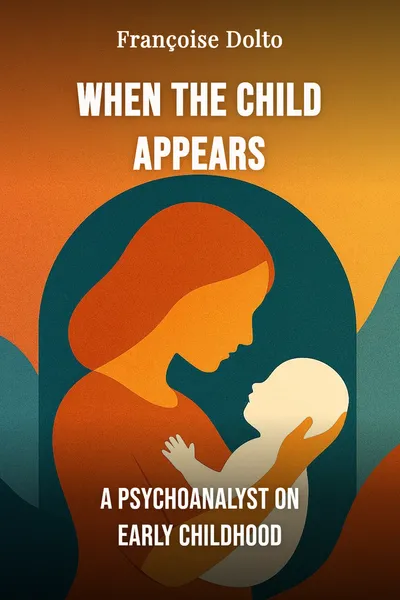
When the Child Appears
A psychoanalyst on early childhood
Description
In 1976 and 1977, a French radio station, France Inter, handed a daily slot to a woman in her late sixties who had spent four decades listening to children in her consulting room. Françoise Dolto was already well known among psychoanalysts, less so among the general public. Then the broadcasts changed that. Parents wrote in with questions — a baby who wouldn't sleep, a toddler who hit, a child frightened of the dark — and Dolto answered on air, in a warm, slightly raspy voice, with an authority that came not from theory but from having sat across from thousands of small human beings and taken them seriously. The letters came by the thousands. The slot became an institution.
What people remembered wasn't advice in the usual sense. Dolto rarely told parents what to do. Instead she reframed what the child was doing, and in doing so she moved the whole scene. A screaming infant was not a problem to be managed but someone trying to say something. A symptom was not a malfunction but a message. The book that later gathered this thinking, When the Child Appears, carries that same posture onto the page: the conviction that a human being is fully present from the very beginning, long before it can form a sentence, and that most of what goes wrong between adults and children comes from forgetting it.
The claim sounds gentle, almost obvious, until we follow where Dolto takes it. If the newborn is already a subject — someone with a history, a desire, a relation to language — then everything we assume about raising it shifts. The parent is no longer shaping raw material. The parent is in a conversation that began earlier than anyone noticed, and the hard part is learning to hear the other side of it.
The question we’re asking : What does it change to treat a baby, from its first day, as a full speaking subject rather than a creature to be trained?What we’ll see : How a radio psychoanalyst's decades of listening reframed the earliest years as a relation already made of language.
Table of contents
01 Chapter 1 — The microphone and the mother
Dolto came to radio late and almost by accident. She had trained in the 1930s, analyzed by one of the first generation of French Freudians, and had built a clinical practice built almost entirely around children — a population that psychoanalysis, in its early decades, had barely known how to approach. By the mid-1970s she was a respected but specialist figure. The France Inter broadcasts pulled her into an entirely different relation with the public: no longer the expert consulted in private, but a voice in the kitchen while the coffee was on.
The format was simple and that was its force. A parent wrote a letter describing an ordinary difficulty — a child who wet the bed, a sibling rivalry that had turned ferocious, a question a four-year-old had asked about death. Dolto read it aloud and responded. She never pretended to diagnose a child she hadn't met. What she did instead was slow the question down, turn it over, and ask what the child might be living through from the inside. The effect on listeners was less reassurance than reorientation.

02 Chapter 2 — A subject from the first day
The core of Dolto's thinking is a claim about when a human being begins to be a subject. The common assumption, then as now, is that a baby is a bundle of needs and reflexes that gradually acquires a self as it grows — that personhood arrives in installments. Dolto reverses this. For her, the infant is already a whole subject at birth, and in a sense before it, carrying a history that includes the desires, words, and expectations that surrounded its conception and the months in the womb.
This is not mysticism. It is a claim about relation. A newborn cannot survive alone; it exists only in a bond with those who care for it, and that bond is saturated with meaning from the first instant. The way a mother holds, speaks, hesitates, the tone in the room, the name chosen, the place the child is meant to take in the family — all of this reaches the infant as something more than physical sensation. The baby is immersed in significance long before it can decode a single word.
03 Chapter 3 — The symbol before the word
If the infant is a subject but cannot yet talk, how does it speak? Dolto's answer is that it speaks before words — through the body, through symptoms, through the dense symbolic traffic that passes between a child and those around it. A child's language is not only verbal and does not wait for grammar. It begins in the earliest exchanges of gaze, touch, and voice, and it is already a language in the full sense: a way of addressing someone and meaning something.
This is why she read symptoms the way one reads a message. A persistent eczema, a refusal to eat, a sudden regression after a sibling's birth — Dolto approached these less as disorders to suppress than as statements that had not found other words. The question was never only how to stop the behavior but what it was trying to say, and to whom. Often the symptom was addressed to the adults, carrying a truth the family had not been able to speak out loud.
04 Chapter 4 — Listening as a form of respect
Stepping back, what Dolto was really proposing was a reversal of authority inside the family — not a loss of it, but a relocation. The adult does not stop being responsible, setting limits, carrying the weight of care. But the adult stops being the only one who means things. The child becomes an interlocutor from the start, and the adult's first task is less to shape than to listen, which turns out to be far harder than issuing instructions.
This is where her thinking asks something genuinely costly of parents. To hear a child as a subject is to accept that its distress may be addressed to us, that our silences reach it, that our unresolved histories are legible in the room. It removes the comfort of treating the child as a project to be executed correctly. There is no method that guarantees the outcome, because the other person in the exchange is free, and already someone, and under no obligation to become what we imagined.
05 Conclusion
The voice on France Inter has been gone for decades, and the letters it answered are yellowing in archives, but the reframing it carried has quietly settled into how many families now hear their own children. When a parent today kneels to explain to a toddler why a grandparent has died, or speaks aloud to a newborn about a move or a separation rather than assuming it understands nothing, something of Dolto's wager is at work — the assumption that there is someone there to be told.
Related books