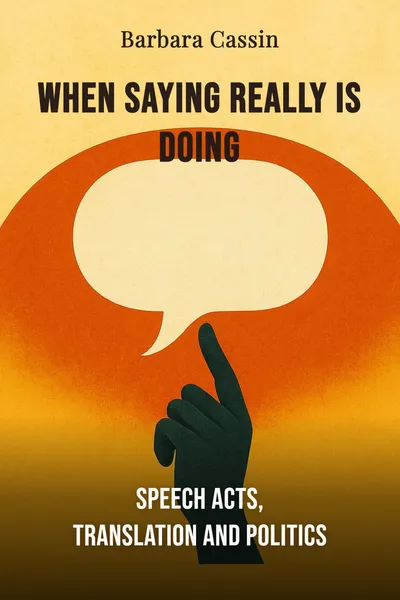
When Saying Really Is Doing
Speech acts, translation and politics
Description
There is a particular sentence you can say only once, and only in the right place, and the moment you say it the world is different. "I now pronounce you married." "I swear." "I forgive you." "The session is open." None of these describes a state of affairs. Each one produces the thing it names. The philosopher of language who noticed this most sharply, J.L. Austin, gave it a plain label in the 1950s: the performative. Some utterances don't report on reality; they intervene in it. Say the words and the deed is done.
Barbara Cassin, a French philosopher and philologist who spent much of her career working between Greek, Latin, German and French, takes that idea and pushes it somewhere Austin didn't go. Austin worked mostly inside English, inside one legal and social order. Cassin asks what happens to "saying is doing" when you move it across languages — when the vow, the verdict, the promise or the reconciliation has to survive translation. Her wager is that the performative isn't a curiosity of grammar. It's where speech touches politics most directly, and where translation stops being a technical problem and becomes a question about what each language can and cannot make happen.
The book gathers this into a single line of thought that runs from the Greek sophists to the courtrooms of the twentieth century. Its instinct is the opposite of the search for a universal, transparent language in which everyone finally agrees. Cassin trusts the friction between tongues, the places where a word won't cross over cleanly. That friction, she argues, is not noise. It's information about what we are doing when we speak.
The question we’re asking : What does it mean that some words don't describe the world but change it — and what happens to that power when we try to carry it from one language into another?What we’ll see : How a philologist follows performative speech from ancient rhetoric into the modern courtroom, and lands on the words that refuse to be translated at all.
Table of contents
01Chapter 1 — The words that do what they say
Start with the ordinary miracle. Most of what we say points at something: it's raining, the coffee's cold, the train left at nine. These sentences can be true or false, and we check them against the world. But a whole class of utterances does something else entirely. When a mayor says "I declare you married," nobody asks whether the sentence is accurate. The sentence isn't reporting a marriage. It is the marriage. Austin called these performatives, and the point is that they can't be true or false — they can only work or misfire.
And they misfire in interesting ways. The right words in the wrong mouth do nothing: a stranger at the next table declaring you married changes nothing at all. Say "I swear" with your fingers crossed, or as a line in a play, and the oath doesn't bind. So a performative isn't just a form of words. It needs the whole apparatus around it — the authority, the setting, the shared agreement that this counts. The sentence borrows its power from a world that has agreed, in advance, to let those words do work.

02Chapter 2 — Sophists, rhetoric and the making of the real
To find where this begins, Cassin goes back to the people philosophy usually treats as villains: the Greek sophists. Gorgias, Protagoras and their contemporaries were the professional speakers and teachers of fifth-century Greece, and Plato spent a good deal of energy discrediting them. The charge was that they didn't care about truth — they cared about persuasion, about making the weaker argument look stronger, about winning. For the philosophical tradition that followed, that made them the enemies of genuine knowledge.
Cassin, who has written admiringly about them for decades, reads the sophists differently. Their scandal, she argues, was that they took speech seriously as a force in the world rather than as a mirror held up to it. For Gorgias, language doesn't copy reality; it produces effects. A speech can heal or wound, calm a crowd or inflame it, make something present that wasn't there. This isn't a failure to reach the truth. It's an attention to what words actually do to the people who hear them — which is precisely the performative dimension Austin would rediscover more than two thousand years later.
03Chapter 3 — When the courtroom rewrites the past
Nowhere is saying-is-doing more consequential than in law, and Cassin turns to the moments when a society uses words to change its own history. The clearest case is amnesty. The Greek word amnestia — literally a kind of enforced not-remembering — named a specific political act: after the civil strife in Athens in 403 BC, the restored democracy required citizens to swear not to recall the wrongs of the recent past. Not to forgive them, exactly. To agree, by oath, not to bring them up. The past wasn't undone; it was declared unspeakable, and the declaration held the city together.
This is a performative of a formidable kind. An amnesty doesn't describe a reconciled society; it commands one into existence by forbidding the reopening of old accounts. Cassin reads the modern versions in the same light — the amnesty laws, the statutes of limitation, the official acts by which states draw a line and say, in effect, from here we start again. Each is an attempt to do something to time itself using nothing but words backed by authority.
04Chapter 4 — What one word refuses to carry across
Behind the whole book stands a project Cassin is best known for: the untranslatable. Not the word that can never be translated — everything can be rendered somehow — but the word you never stop translating, the one that keeps generating disagreement every time it crosses a border. She directed a vast dictionary of these terms, and her definition is precise and almost gentle. An untranslatable is a symptom. It marks a place where two languages have organized the world differently, and where the difference won't dissolve into a shared meaning underneath.
This is the point where performatives and translation meet. If speech is an act, then the acts a language can perform are folded into its untranslatables. The Greek logos is not the Latin ratio is not the English "reason" or "word" or "speech" — and the gaps between them are gaps between whole ways of doing things with language. To say that a word is untranslatable is to say that some deed it accomplishes in one tongue has no exact counterpart in another. The resistance isn't a defect in the dictionary. It's the truth of the matter showing through.
05Conclusion
The line runs, in the end, from a mayor's "I declare you married" to the Athenian oath not to remember, to a confession spoken in a Cape Town hearing room, to a dictionary of words that never sit still. Cassin's argument holds them together with a single insistence: speech is an act, acts are situated, and what is situated cannot be lifted out cleanly and dropped somewhere else. Austin found the performative inside English. Cassin sends it traveling, and in the traveling it reveals how much of any language is bound up with a particular way of doing things.
Related books