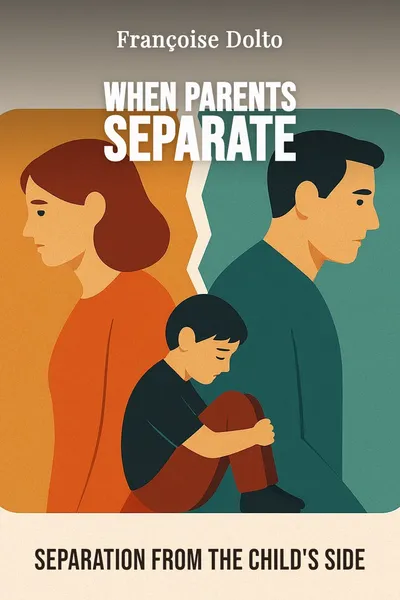
When Parents Separate
Separation from the child's side
Description
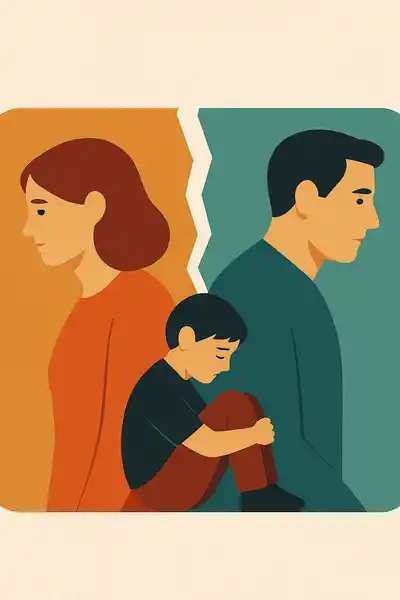
When a couple comes apart, the adults tend to measure the damage in their own currency: the lawyer's fees, the divided furniture, the Sunday handovers in a supermarket parking lot. The child stands somewhere in the middle of all that, smaller than the suitcases, and is usually spoken about rather than spoken to. Françoise Dolto spent decades listening to those children — in her consultations, on her radio broadcasts, in the overflowing mailbags that followed. What she heard was not what the parents assumed. The child, she found, almost always knows more than anyone thinks, and suffers less from the facts than from everything left unsaid around them.
Dolto was a pediatrician and psychoanalyst, and her core conviction was almost scandalous in its simplicity: a child is a person. Not a project, not an extension of the parents, not a fragile object to be shielded from reality at all costs. A person — which means a being who perceives, who interprets, who builds a story out of whatever scraps of truth the adults around them are willing to share. In "When Parents Separate," she turned that conviction on one of modern family life's most ordinary ruptures, and asked what it looks like from down there, at the height of a child who did not choose any of it.
The book refuses the two reflexes parents reach for first — pretending nothing is wrong, or dragging the child into the adult quarrel as a witness, a judge, a consolation prize. Dolto's position sits between those traps, and it is more demanding than either. It asks adults to say true things, clearly, and to keep saying them. The separation itself, she argues, is rarely the real injury. The injury is what gets done to the truth.
The question we’re asking : What does a separation actually do to the child caught inside it, and what would it take for that child to come through whole?What we’ll see : How Dolto reads the breakup from the floor level of the one person nobody thought to consult.
Table of contents
01 Chapter 1 — The child reads the silence before the words
Long before a parent sits a child down for the careful conversation, the child already knows something has shifted. Dolto insisted on this again and again: children are extraordinary readers of atmosphere. They register the tone that drops when they enter a room, the forced cheerfulness at dinner, the phone calls taken in the hallway, the bed that is suddenly made differently. A small child does not have the vocabulary for "my parents are separating," but the body has already filed the data. The tension is in the air, and the air is what a child breathes.
The problem begins when the adults' words contradict what the child's senses have already established. A mother says everything is fine while her eyes are red; a father insists nothing has changed while he sleeps on the couch. The child is now holding two incompatible truths — the spoken one and the perceived one — and has no way to resolve them. Dolto saw this gap as the source of real damage. Not the separation, which is a fact, but the dissonance, which the child cannot name and therefore turns inward.

02 Chapter 2 — Not the breakup that wounds, but the lie around it
The central reversal in Dolto's thinking is this: children are far more resilient to painful facts than to confusion. A separation, clearly stated, is survivable. What is not survivable, or survivable only at great cost, is a reality that keeps being denied, softened, or rewritten. The lie — even the kind lie, the protective lie — corrodes something the child needs intact, which is trust in their own perception of the world.
Dolto was blunt about the stories parents tell to spare themselves, not the child. "Daddy is away on a long trip" when the father has in fact left. "We still love each other very much" said in a tone that the child can hear is hollow. These fictions ask the child to disbelieve their own eyes in order to keep the peace. And a child who learns to distrust their own perception, to override what they plainly sense in favor of what the adult insists, pays for it later in a shaky relationship to reality itself.
03 Chapter 3 — The child who tries to carry the couple
One of the quieter dramas Dolto observed is the child who steps into roles far too large for them. When one parent leaves, the remaining one may, without quite meaning to, lean on the child — as confidant, as companion, as the little man or little woman of the house. The child, desperate to help and to be loved, takes up the burden. For a while it can even look like maturity. It is not. It is a child giving up childhood to prop up an adult.
Dolto urged parents to resist this, however tempting the comfort. A child is not a substitute spouse, not a therapist, not a messenger to be sent between two households carrying grievances in both directions. When a child becomes the go-between — "tell your mother this," "ask your father why" — they are placed at the exact center of the conflict, forced to manage adult emotions they have no tools for. The loyalty they feel to each parent becomes a vise, and they are squeezed in it every week.
04 Chapter 4 — What a child is owed when the family splits
Step back from the specific scene of a divorce and Dolto's argument opens onto something larger: her whole clinical vision of what a child actually is. The child is a subject — a person with their own inner life, their own reading of events, their own right to the truth of their situation. Separation simply makes this visible under pressure. The adult reflex to shield, to postpone, to decide what the child can and cannot handle, rests on treating the child as an object to be managed. Dolto's work is a sustained argument against exactly that.
Her radical move was to take the child's words, and even the child's symptoms, as meaningful speech rather than noise to be corrected. The bedwetting, the sudden fears, the regression after a parent moves out — these are not malfunctions. They are a person telling the truth about an intolerable situation in the only register they have. To answer them with pills or punishment, instead of with honest words, is to refuse the child the status of someone who means something. Naming the reality, by contrast, gives the symptom somewhere to go.
05 Conclusion
The parents who wrote to Dolto, and the ones who sat across from her, usually arrived braced for a verdict on whether their divorce would harm their children. She gave them something harder and more hopeful instead. The breakup is not the thing that scars. Children can absorb a changed family; what they struggle to absorb is a reality that the adults around them keep denying, distorting, or loading onto their shoulders. The damage lives in the handling, not in the fact.
Related books