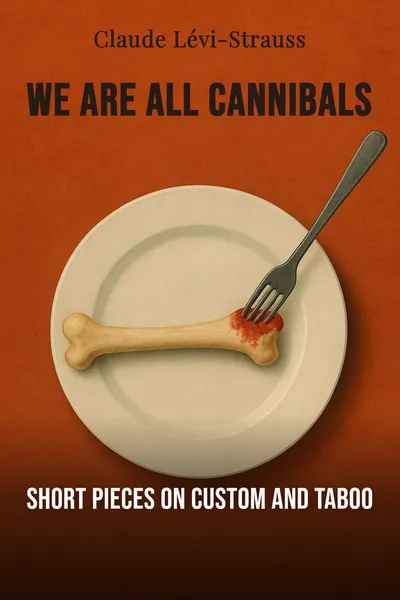
We Are All Cannibals
Short pieces on custom and taboo
Description
In the mid-1990s, a Milanese newspaper called on Claude Lévi-Strauss, then in his late eighties, to comment on the news. The great anthropologist, who had spent a lifetime among the myths of the Amazon and the kinship systems of the world, agreed — on his own terms. Over the following years he sent short essays, each a few pages, prompted by whatever the moment offered: an epidemic in British cattle, a change to French inheritance law, a case of surrogacy, a Christmas tree burned in effigy. Written for a wide readership rather than for colleagues, they were later gathered under a title that reads like a provocation: We Are All Cannibals.
The provocation is the point. When mad cow disease swept European herds, Lévi-Strauss looked at the panic and saw something the headlines missed. Feeding ground-up sheep and cattle remains back to cattle — the industrial practice behind the outbreak — was, in the plainest sense, forcing herbivores into cannibalism. The horror people felt was real. But the same people who recoiled were carrying, in their own history and habits, older and stranger versions of the very thing they were disgusted by. The frontier between us and the eaters of human flesh, he suggested, is thinner and more movable than we like to think.
That is the thread running through these pieces. Lévi-Strauss was never in the business of shocking for its own sake. He used the small events of the news the way he had always used myths: as doorways into the deep grammar of how societies decide what is sacred, what is forbidden, and what is merely food. The essays are brief, but the questions underneath them are not.
The question we’re asking : Where does the line between custom and abomination actually run, and who draws it?What we’ll see : How a lifelong anthropologist read the ordinary news — epidemics, families, rituals — and found our certainties about disgust far less solid than they appear.
Table of contents
01Chapter 1 — Mad cow, or cannibalism by proxy
The essay that gives the collection its name begins with a factory. To fatten cattle faster and waste nothing, European agriculture had taken to grinding up animal carcasses — including sheep and other cattle — and mixing the meal back into feed. Bovine spongiform encephalopathy, the disease that liquefied cows' brains and jumped, in a variant form, to humans, was the result. Lévi-Strauss states the obvious that everyone was too queasy to name: we had turned peaceful grass-eaters into cannibals, and then eaten the cannibals ourselves.
From there he does the thing anthropologists do. He turns the mirror. Societies that practiced human cannibalism, he reminds the reader, rarely did so out of hunger or cruelty. They ate the dead to absorb their courage, to keep a beloved kinsman inside the living body of the group, to complete a mourning that burial alone could not. Endo-cannibalism — eating one's own — was frequently an act of love and continuity, a way of refusing to let the dead simply vanish. Placed beside our own habit of feeding animals to animals for a faster profit margin, the ranking of who is barbaric starts to wobble.

02Chapter 2 — What the anthropologist saw in a fever
The mad cow essay is the loudest in the book, but it belongs to a method that runs through all of them. Lévi-Strauss treats a news item the way he once treated a myth from central Brazil: not as an isolated fact to be judged, but as a variation on a theme that other societies have played in other keys. The epidemic is one variant. Ritual consumption of the dead is another. Medical grafting is a third. Lined up, they reveal a structure that no single case shows on its own.
This is the discipline he had spent decades building. In his great studies of kinship and myth, he argued that beneath the endless surface variety of human custom lie a small number of recurring oppositions — raw and cooked, nature and culture, the permitted and the prohibited — which every society arranges in its own way. There is no ladder from primitive to advanced. There are only different solutions to the same handful of problems, and the anthropologist's job is to describe them without ranking them.
03Chapter 3 — Fathers who are mothers, children who are gifts
Several of the essays leave the slaughterhouse for the family, and here Lévi-Strauss is on the ground he mapped most thoroughly. When French law and public debate wrestled with surrogacy, artificial insemination and new definitions of parenthood, commentators spoke as though biology had suddenly been unmoored from the family for the first time. Lévi-Strauss, who had catalogued the world's kinship systems, found the panic almost quaint. Human societies had always been busy separating the biological facts of reproduction from the social facts of parenthood.
He reaches for cases from the ethnographic record. Among certain African peoples a wealthy woman could marry another woman, becoming the social father of the children her wife bore by a chosen man. In parts of Amazonia the idea circulated that a child could have several fathers, each man who had a hand in its making contributing to its substance. Some societies traced descent through the mother's brother rather than the father; others invented forms of adoption so complete that the biological tie became irrelevant. The point is not that anything goes, but that kinship has always been a construction, a set of rules a group agrees on, not a simple transcript of nature.
04Chapter 4 — The line we draw, and where we draw it
Read together, the essays keep circling a single insight, and it is worth stating plainly because Lévi-Strauss never quite does. The border between the acceptable and the monstrous — between food and abomination, between family and stranger, between custom and crime — is not given by nature. It is drawn by culture, and it moves. What one society treats as a sacred duty another treats as an atrocity, and the same society will shift the line across a few generations without noticing it has done so.
This is not a licence for indifference, and it would be a misreading to take it as one. Lévi-Strauss was not saying that all customs are equally good or that disgust is meaningless. He was saying something harder to hold: that our disgust is real and consequential, and also arbitrary in its placement. We recoil from eating the dead and feel nothing about feeding animals to animals until the practice sickens us. We are scandalized by a stranger carrying a couple's child and untroubled by centuries of arranged fosterage in other forms. The feeling is trustworthy as a feeling; it is unreliable as a map of the world.
05Conclusion
The book ends where it began, with an old man reading the newspaper and refusing to be fooled by its certainties. The mad cow crisis passed, the laws on parenthood kept changing, the rituals of other peoples continued to appear in the news as curiosities or horrors. Through all of it Lévi-Strauss held to the same quiet operation: take the thing that seems self-evidently monstrous, set it beside the things we do without a second thought, and watch the difference shrink. Not vanish — shrink, until it looks less like a law of nature and more like a decision.
Related books