
Walt Disney
The man behind the magic
Description
On December 15, 1966, Walt Disney died of lung cancer in a hospital in Burbank, California, across the street from the studio that carried his name. He was sixty-five. At the moment of his death he was the most recognized entertainer in the world, a man whose signature had become a corporate logo, whose voice millions of children knew as Mickey Mouse, and who had built, in the last decade of his life, a place in Anaheim that redefined what a family vacation could be. And yet the man himself remained oddly unknown — hidden behind the brand, the smile, the folksy on-camera persona that introduced television programs every Sunday night.
Neal Gabler spent years inside the Disney archives, granted access no previous biographer had received, to reconstruct the person underneath. What he found was not the benevolent uncle of legend but someone far more interesting and more troubled: a Missouri farm boy shadowed by financial insecurity, a compulsive perfectionist who could not stop tinkering, a man who twice pushed himself to nervous collapse chasing a fantasy of total control over a world he alone could imagine. The magic was real. So was the anxiety underneath it.
Gabler's biography sets out to close the gap between the icon and the individual, tracing how a restless, driven boy from the Midwest built an empire out of drawings and then out of concrete and steel. It is a portrait of ambition that never rested, and of a mind that treated the imagination not as a hobby but as something to be engineered, refined, and finally made physical.
The question we’re asking : Who was the man underneath the world's most familiar brand, and what drove him to keep building?What we’ll see : How a farm boy's need to command his own world turned private fantasy into an empire — and reshaped the century that followed.
Table of contents
01Chapter 1 — The farm boy who wanted control
Walter Elias Disney was born in Chicago in 1901, but the formative years of his childhood belonged to a farm near Marceline, Missouri, where the family moved when he was small. Gabler treats these years as the emotional source of everything that came later. The farm was a place of animals, open space, and imaginative freedom — a small self-contained world that Walt would spend the rest of his life trying to recover. When the family lost the farm and moved to Kansas City, the loss registered as a wound. The idyll had been taken away, and someone had failed to protect it. That someone was his father.
Elias Disney is one of the quiet villains of Gabler's account: a rigid, unsuccessful, often harsh man whose business ventures kept collapsing and who put his sons to work delivering newspapers before dawn in brutal Kansas City winters. Walt would later describe waking at three-thirty in the morning, sometimes falling asleep in doorways from exhaustion. The insecurity of those years — the sense that the ground could give way at any moment — settled into him permanently. Gabler argues that Disney's later obsession with control, his refusal to delegate, his need to own and command every detail, all trace back to a childhood in which nothing felt secure.

02Chapter 2 — Mickey, and the machine behind him
Hollywood in the 1920s was not waiting for Walt Disney, and his early years there were a grind of small contracts and thin margins. His first success was a character called Oswald the Lucky Rabbit, made for a distributor — and it taught him the hardest lesson of his career. In 1928, the distributor informed Walt that he owned Oswald outright and had quietly hired away most of Disney's animators. Walt lost the character and much of his staff in a single meeting. Gabler presents this as the defining betrayal: from that point on, Disney would never again let anyone else own what he made.
Mickey Mouse was the answer. Created with his indispensable animator Ub Iwerks, Mickey debuted in Steamboat Willie in 1928 — and the innovation that made him a sensation was sound. Disney synchronized music and effects to the animation with an obsessive precision no one had achieved before. The little mouse whistling on the steamboat was not just a cartoon; it was a technical breakthrough, and audiences responded instantly. Mickey became a global phenomenon, and Walt, tellingly, provided the character's voice himself for two decades.
03Chapter 3 — The park nobody thought would work
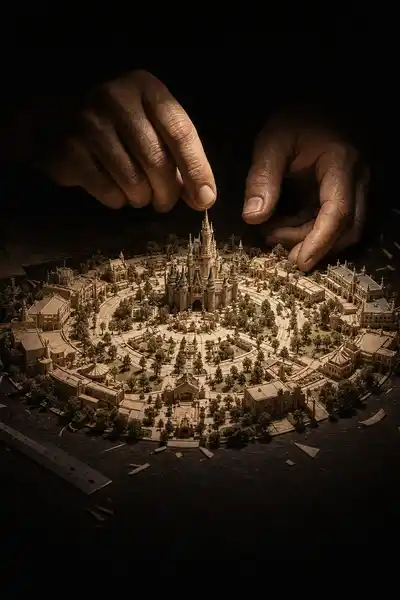
By the early 1950s, Disney was restless in a way that unsettled everyone around him. Animation, the thing he had pioneered, no longer held him. Gabler describes a man looking for a new world to build — and finding it in an idea his own brother Roy, his financial backers, and most of the industry considered a folly. Amusement parks were seedy, dirty places, associated with carnivals and pickpockets. Walt wanted to build something no one had seen: a clean, controlled, immersive environment where the fantasy was total and nothing broke the spell.
The vision was, again, about control. Disneyland would be a place where every sightline was managed, every detail themed, every unpleasant intrusion of the outside world engineered away. It was, in a sense, the Marceline farm rebuilt at scale — a self-contained world entirely under his command, where the disorder that had haunted his childhood could not enter. He mortgaged his life insurance to fund early planning and struck a deal with the fledgling ABC television network, trading a weekly show for the capital he needed.
04Chapter 4 — What one man's imagination did to a century
What Gabler's biography ultimately describes is a strange and consequential achievement: Walt Disney industrialized the imagination. Before him, fantasy was something individual and ephemeral — a story told, a picture drawn, a daydream that vanished. Disney treated it as raw material to be engineered. He built systems, refined techniques, trained armies of artists and, later, poured concrete, so that the private worlds inside one anxious man's head could be reproduced flawlessly, at scale, for millions of people at once. The daydream became a manufacturing process.
That is the deeper meaning of his obsession with control. It was not merely a personality quirk left over from a hard childhood; it was the operating principle of everything he made. A cartoon works only if every frame obeys its creator. A park works only if every sightline is governed. Disney's need to own, command, and perfect was inseparable from the seamlessness of the results — the very seamlessness that made his work feel like magic rather than labor. The hidden machinery was the point, and hiding it was the art.
05Conclusion
When Walt Disney died in 1966, the swamp in Florida was still just swamp, and EPCOT existed only in his notes and in the minds of the men he had briefed. Roy Disney would go on to complete Walt Disney World, insisting the name honor his brother. The empire kept expanding long after its founder was gone, which is perhaps the final proof of what Gabler argues: Disney had not simply made films or parks, he had built a system durable enough to outlive the imagination that started it.