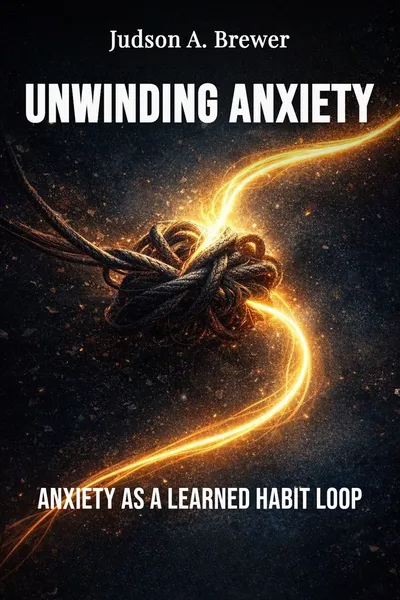
Unwinding Anxiety
Anxiety as a learned habit loop
Description
A psychiatrist named Judson Brewer spent years training people to quit smoking, and somewhere in that work he noticed something odd. The mechanism that hooked a person to a cigarette — the trigger, the behavior, the little payoff — looked identical to the mechanism that kept people anxious. Same loop, different content. A smoker feels a craving, lights up, gets relief, and the brain files the sequence away as useful. An anxious person feels a jolt of unease, starts worrying, gets a faint sense of doing something about it, and the brain files that away too. Worry, it turns out, can be rewarding. Not pleasant — rewarding, in the technical sense that the brain keeps coming back to it.
That reframe is the spine of Brewer's book Unwinding Anxiety, published in 2021. He is a researcher at Brown University who studies the neuroscience of habit and mindfulness, and his argument is deceptively simple: anxiety is not a fixed trait or a chemical verdict handed down at birth. It is, in large part, a habit — a behavior the brain has learned and reinforced, over and over, because at some point it seemed to help. And anything learned can, in principle, be unlearned.
What makes the claim worth sitting with is that it cuts against almost everything we've been told about managing anxiety. We're coached to fight it, distract ourselves, white-knuckle through it, reason with it. Brewer says most of that fails for a reason rooted in how the brain is actually built — and that the way out is stranger and gentler than we'd expect.
The question we’re asking : If anxiety is a habit the brain keeps rewarding, why does trying harder to stop it make it worse — and what actually breaks the loop?What we’ll see : How a smoking-cessation researcher came to see worry as a reinforced behavior, why the usual tools backfire, and where a quieter exit turns out to be.
Table of contents
01Chapter 1 — Anxiety runs on the same wiring as any habit
Brewer builds everything on a piece of machinery so old it predates the neocortex: the reward-based learning loop. It has three parts. A trigger, a behavior, and a result the brain evaluates. Our ancestors saw food (trigger), ate it (behavior), felt full (reward), and the brain encoded a lesson — do that again. The system was designed for survival, and it works beautifully for finding calories and avoiding danger. The trouble is that it doesn't care what content you feed it. It runs the same way on cake, on cigarettes, on scrolling, and on worry.
Here is how anxiety slips into that groove. Something sets off a feeling of unease — an email, a symptom, a vague sense that something is off. That's the trigger. The behavior that follows is worrying: running scenarios, planning, ruminating, googling. And the reward is subtle but real. Worrying gives us the sensation of control, of doing something, of being on the case. The dread doesn't lift, but the brain registers that we responded to the threat, and it quietly reinforces the sequence. Next time the unease shows up, worry arrives a little faster.

02Chapter 2 — Willpower is the wrong tool for the job
The standard advice for anxiety is some flavor of force. Push through it. Tell yourself it's irrational. Replace the negative thought with a positive one. Distract yourself until it passes. All of this leans on willpower — on the prefrontal cortex, the newest, most sophisticated part of the brain, the one that plans and reasons and knows better. It sounds like the right lieutenant for the fight. Brewer argues it's the worst one.
The prefrontal cortex has a fatal limitation for this particular battle: it goes offline exactly when we need it. Under stress, under fatigue, under the flood of anxiety itself, the reasoning brain is the first system to drop out. It's metabolically expensive and easily overwhelmed, and the older reward-based circuits simply outrun it. This is why we can know, with total intellectual clarity, that our worry is pointless — and worry anyway. The part of us that knows better isn't driving. It's a passenger, offering excellent commentary while the reflex steers.
03Chapter 3 — Curiosity is the intervention hiding in plain sight
Brewer's move is to attack the loop at its only vulnerable point: the reward. A habit persists because the brain believes the behavior pays off. Change what the brain learns about the payoff, and the habit loses its grip on its own. You don't have to fight it. You have to update it. And the way you update it is by paying close, honest attention to what worrying actually delivers.
This is where mindfulness enters, though Brewer strips it of any mystical baggage. The instruction is almost embarrassingly plain: when the worry comes, instead of feeding it or fighting it, turn toward it and get curious. What does the anxiety feel like in the body right now? What does the worrying actually give me? Sit with it and watch. When people do this repeatedly, the brain gets accurate information for the first time — that worry feels tight and awful and leads nowhere — and it begins, on its own terms, to lose interest. The reward value of the habit deflates because the brain finally sees it clearly.
04Chapter 4 — The problem was never the feeling
Step back from anxiety specifically and Brewer's framework starts to rearrange the whole landscape of self-improvement. We tend to treat our unwanted behaviors — the worrying, the snacking, the doomscrolling, the short temper — as evidence of insufficient discipline. The implied fix is always more willpower, more resolve, more gritting of teeth. Brewer's argument suggests this entire model is built on a misunderstanding of how the brain changes. We've been recruiting the reasoning mind to police the reflex mind, and losing, and calling the loss a lack of character.
The deeper shift is in where he locates the problem. It was never the anxious feeling itself. Feelings pass; sensations rise and fall on their own if left alone. The problem is the relationship we form with the feeling — the reflexive fighting, avoiding, and controlling that turns a passing wave into a permanent loop. Brewer's approach doesn't try to eliminate anxiety, which would be like trying to eliminate hunger. It changes what we do when anxiety arrives, and that change is enough to drain the habit of its fuel.
05Conclusion
Brewer arrived at all of this by noticing that the smoker trying to quit and the patient drowning in worry were caught in the same machinery. The insight of Unwinding Anxiety is that anxiety is less a condition we have than a pattern we practice — a loop the brain learned, reinforced, and automated because worry once felt like control. And because it was learned, it can be met on its own terms rather than fought on ours.
Related books