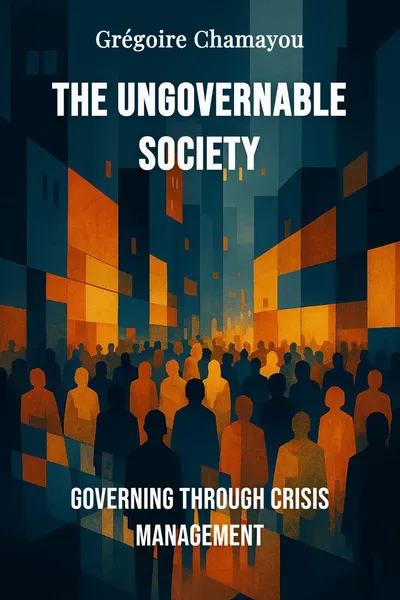
The Ungovernable Society
Governing through crisis management
Description
Around 1970, in the boardrooms and business schools of the United States, a peculiar mood took hold among the people who ran large corporations. They felt hunted. Consumer activists like Ralph Nader were suing them, environmentalists were naming them, journalists were exposing them, and their own workers seemed to have stopped believing that a job was its own reward. In August 1971, a corporate lawyer named Lewis Powell wrote a confidential memo to the US Chamber of Commerce warning that the American free-enterprise system was under broad assault and that business had been passive, indulgent, and slow to defend itself. It read less like analysis than a call to arms.
The French philosopher Grégoire Chamayou takes that mood as his starting point. His book reconstructs how, over the following decades, a loose coalition of managers, economists, PR strategists and consultants set about answering a single question that panicked them: how do you keep governing a society that no longer wants to be governed the old way? Chamayou's wager is that we usually read this period as ideology — the rise of neoliberalism, the triumph of markets. He reads it instead as a workshop, a place where concrete techniques of control were designed, tested, and quietly installed.
What emerges is a strange inversion. The word we reach for to describe the era — freedom — turns out to sit on top of an enormous labor of management. Behind the celebration of the unbound market, Chamayou finds people meticulously figuring out how to defuse protest, absorb dissent, discipline workforces, and neutralize the state's capacity to interfere. The society that called itself free was also, from the top, a society being managed against the constant threat that it might slip the leash.
The question we’re asking : How did those who run the economy respond when society, in the 1970s, seemed to stop being governable?What we’ll see : how a corporate panic hardened into a genealogy of governance — the techniques invented to keep an unruly society in hand.
Table of contents
01 Chapter 1 — The moment capital felt watched
Chamayou opens on a sense of siege. By the late 1960s, the large American corporation faced pressure on several fronts at once, and what strikes him is how the people inside experienced it. They did not see a healthy democracy holding power to account. They saw an ecosystem turning hostile. Ralph Nader had made the auto industry defend the safety of its own cars. New agencies were writing rules on pollution and product liability. Reporters treated the firm as a legitimate object of suspicion. And crucially, this pressure came from outside the old channels — not from unions bargaining over wages, but from citizens, courts and campaigns that the corporation had no seat at the table to manage.
The Powell memo crystallized the reaction. Its argument was that business had made a fatal mistake by staying quiet, by treating politics as beneath it, by assuming the system would defend itself. Powell called for organization: think tanks, endowed chairs, legal advocacy, a sustained presence in universities and media. The point was not to win a single argument but to build durable capacity — an infrastructure that could shape the terrain on which future arguments happened. Chamayou reads this as the birth of a strategic posture, not just a complaint.

02 Chapter 2 — The manager who learned to negotiate
The first battlefield was the workplace itself. In the same years, factories in the United States and Europe were hit by a wave of trouble that unnerved managers as much as strikes did: absenteeism, sabotage, indifference, the sense that workers were present in body and gone in spirit. The assembly line, perfected to extract effort, seemed to be producing quiet refusal. Chamayou lingers on the 1972 events at a General Motors plant in Lordstown, Ohio, where a young workforce disrupted a hyper-accelerated line — a strike widely read at the time as a revolt against the meaninglessness of the work itself.
Management's answer was not only force. A whole literature emerged on job enrichment, participation, quality of working life, humanizing the job. Chamayou is careful here, and this is the sharp edge of his reading. He does not celebrate these reforms as workers winning dignity, nor dismiss them as pure manipulation. He shows them as governance learning a new technique: instead of fighting resistance head-on, you absorb it, you give it a channel, you let some autonomy in so the whole system keeps running. Concessions became a tool. The goal was a workforce that governed itself in the firm's interest.
03 Chapter 3 — Milton Friedman and the counter-offensive
That theory arrived, in part, through the economist Milton Friedman. In a much-discussed 1970 essay, Friedman argued that the social responsibility of business is to increase its profits — that a corporate executive who spends shareholders' money on social causes is effectively taxing and spending without a mandate. Chamayou treats this less as economics than as a weapon in the environmental war of the previous chapter. The doctrine of shareholder value stripped the firm of the soft obligations that activists and reformers wanted to load onto it. It redrew the corporation's duties down to a single, hard line.
The move was doubly useful. It disarmed the critics who demanded that companies behave responsibly, by declaring responsibility a category error. And it re-anchored authority inside the firm around the owners, against both restless workers and an interfering public. Chamayou shows how this fed a broader counter-offensive: the funding of think tanks, the cultivation of sympathetic academics, the reframing of regulation as an assault on freedom. The genealogy of governance now runs through ideas deployed as instruments — arguments engineered to change what could be demanded of a corporation in the first place.
04 Chapter 4 — When governing becomes a technique
Step back, and Chamayou's real subject comes into focus: not neoliberalism as a set of beliefs, but governance as a craft. Across his chapters, the people running the economy behave less like ideologues than like engineers of control. They study their environment, model threats, test countermeasures, and adopt whatever works — participation here, doctrine there, deregulation elsewhere. What holds the story together is not a coherent creed but a shared problem and a growing toolkit for managing it. Governance, in this reading, is what you build when authority alone no longer suffices.
This is why he calls the society ungovernable, and the phrase is a diagnosis rather than a lament. The ungovernable is not chaos. It is the permanent condition that governance is designed to hold at bay — the fact that workers can refuse, citizens can mobilize, and the governed never fully consent to being ruled. Every technique in the book is a response to that condition, and none of them ends it. The reforms of the workplace do not abolish refusal; they metabolize it. The doctrines do not silence critics; they redraw the field. Management is a labor without a final victory, because the material it works on keeps moving.
05 Conclusion
The corporate managers who felt hunted around 1970 did not, in the end, restore the deference they missed. They did something more lasting: they built a repertoire for governing without it. Chamayou's book follows that repertoire from the Powell memo through the humanized assembly line to Friedman's hard line on profit, and shows each piece as an answer to the same nagging fact — that the governed were no longer reliably governable, and never would be again.
Related books