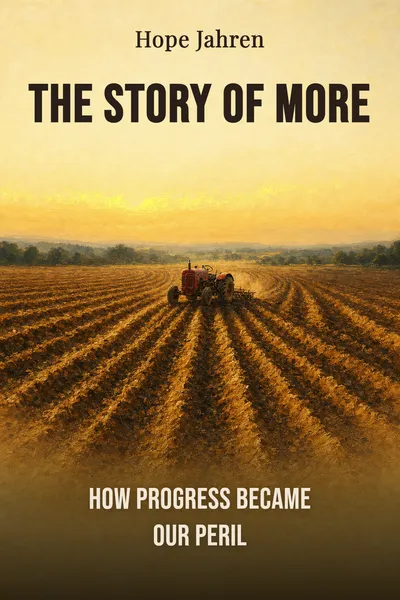
The Story of More
How progress became our peril
Description
Hope Jahren was born in 1969 in Austin, Minnesota, a meatpacking town where her father taught science at the community college for forty-two years. When she sat down to write The Story of More, published in 2020, she started with a number close to home: her own lifetime. In the years she has been alive, the human population has roughly doubled, from about 3.5 billion to more than 7.5 billion. The amount of food grown each year has more than tripled. The amount of energy burned has climbed faster still. Jahren is a geobiologist by training — she has spent decades studying how living things and the planet leave marks on each other — and she noticed that if you plot almost any measure of human activity across the twentieth century, you get the same shape. A flat line, then a sudden bend upward.
That bend is the subject of her book. Not the villains, not the culprits, but the mechanism — the ordinary inventions that made the line turn. Electric power. The tractor and the seed drill. The car. The refrigerator. Each one solved a real problem, fed real people, extended real lives. And each one, running at planetary scale, releases carbon dioxide into an atmosphere that has no way to hand it back. Jahren's move is to refuse the usual framing of climate as a distant catastrophe. She writes it as a domestic story: what we eat, what we drive, what we throw away, multiplied by billions.
What makes the book unusual is its tone. Jahren is not scolding. She grew up admiring the human genius that tamed wheat, cured disease, and put people on the moon, and she keeps that admiration on the page even as she tallies the bill. She treats the reader as an adult who can hold two facts at once: that progress worked, and that progress is now the danger. The book is short, the chapters are plain, and the argument accumulates the way a debt does — quietly, then all at once.
The question we’re asking : How did the same inventions that lifted us out of scarcity end up warming the planet toward crisis?What we’ll see : How Jahren traces a century of ingenuity, follows the carbon it left behind, and reframes the climate question as one of arithmetic rather than blame.
Table of contents
01 Chapter 1 — The century that changed the graph
Jahren opens where a geobiologist would: with time and quantity. For most of human history, the graphs of population, food, and energy were nearly flat. A person born in 1200 lived in roughly the same material world as an ancestor born five centuries earlier — same crops, same muscle power, same darkness after sunset. Then, somewhere in the late nineteenth and early twentieth century, every one of those lines bent. Jahren's book is organized around watching that bend happen, one system at a time, and refusing to let it stay abstract.
Population is the first line. When Jahren was born, the world held about 3.5 billion people. By the time she wrote, it held more than twice that. She is careful about why: not because people started having dramatically more children everywhere, but because far fewer of them died young. Infant mortality collapsed. Life expectancy in many countries nearly doubled over a century. This is one of the humane triumphs of the modern age, and Jahren says so plainly — before pointing out that every one of those saved and lengthened lives also eats, moves, and consumes.

02 Chapter 2 — What we grew, what it cost
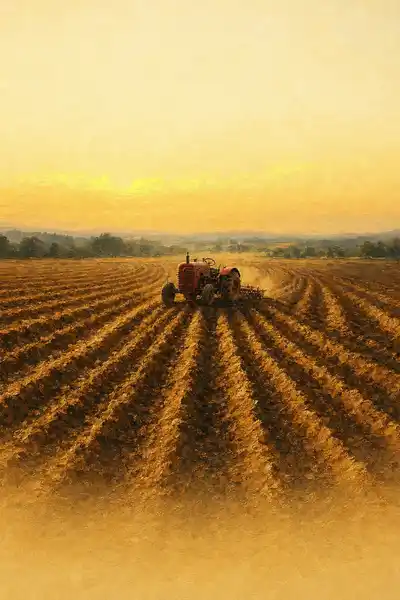
The heart of the book is food, and Jahren writes about it with the intimacy of someone who studies how plants actually live. In roughly the span of her lifetime, the world's grain harvest more than tripled. That did not happen because we planted three times as much land. It happened because of a bundle of inventions working together: high-yield seed varieties bred through the mid-century Green Revolution, synthetic nitrogen fertilizer, irrigation, pesticides, and machines that let one person farm what once took dozens. Norman Borlaug's dwarf wheat alone is credited with feeding hundreds of millions who would otherwise have gone hungry.
Jahren refuses to sneer at this. Growing enough food to more than keep pace with a doubling population is, she insists, one of the extraordinary achievements of our species. But she also does the accounting the celebration usually skips. Synthetic fertilizer is made using fossil fuels and releases greenhouse gases as it breaks down in the soil. Tractors and irrigation pumps run on oil. And the abundance itself changed what we do with food — much of the extra grain does not feed people directly. It feeds animals.
03 Chapter 3 — The molecule that stays
Having traced food, Jahren turns to the physics underneath everything else, and she makes it simple without making it thin. Carbon dioxide is the residue of combustion. Burn coal, oil, or gas — to light a room, move a car, smelt steel, or make fertilizer — and carbon that was locked underground for millions of years enters the air. The concentration of carbon dioxide in the atmosphere has risen well past 400 parts per million, a level not seen in human history and likely not for hundreds of thousands of years.
The problem, as she explains it, is not that the gas is exotic. It is that it lingers. A molecule of carbon dioxide released today can stay in the atmosphere for a century or more, trapping heat the whole time. This is why the story is one of accumulation rather than emission. Even if the world stopped burning fuel tomorrow, the carbon already up there would keep warming the planet for generations. We are not adjusting a thermostat; we are filling a bathtub with a very slow drain.
04 Chapter 4 — The math of enough
Step back from the individual inventions and Jahren's real subject comes into focus. The through-line of the book is not that humans are greedy or that technology is bad. It is that the enterprising spirit which conquered scarcity has kept running long after the scarcity was solved, and now produces a surplus the planet cannot absorb. The same drive that bred better wheat and cured disease also fills landfills and warms oceans. Progress did not fail. It succeeded so completely that success became the hazard.
This reframing matters because it changes what a solution looks like. If the villain were a single industry or a single vice, the fix would be to punish it. But Jahren's diagnosis is arithmetic. More people, times more consumption per person, times the carbon each unit of consumption releases, equals a rising line. Bend any one of those terms and the line bends with it. She is drawn less to grand pledges than to the unglamorous levers: eating less meat, wasting less food, burning less fuel, generating power without combustion, and — the term the wealthy world flinches from — simply using less.
05 Conclusion
Jahren ends the book close to where she began, back among the graphs of her own lifetime. The bend she has traced through food, energy, and carbon is not the work of monsters; it is the sum of billions of reasonable choices, each defensible on its own, adding up to a line no one intended. She has spent the short chapters showing that the mechanism is knowable, the sources are nameable, and the consequences are already arriving — bigger storms, higher water, hotter seasons — carried by a molecule that stays in the air long after the light is switched off.
Related books