
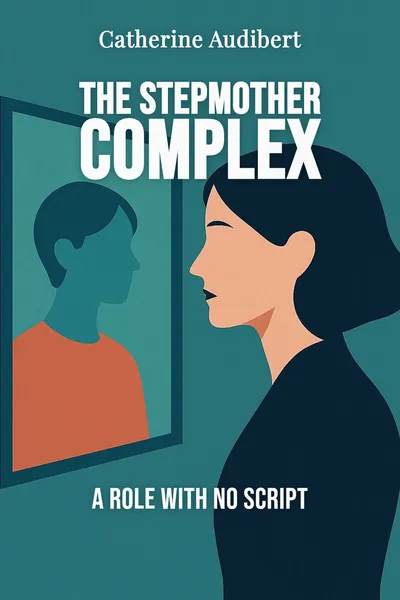
The Stepmother Complex
A role with no script
Description
The word arrives before the woman does. Long before a child meets the person their father has chosen, they already know what a stepmother is — she is the one in the fairy tales, the jealous one, the cold one, the one who feeds Snow White the apple. Catherine Audibert, a French clinical psychologist and psychoanalyst, opens her book on exactly this gap: a real woman steps into a family, and a centuries-old shadow walks in with her. She did not audition for the shadow. She inherited it the moment she fell in love with someone who already had children.
What Audibert sets out to do is unusual. Rather than defend stepmothers or offer them tips, she treats the position itself as a psychological object — something with its own structure, its own tensions, its own quiet suffering that mostly goes unspoken because complaining about it feels illegitimate. The stepmother, after all, usually chose this. She fell for a man and got a family as part of the deal. So when the arrangement turns out to be harder than anyone warned her, she tends to blame herself, and to keep quiet.
Audibert's argument is that the difficulty is not a personal failing but a structural one. The mother has a role, worn smooth by millennia. The father has a role. The child knows how to be a child. The stepmother alone steps into a family holding a part that no one ever wrote down — and the only version of it on record is the villain.
The question we’re asking : Why is the stepmother's place so uniquely hard to occupy, even when everyone involved means well?What we’ll see : How a psychoanalyst reads the stepmother's position from the inside, and what its emptiness reveals about the roles a culture is willing to imagine.
Table of contents
01 Chapter 1 — The figure everyone recognizes and nobody wants
Audibert begins where the culture begins: with the image. The wicked stepmother is one of the most stable characters in the Western imagination. Cinderella, Snow White, Hansel and Gretel — in each the father is absent or weak, and the woman who takes the mother's place is cruel, envious, often murderous. The pattern is so old and so consistent that it functions less like a story than like a warning passed between generations. A child does not need to be taught to distrust a stepmother. The distrust is already in the air.
What Audibert finds striking is that no comparable figure exists on the good side. There is no beloved archetype of the stepmother who got it right, no reassuring counter-image to balance the witch. The mother can be good or bad, saint or monster; the culture holds both. The stepmother is offered only one slot, and it is already filled by the villain. A woman entering the role has nothing positive to measure herself against — only something to desperately avoid becoming.

02 Chapter 2 — A role built on somebody else's absence
The deeper problem, in Audibert's reading, is that the stepmother's position is defined entirely by a prior loss. She exists because a first couple ended — through separation or death — and she arrives into the space that rupture left behind. However she came to be there, her presence is bound up with an absence. For the child, she is the living sign that the original family is not coming back. No amount of warmth erases that meaning. She can be kind, and still be the person standing where the mother used to stand.
This is what makes the stepmother so different from the mother, and Audibert insists on the distinction. Motherhood is grounded in something the culture treats as given — the body, the pregnancy, the primal bond. The stepmother has none of that anchoring. She is attached to the child only through the father, as a sort of consequence of adult love. The bond is lateral, indirect, and reversible in a way the maternal bond is not. If the couple breaks up, she usually vanishes from the child's life entirely, which tells you how contingent her place always was.
03 Chapter 3 — Loving a child who isn't asking for it
At the heart of the book is a question most stepmothers face privately and few ask aloud: am I supposed to love this child? Audibert refuses the easy answers. The injunction to love — the idea that a good stepmother naturally comes to cherish her partner's children — is, she argues, a trap. Love cannot be willed into existence, and treating it as an obligation only produces guilt when it fails to appear on schedule. Worse, the child can sense a manufactured tenderness and recoil from it, which deepens the very distance everyone wanted to close.
What complicates the picture further is the father. In many of the situations Audibert describes, the man quietly hopes his new partner will take over the emotional and domestic care of his children — will mother them, in effect — while remaining his lover and equal. The stepmother is pushed toward a maternal function without any of the maternal authority, expected to nurture children who may not obey her and whom she cannot discipline without being accused of overstepping. She does the work of a parent in a position that grants her none of a parent's standing.
04 Chapter 4 — Why the culture never wrote the part
Step back from the individual stepmother and a broader pattern comes into view, and this is where Audibert's analysis widens. A society scripts the roles it can idealize and leaves blank the ones that make it uneasy. Motherhood gets endless models, images, and sacred language because the culture wants to believe in it. The stepmother gets a witch and nothing else, because her existence points to things the culture prefers not to dwell on — that couples fail, that families reassemble, that love arrives late and secondhand and still has to function.
The absence of a model is not a trivial gap, in Audibert's view. We largely become our roles by imitation, by having images to lean on and language to describe what we feel. Deprived of both, the stepmother has to invent her position from scratch, in real time, under the suspicious gaze of a story that casts her as the enemy. The improvisation is exhausting, and the exhaustion is invisible, because there is no recognized role whose difficulty could be acknowledged.
05 Conclusion
The woman arrives, and the shadow arrives with her — that is where Audibert began, and the book's achievement is to show that the shadow was never really about her. It is a cultural inheritance, a story the child needed and the society kept, dropped onto a real person who happens to be standing in the wrong place at the wrong moment in a family's history. Understanding this does not make the position easy. It makes it legible, which turns out to matter more than reassurance.
Related books