The Sixth Extinction
Life on Earth—irreversibly changed
Description
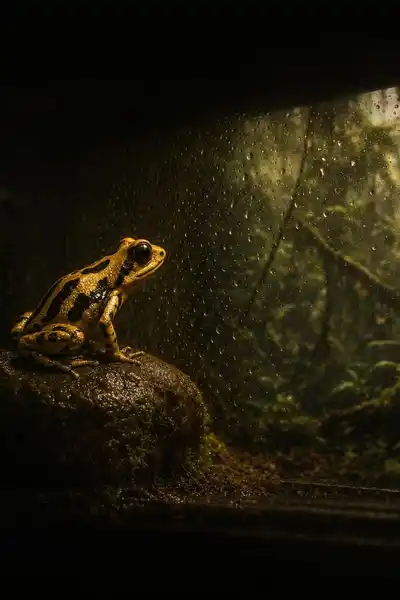
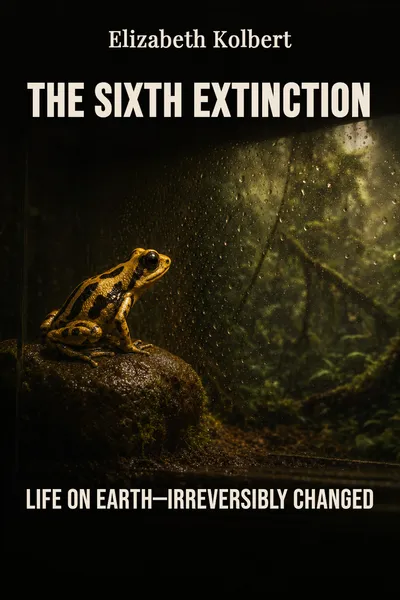
There is a frog, small and gold, that used to live in the cloud forests around the Panamanian town of El Valle de Antón. In the early 2000s the golden frogs were everywhere along the streams; guides pointed them out to tourists. Elizabeth Kolbert, reporting for a book that would appear in 2014, went looking for them and found them mostly gone, gathered up by biologists into aquariums and hotel rooms because a fungus was sweeping through the forest faster than anyone could stop it. The wild population collapsed in a matter of years. What was left of a species that had survived for a very long time now fit inside a few glass tanks.
That fungus, it turned out, had been carried around the planet by people—on boots, in shipments, on the bodies of frogs traded across borders. It was a small, local catastrophe with a very modern cause. And it was, in Kolbert's telling, a single thread in something much larger: a wave of disappearances happening across coral reefs, rainforests, mountainsides and ocean depths at a rate the fossil record reserves for its rarest and worst chapters. Scientists have a name for those chapters. There have been five of them.
Kolbert's book is an attempt to look at the sixth while we are living inside it. She does it the way a good reporter does—by going to the places, following the researchers, holding the specimens—rather than by lecturing. The frog is where she starts because the frog is where the abstraction becomes a thing you can hold in your hands, right before it slips away.
The question we’re asking : What does it actually mean to say we are living through a mass extinction—and how do we know?What we’ll see : How a strange idea became settled science, what the rocks and reefs are telling researchers now, and where the story leads once we follow it all the way down.
Table of contents
01 Chapter 1 — The idea nobody believed at first
Extinction is such a familiar concept now that it takes an effort to remember it once seemed impossible. For most of human history, people assumed that every kind of animal that had ever existed still existed somewhere—out past the edge of the map, in some forest no one had reached. A creature could not simply stop being. The naturalist Georges Cuvier changed that around 1800, working in Paris with the bones of animals that plainly matched nothing alive: the mastodon, the giant ground sloth, a reptile the size of a barn. He argued that these were species that had vanished, wiped out by what he called révolutions—sudden catastrophes that periodically remade the living world.
Cuvier was right about extinction and, it turns out, right about catastrophe—but he had to fight the intellectual current of his own century. When Charles Lyell and then Charles Darwin came along, they built a science on the opposite intuition: that change is slow, gradual, the work of small forces accumulating over enormous time. Mountains rise grain by grain; species fade one at a time. Catastrophe felt unscientific, almost superstitious. So Cuvier's revolutions were quietly filed away as an old man's exaggeration.

02 Chapter 2 — What the fossils learned to say
Once scientists accepted that extinctions come in waves, they set about counting them. The record in the rock, read patiently, shows five moments when the diversity of life crashed—the so-called Big Five. The largest, at the end of the Permian some 250 million years ago, killed off an estimated ninety percent of marine species; life took millions of years to recover. The most famous, the one that ended the dinosaurs 66 million years ago, is only the most recent. Between these catastrophes runs a slow, steady trickle of ordinary loss that paleontologists call the background rate.
The background rate is the crucial baseline, and it is very low. A given species of mammal, on average, might last a million years or so before disappearing through ordinary bad luck. Measured against that clock, extinction is rare enough that a person could go several lifetimes without expecting to witness one. This is what makes the present alarming to the researchers Kolbert visits. Frogs, bats, corals, birds, and mammals are vanishing at rates that, extrapolated, look nothing like background and everything like one of the Big Five. The numbers are estimates, argued over at the margins, but the order of magnitude is not in serious dispute.
03 Chapter 3 — The oceans running the experiment
If you want to see the sixth extinction as it happens, Kolbert suggests, look underwater. She travels to the Great Barrier Reef and to a small volcanic island off Italy called Castello Aragonese, where natural vents bubble carbon dioxide up through the seawater. That island is an accidental laboratory. Around the vents the water is more acidic, and the closer you get, the fewer species survive. Snails dissolve. Corals thin out and stop building. It is, in miniature, a preview of where the whole ocean is headed.
The mechanism is straightforward chemistry, which is what makes it so unsettling. Roughly a quarter to a third of the carbon dioxide humans release ends up dissolved in the sea, where it forms carbonic acid and lowers the water's pH. The surface ocean is already measurably more acidic than it was before industrialization, and the change is happening faster than at almost any point in the geological record. For any creature that builds a shell or a skeleton out of calcium carbonate—corals, oysters, certain plankton at the base of the whole food web—more acidic water makes that basic act of construction harder.
04 Chapter 4 — A geological force that reads books
The step Kolbert asks us to take is genuinely strange to absorb. Extinctions of this scale have, in the past, required forces of a certain grandeur: continent-drowning volcanism, an asteroid, the slow drift of continents rearranging the climate. The sixth extinction is being caused by an animal. Not by its malice—no one set out to empty the reefs—but by the ordinary sum of what the species does. Clearing land, burning fuel, moving other creatures around the planet: each act is small, and together they add up to a geological force. That is the claim beneath the book, and it is why some scientists have begun calling our moment the Anthropocene, the age of humans written into the rock.
There is a peculiar recursion in this. The same species causing the extinction is the one that discovered extinction in the first place—Cuvier with his bones, the Alvarezes with their iridium. We are, as far as anyone knows, the only creature that has ever understood what an extinction is, dug up the record of past ones, and named the one it is currently producing. Kolbert lets that irony sit without over-explaining it. The animal that reads the fossil record is now writing a chapter of it.
05 Conclusion
Kolbert ends where the science leaves her, which is not in despair and not in reassurance. Some species are proving stubborn—adapting, migrating, hanging on in the margins we have left them, and a handful survive only because people have decided to keep them alive by hand, the way the golden frogs survive in their tanks. That kind of survival is real, but it is a strange, diminished thing: a species preserved rather than living, kept going by the same hands that emptied its forest.
Related books