The Savage Mind
Untamed thought is not primitive
Description
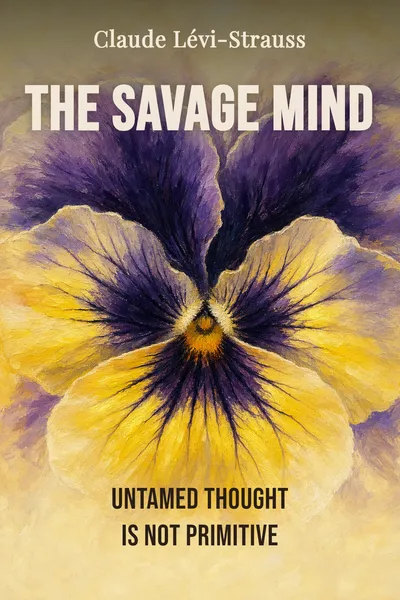
In 1962, a French anthropologist named Claude Lévi-Strauss published a book with a title that reads today like a provocation: La Pensée sauvage, translated into English as The Savage Mind. The pun is untranslatable — pensée in French means both "thought" and "pansy," the flower, which is why the original cover carried an image of the wild pansy. But the provocation survives the translation. For most of the history of Western thought, the mind of people living in societies without writing, without cities, without formal science had been filed under a single word: primitive. Simpler. Earlier. A rung below us on some ladder of reason. Lévi-Strauss set out to dismantle that idea, and he did it not with outrage but with plants, animals, kinship charts, and a tour of the categories that so-called primitive peoples actually use.
His claim, stated plainly, is that there is no such thing as a primitive mind. There is only the untamed mind — thought in its wild state, before science domesticated a corner of it. A hunter who can name and distinguish hundreds of species, track their habits, and organize them into an elaborate system is not doing something cruder than a botanist. He is doing something rigorous with different materials. The intelligence is the same intelligence. What changes is what it grabs hold of.
That single move reshaped anthropology and unsettled philosophy. It meant the boundary the West had drawn between magical thinking and rational thinking, between "them" and "us," was not a boundary between two kinds of brain. It was a boundary between two ways of putting a shared faculty to work — and neither one, Lévi-Strauss insisted, was the childhood of the other.
The question we’re asking : What does it mean to call a whole way of thinking "savage" — and is that mind really below ours, or just aimed elsewhere?What we’ll see : How a science built out of the concrete world turns out to be as demanding as our own, and what it makes of a thinker who builds with whatever is at hand.
Table of contents
01Chapter 1 — The gardener who names two hundred plants
Lévi-Strauss opens with an inventory, and the inventory is the argument. Across the ethnographic record, he assembles case after case of people whose knowledge of the living world puts most modern city-dwellers to shame. The Hanunóo of the Philippines distinguish roughly two thousand plants where a botanist's survey might record around thirteen hundred. A single group can hold in mind the names, uses, and seasonal behaviors of hundreds of birds, insects, and mammals. This is not vague familiarity. It is a system, learned young, carried in memory, and constantly refined.
The point is that this knowledge is not driven by need alone. You do not have to identify two hundred plants to eat. Much of what is named and classified is of no practical use whatsoever — plants nobody harvests, animals nobody hunts, distinctions with no economic payoff at all. Lévi-Strauss reads this as decisive. If people classify far beyond what survival requires, then classification is not merely a tool. It answers an intellectual demand — the demand for order itself, the refusal to leave the world an undifferentiated blur.

02Chapter 2 — A science of the concrete
Lévi-Strauss gives this untamed thought a name that has stuck: the science of the concrete. Modern science works by abstraction. It strips away the sensible qualities of things — color, smell, texture, taste — in order to reach the properties that can be measured, weighed, and written as an equation. The science of the concrete does the opposite. It builds its whole system out of exactly those sensible qualities. A world is sorted by what is hot and cold, raw and cooked, high and low, male and female, sky and earth.
This is not a poorer method. It is a different one, and within its terms it is astonishingly systematic. A single animal might be classified at once by where it lives, how it moves, what it eats, what sound it makes, and what it means. From these concrete traits, whole cosmologies are constructed, in which the parts mirror and answer one another. Lévi-Strauss shows that a totemic system — where a clan is linked to an eagle, another to a bear — is not a confused belief that people descend from animals. It is a code. The differences between species are borrowed to think about the differences between human groups. Animals, in his famous phrasing, are not chosen to eat but chosen to think with — they are good to think.
03Chapter 3 — The logic that has no name for it
If the science of the concrete is a genuine logic, why did the West so long fail to see it? Lévi-Strauss's answer is that we mistook its subject matter for its intelligence. Because it dealt in myths, spirits, and totems, we assumed the reasoning behind it must be loose, emotional, pre-logical. He argues the exact reverse: the operations are as tight as our own. Classification, opposition, symmetry, inversion — these are formal moves, and the mind that makes them is obeying constraints as strict as any grammar.
He is especially hard on the old idea, associated with earlier anthropologists, that primitive thought is dominated by feeling and mystical participation rather than by the demand for consistency. On the contrary, he shows a relentless drive toward order everywhere he looks. Nothing is left unclassified. A new object, a stranger, an anomaly — each is immediately absorbed into the existing scheme, given a place, related to everything else. This horror of the loose end is not the mark of a mind afraid of the world; it is the mark of a mind determined to make it intelligible down to the smallest detail.
04Chapter 4 — Bricolage against engineering
The image Lévi-Strauss leaves us with is that of the bricoleur — the tinkerer, the odd-job man who makes do with whatever is lying around. The bricoleur does not go out and acquire the perfect tool for the task. He works from a fixed stock of odds and ends, accumulated over time, whose only common feature is that they might come in handy someday. Faced with a problem, he rummages through this heap and asks what each fragment could be made to do. His materials carry histories and previous uses, and he builds by redeploying them.
Against him stands the engineer. The engineer starts from the concept, defines exactly what he needs, and procures materials made to specification. Where the bricoleur is bounded by his inventory, the engineer opens onto the whole universe of raw materials, constrained only by the state of theoretical knowledge. Lévi-Strauss maps this contrast onto his two forms of thought: mythical thinking is bricolage, assembling meaning out of the leftover images and events a culture has to hand; scientific thinking is engineering, building outward from abstract concepts toward new structures the given world never contained.
05Conclusion
The book that opened with a joke about a flower closes by dissolving the very distinction its title seemed to assume. There is no savage mind on one side and civilized mind on the other. There is one mind, working sometimes with abstract concepts and sometimes with the raw stuff of the sensible world, sometimes as engineer and sometimes as bricoleur — and doing all of it with the same appetite for order. The peoples the West had filed under "primitive" turn out to command sciences of the concrete every bit as demanding, and every bit as logical, as the science we happen to prize.
Related books