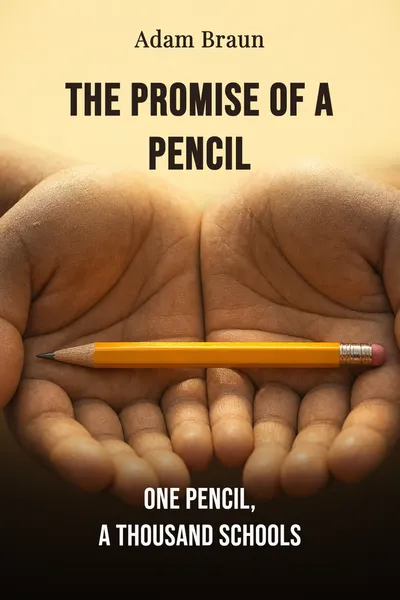
The Promise of a Pencil
One pencil, a thousand schools
Description
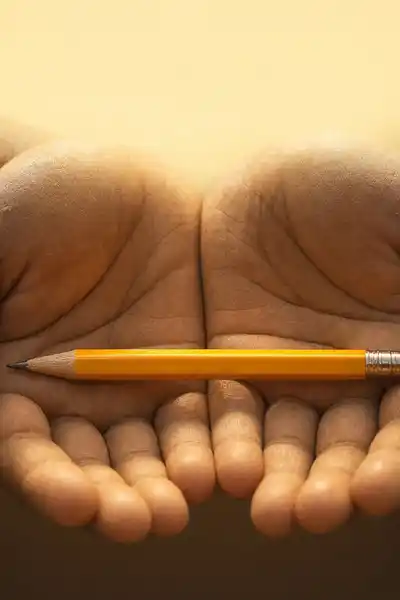
In the mid-2000s, a college student from Long Island named Adam Braun spent a semester at sea, then kept traveling on his own — backpacking through more than fifty countries with the specific habit of asking children in each one a single question. If you could have anything in the world, what would you want? The answers ranged from the grand to the impossible: a car, a house, a dance. Then, on a street in India, he put the question to a young boy who was begging, and the boy said something Braun had not heard before. A pencil.
Braun had one in his backpack. He handed it over and watched the boy's face open with a kind of wonder that a pencil, in most of the world, does not produce. It was a small moment, the sort a traveler files away and forgets. Except Braun didn't forget it. He kept asking the pencil question, kept handing out pencils, and eventually did the thing most people never do with a passing feeling — he built something on top of it. In 2008, with $25, he started an organization he called Pencils of Promise.
The memoir he wrote about it, published in 2014, is partly the story of how a twentysomething with a comfortable job at a management consulting firm walked away to open schools in Laos, Guatemala and Ghana. But it is also a book with a quieter argument underneath the inspiration — about what separates a warm gesture from a working institution, and why good intentions almost never survive contact with reality unless they are forced to grow up.
The question we’re asking : How does a single street-corner encounter become an organization that builds hundreds of schools — and what has to change along the way?What we’ll see : How a chance question turned into a working nonprofit, and what the pencil reveals about the distance between wanting to help and actually doing it.
Table of contents
01 Chapter 1 — The boy on the street and the question
Braun grew up in a family that talked about giving back but lived a fairly ordinary suburban life. He was headed, by his own account, toward the standard version of success — a good degree, a consulting job at Bain, the steady climb. The travel that reshaped him started with Semester at Sea, a study-abroad program run on a ship, which was nearly wrecked by a rogue wave off the coast of Hawaii early in his voyage. The near-disaster left him with a blunt sense that the safe path he had planned wasn't guaranteed anyway, so he might as well spend his time on what mattered.
What mattered turned out to be that question he kept asking children everywhere he went. It was a small ritual, a way to connect across language and circumstance. Most kids named objects or dreams scaled to what they'd seen. The boy in India named a pencil because a pencil, to him, meant school, and school was the thing he was on the outside of. That gap — between what a pencil costs us and what it represents to a child locked out of education — is the hinge the whole book turns on.

02 Chapter 2 — Thirty questions, thirty schools
When Braun finally started Pencils of Promise, he did it with $25 deposited into a bank account and no real infrastructure. The name mattered to him — he insisted the schools be built with, not for, the communities they served, and that families contribute land, labor or materials so the buildings would belong to them rather than to a distant donor. The first school opened in Laos. It cost far less than most Westerners assume a school costs, which was part of the point: the barrier was rarely money alone, it was organization and trust.
The book is structured around what Braun calls his mantras — thirty short principles that double as chapter titles, each pulled from a specific episode. Some read like startup advice, some like personal-growth affirmations, and a skeptical reader can feel the memoir tipping toward the self-help shelf. But the useful ones are grounded in a real cost he paid. "Make the first move." "Get out of your comfort zone." "Big dreams start with small, unreasonable acts." They are earned the hard way, through fundraising that didn't work and pitches that fell flat.
03 Chapter 3 — Building a for-purpose organization
Braun disliked the word nonprofit. It defines an organization by what it is not, and it carried, for him, a whiff of amateurism — the assumption that charity work should run on good hearts and tolerate sloppy execution. He preferred "for-purpose," and the relabeling wasn't just branding. It reflected a decision to build Pencils of Promise with the discipline of a company: clear metrics, professional staff, a board, real accountability to the people writing checks and the families receiving schools.
This is where the memoir's genre — inspirational, sometimes breathless — sits in tension with its most interesting content. The story wants to tell you that vision and belief carry the day. The details tell you something less romantic. What carried the day was hiring people better than himself at operations, refusing to let the mission excuse bad management, and treating a village in rural Guatemala with the same seriousness a consultant would bring to a corporate client. Braun's Bain training, which he sometimes frames as the life he escaped, is quietly everywhere in how he built the thing.
04 Chapter 4 — When impact needs proof
Step back from the schools and the pencil, and the book is really a case study in the moment a good deed has to decide whether it wants to become an institution. Handing a child a pencil is complete in itself — it costs almost nothing, it feels good, and it asks nothing further of the giver. Building schools that still stand in a decade is a different animal entirely. It demands that the warm feeling be converted into budgets, staff, measurement and the willingness to be told you are failing. Most generosity never makes that conversion, and the book is honest about how uncomfortable the conversion is.
Braun's insistence on "for-purpose" over "nonprofit" points at something broader than one man's vocabulary preference. There is a long, patronizing tradition of expecting less of organizations that do good than of organizations that make money — forgiving them their inefficiency because their hearts are in the right place. Pencils of Promise was built against that expectation. The families had to invest in their own schools; the donors got reports; the outcomes were counted. That refusal to hide behind good intentions is what gives the pencil story a spine.
05 Conclusion
The book ends more or less where it began, with the pencil — but the object has changed weight. What started as a coin dropped into a moment of pity became the organizing symbol of a working organization, one that by the time of writing had put up hundreds of schools across Laos, Guatemala and Ghana. Braun's own arc closes the loop too: the consultant who nearly took the safe ship now measures his life by a different ledger. The near-shipwreck that opened his eyes, the boy who named a pencil, the $25 account — each turns out to be a link in a chain that only looks inevitable in hindsight.
Related books