The Premonition
When the warnings came too late
Description
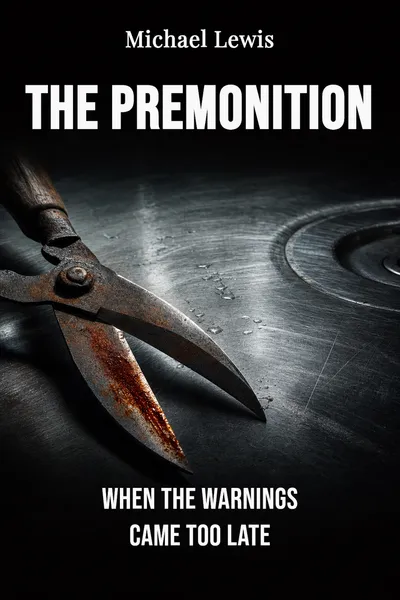
Charity Dean was a local public health officer in Santa Barbara County, California, and in 2013 she found herself in a hospital morgue, cutting into the liver of a dead man with a pair of garden shears because the pathologist refused to touch the body. She suspected tuberculosis. She needed tissue to prove it and force the county to act, and nobody with the proper credentials would help. That image — a woman in a borrowed apron, doing the ugly work herself because the machine around her wouldn't — is where Michael Lewis begins The Premonition, his account of how a handful of Americans saw the coronavirus coming and could not get their own country to move.
The book is not really about the virus. It is about the people who understood, sometimes years in advance, exactly how a pandemic would unfold in the United States, and about the institutions that were supposed to listen to them and did not. Lewis follows a small, scattered group — a county health officer, a couple of physicians who had rewritten pandemic planning inside the George W. Bush administration, a biochemist who could read genomes faster than anyone thought possible — as they collide, in early 2020, with the Centers for Disease Control and Prevention, the most respected public health agency on earth.
What Lewis found was a system rich in expertise and poor in nerve. The knowledge existed. The plans existed. The people who could have acted were, again and again, the ones without the authority, while the people with the authority waited for certainty that never arrives in time. The story is one of premonition in the literal sense: a warning felt clearly, early, and ignored.
The question we’re asking : Why did a country with the world's deepest public health expertise fail to act on warnings its own experts kept sounding?What we’ll see : A handful of outsiders who saw the pandemic coming, and the celebrated agency that couldn't bring itself to move.
Table of contents
01 Chapter 1 — The public health officer who kept a mental list of failures
Charity Dean is the human center of Lewis's book, and the morgue scene is not an exception in her career but a distillation of it. As health officer for Santa Barbara County, she held a strange kind of power — the legal authority, dating back to the era of tuberculosis and smallpox, to quarantine people, close buildings, and override the objections of doctors and businesses in the name of stopping disease. Almost nobody around her wanted her to use it. The instinct of the surrounding system was always to wait, to gather more data, to avoid the lawsuit and the panic. Dean's instinct was the opposite: move first, before the disease had a chance to prove how bad it was, because by the time it proved it, the moment to stop it was gone.
Lewis is drawn to her because she embodies a theory the book keeps circling. Public health, done right, is preemptive and therefore invisible. The reward for stopping an outbreak is that nothing happens, and nothing that happens is hard to take credit for and easy to second-guess. A health officer who acts early looks alarmist. One who waits looks prudent, right up until the bodies appear. Dean spent years learning that the system quietly punished the people who tried to prevent things and protected the people who merely reacted to them.

02 Chapter 2 — The mavericks who saw the shape of it early
The second thread runs through a loose network Lewis calls, only half-jokingly, the Wolverines — a group of doctors and thinkers who had been chewing on the problem of pandemics for fifteen years. Its origins lie in the George W. Bush administration, when Bush read a history of the 1918 flu and demanded a real national plan. Two White House physicians, Richard Hatchett and Carter Mecher, were tasked with building one, and what they came up with was quietly radical. The received wisdom held that you couldn't do much against a fast respiratory virus except treat the sick. Hatchett and Mecher argued you could slow it down — by closing schools, keeping people apart, breaking the chains of transmission before a vaccine arrived.
03 Chapter 3 — The agency that studies pandemics instead of stopping them
The CDC is the antagonist of The Premonition, though Lewis is careful about how he draws it. He is not describing incompetent people. The CDC is full of brilliant scientists, and its reputation for rigor is deserved. His argument is subtler and more damning: the agency had, over decades, transformed from a scrappy disease-fighting outfit into something more like a great academic institution — cautious, publication-minded, allergic to the risk of being wrong in public. It had come to prize the careful retrospective study over the messy real-time decision.
Lewis traces this back to a specific wound. In 1976, the CDC pushed a mass vaccination campaign against a swine flu that never became the pandemic it feared, and the effort was blamed for rare side effects and became a national embarrassment. The director lost his job. The lesson the institution absorbed, Lewis suggests, was not about the science but about the politics: acting decisively and being wrong was career-ending, while waiting and letting events unfold was survivable. An agency that had once cracked outbreaks by sending people into the field learned, slowly, to hedge.
04 Chapter 4 — What a country learns about itself under a virus
Step back from the individual failures and a larger pattern comes into focus, and it is the pattern Lewis is really after. A pandemic is a stress test for a society's relationship to risk — specifically, its willingness to bear the cost of acting on a threat that has not yet fully arrived. Everything about a fast-moving virus punishes delay and rewards preemption, and everything about a mature bureaucracy does the reverse. The United States had assembled, over decades, more scientific talent and better plans than perhaps any nation on earth. What it had not assembled was a place where someone was both able to see the danger and authorized to act on it before it became undeniable.
05 Conclusion
The Premonition ends where a triumphant story would have begun. The people Lewis follows were right — about the virus, the timing, the need to move early — and being right changed almost nothing. Charity Dean eventually left government, worn down by the distance between what she could see and what she was allowed to do. Hatchett, Mecher, and the rest kept trading their urgent emails, watching the country walk into the disaster they had spent fifteen years describing. The plan existed. The talent existed. The premonition was clear and specific and shared among people who had the credentials to be believed.
Related books