

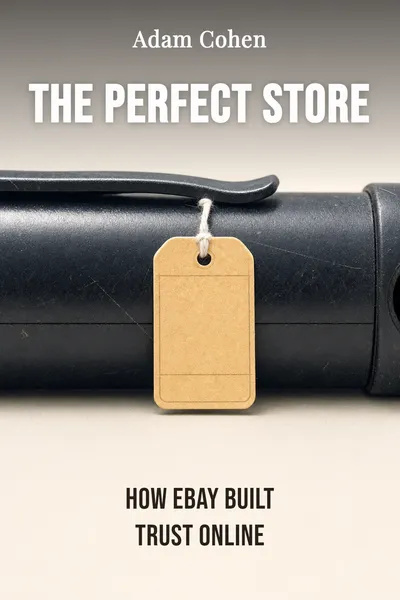
The Perfect Store
How eBay built trust online
Description
On Labor Day weekend in 1995, a software developer named Pierre Omidyar sat down at his home in the Bay Area and wrote code for a side project he called AuctionWeb. It lived as one page inside a larger personal site he was already paying to host, alongside, among other things, a tribute to the Ebola virus. The first item that sold was a broken laser pointer. Omidyar emailed the buyer to make sure he understood it didn't work. The reply came back: the man collected broken laser pointers. Something about that exchange stuck.
Within months the little auction page was pulling more traffic than everything else Omidyar hosted, and his internet provider started charging him business rates. So he began charging sellers a small cut of each sale. Checks arrived in the mail — more than he could open. By 1998 the thing he'd built over a weekend had a real name, eBay, a chief executive poached from Hasbro named Meg Whitman, and one of the most talked-about public offerings of the dot-com boom. It was profitable, which almost no internet company of the era could say.
Adam Cohen was given rare access to the company at the peak of that ascent, and the book he wrote from it, The Perfect Store, is less about a website than about a strange new kind of place — one where millions of strangers agreed to send money to people they would never meet, for goods they could not touch, and mostly got what they paid for. That agreement was not obvious. It had to be built.
The question we’re asking : How did a company selling nothing of its own get millions of strangers to trust one another with their money?What we’ll see : The founding weekend, the mechanism that made honesty pay, the moments trust nearly broke, and what eBay revealed about commerce itself.
Table of contents
01Chapter 1 — A broken applet and a Pez legend
For years the origin of eBay came wrapped in a charming story: Omidyar built it so his fiancée, Pam, could trade Pez dispensers with other collectors. It was a lovely tale, repeated in profiles and press kits, and Cohen's reporting makes clear it was mostly invention — a bit of narrative polish added later by an early public-relations hire who understood that a broken laser pointer made for a duller founding myth than a candy dispenser. The truth was plainer. Omidyar was interested in markets, and in whether a genuinely open one could exist online.
What he actually believed in was closer to a small political theory than a business plan. Omidyar had a libertarian streak and a real conviction that people, left to sort things out among themselves, were basically decent. AuctionWeb was an experiment in that idea. There was no warehouse, no inventory, no staff walking the floor. The site simply introduced a person who had something to a person who wanted it, took a modest fee, and stepped back. The buyers and sellers did everything else — set prices, described goods, mailed packages, settled disputes.

02Chapter 2 — The feedback that ran the place
The single most important thing Omidyar built was not the auction software. It was the Feedback Forum. After every transaction, buyer and seller could rate each other — positive, negative, or neutral — and leave a line of comment. Those ratings accumulated into a public score attached to every username, visible before anyone bid a cent. A seller with nine hundred positives and no negatives was a known quantity. A brand-new account with a suspiciously cheap Rolex was not. Reputation, on eBay, became currency.
This was a quietly radical solution to the oldest problem in trade among strangers: how do I know you won't cheat me? For most of history the answer was proximity — you dealt with the merchant in your town because he'd be there tomorrow and your neighbors would hear if he robbed you. eBay had no town. So it manufactured the equivalent. Cheating someone now cost you your rating, and your rating was the thing that let you keep selling. Honesty stopped being a virtue and became, for anyone who wanted to stay in business, simply the smart play.
03Chapter 3 — When the company got out of the way
Trust, once built, was easy to spend and hard to replace, and eBay's hardest years were the ones where the technology strained. The most dangerous stretch came in June 1999, when the site crashed and stayed down for twenty-two hours. For a marketplace, going dark meant every running auction froze, every seller lost sales, and every buyer wondered whether the whole thing was as solid as they'd assumed. The stock fell hard. The engineering had simply not kept pace with the growth, and for a company whose entire value was reliability, an unreliable site was an existential threat.
Whitman's response revealed what kind of company eBay had become. Rather than issue a terse corporate statement, executives got on the phones with users, credited fees, and treated the outage as a broken promise to a community rather than a service interruption to be managed. They over-invested in the technical backbone afterward, hiring aggressively and rebuilding the infrastructure so the site could carry loads no one had planned for. Underneath the folksy tone was a serious operating discipline.
04Chapter 4 — What a marketplace is really made of
Step back from the auctions and the Pez and what eBay actually solved was the problem the early internet kept tripping over. The web made it trivially cheap to connect a buyer in Ohio with a seller in Portugal. What it could not do, on its own, was make either one believe the other would hold up their end. Everyone in the 1990s could see the connectivity. Very few figured out the trust. eBay's real invention was not a way to hold auctions online — it was a way to make strangers accountable to one another at internet scale.
The mechanism was almost boring in its elegance. Give every participant a persistent identity, attach to it a public record of how they've behaved, and let that record be the thing they can't afford to burn. It is, in a sense, how reputation has always worked in small communities — but eBay engineered it into software and thereby scaled it to millions of people who shared no geography, no language, no prior contact. Reputation became portable, legible, and permanent, and on that foundation a genuine economy could stand.
05Conclusion
eBay never did become the thing it feared — a warehouse, an inventory, a store with its own shelves. It stayed, at its core, the odd little experiment Omidyar coded over a holiday weekend: a place that owned nothing and sold nothing, and made its money renting out the trust it had learned to grow. The broken laser pointer that a stranger wanted anyway turned out to contain the whole idea. People will trade almost anything, with almost anyone, if you give them a good enough reason to believe.