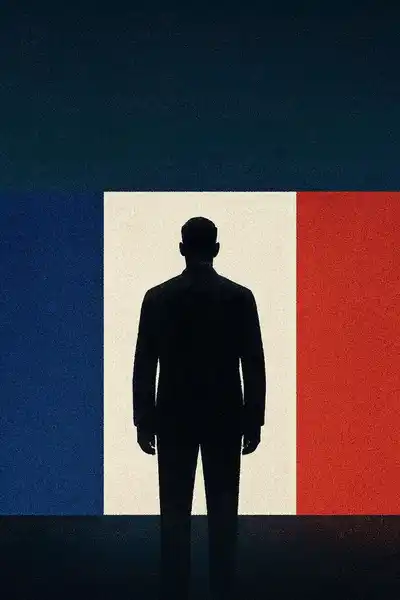
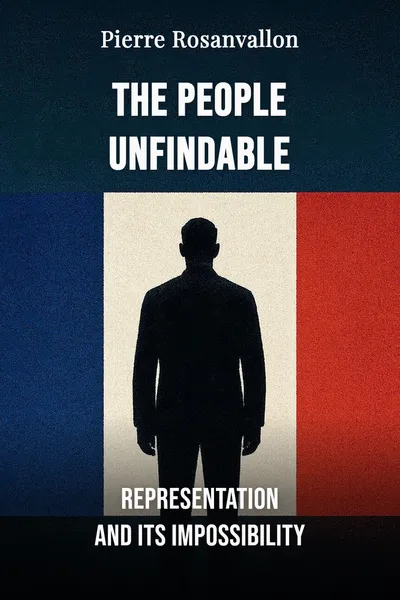
The People Unfindable
Representation and its impossibility
Description
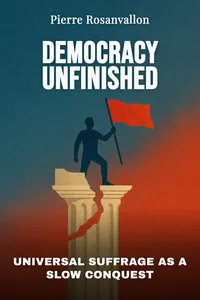
There's a phrase that gets thrown around at every election, on every ballot line, in every speech that begins with a raised chin: the will of the people. We treat it as if it pointed at something solid, a thing you could photograph or poll or put in a room. The French historian Pierre Rosanvallon spent a career poking at that assumption, and in a book he titled Le peuple introuvable — the people unfindable — he laid out an uncomfortable idea. The people that democracy claims to represent has never actually been locatable. Not because the surveys are bad. Because there is no single object there to find.
This is not a cynic's point. Rosanvallon is not saying democracy is a con. He's a historian of French democracy from the Revolution onward, and what he traces is stranger and more interesting than fraud. From 1789 to the present, every attempt to make "the people" visible — to count it, to picture it, to seat it in a chamber — has run into the same wall. The people is invoked constantly and grasped never. And rather than admit defeat, democratic societies kept inventing new machinery to close a gap that, it turns out, cannot be closed.
That gap is the whole subject. It sits between the flesh-and-blood millions who live in a country and the tidy abstraction a government points to when it says it speaks for them. Rosanvallon's book is a history of that gap: how it opened, how people tried to bridge it, and why the bridges kept collapsing. What we get from it is less a diagnosis than a way of seeing what representation has actually been doing all along.
The question we’re asking : If the people can never quite be located, what exactly are democracies representing when they claim to represent it?What we’ll see : How a two-century French effort to make "the people" visible kept failing, and what that stubborn failure reveals about representation itself.
Table of contents
01 Chapter 1 — When the people stopped being a body
Before modern democracy, the question barely arose. Sovereignty had a face. It sat on a throne, it was a body you could bow to, a person with a name and a lineage. Power was embodied, quite literally, in the king. You knew where sovereignty was because you could point at the man wearing it. The old order had many injustices, but ambiguity about the location of authority was not among them.
The French Revolution decapitated that certainty along with the king. Once sovereignty passed from the monarch to "the nation" or "the people," it lost its body. Rosanvallon's point is that this was not a small administrative handover. It created a new kind of political object that had never existed before — a sovereign that everyone agreed was supreme and that no one could actually see. The people was declared the source of all legitimate power in the same breath that made it impossible to point to.

02 Chapter 2 — The unfindable majority
The most obvious way to find the people is to count it. Add up the votes, and the majority speaks. This is the intuition behind universal suffrage, and its arrival across the nineteenth century felt like the solution to Rosanvallon's whole problem. If you can't point at the people, you can at least tally it. Numbers seemed to give the abstraction a hard, verifiable form at last.
Except the number never quite delivered the whole. A majority is not the people; it is a slice of the people, and often a thin one. Fifty-one percent governs the forty-nine, and the losing side does not stop being part of the nation the morning after the vote. Rosanvallon shows how the equation of majority with people was always a convenient fiction, tolerated because it produced decisions, not because anyone truly believed the outnumbered had ceased to count. The arithmetic settled who would rule; it did not conjure a unified will.
03 Chapter 3 — The impossible portrait
If counting won't do it, perhaps you can depict it. A recurring dream in Rosanvallon's history is the idea that a parliament should be a portrait of the nation — a chamber that mirrors the society outside, its trades and classes and regions faithfully reproduced in miniature. Get the picture right, the thinking goes, and representation becomes almost automatic. The assembly would simply be the people, shrunk to a workable size.
The trouble is deciding what the portrait should capture. Represent the country by profession, and you erase region. Balance it by region, and you flatten class. Weight it by class, and you neglect generation, or belief, or the thousand identities a modern society carries at once. Every mirror has to choose an angle, and every angle leaves someone out of frame. The society being depicted has no single true likeness, because it is not one thing — it is a churn of overlapping groups that refuse to line up into a stable image.
04 Chapter 4 — A democracy that lives on its own doubt
Step back from the particular failures and a pattern emerges that Rosanvallon treats as the real discovery of his book. Representation does not rest on a solid foundation that occasionally cracks. It rests on a fiction that everyone half-knows to be a fiction — the fiction that a chamber, a majority, a set of officials can stand for a people that cannot be found. What holds a democracy together is not the successful location of that people. It is the shared agreement to keep acting as if it had been located.
This sounds fragile, and it is. But Rosanvallon's argument is that the fragility is also the strength. A regime that genuinely believed it had captured the people — that its majority was the whole, that its assembly was the perfect mirror — would have no reason to tolerate dissent, revision, or the next election. It would have arrived. The unfindability of the people is precisely what keeps the question open, what forces power to submit itself again and again to a verdict it can never finally own. The gap is not a defect in the machine. It is what keeps the machine turning.
05 Conclusion
The book began with a king who could be pointed at and a Revolution that removed him, leaving a sovereign with no body. Everything that followed — the ballot counts, the proportional formulas, the dream of a parliament that mirrors the nation — was an effort to give that missing body some form. Rosanvallon's history is the record of those efforts and of their honorable, repeated failure. The people was never once located, and the search never once stopped.
Related books