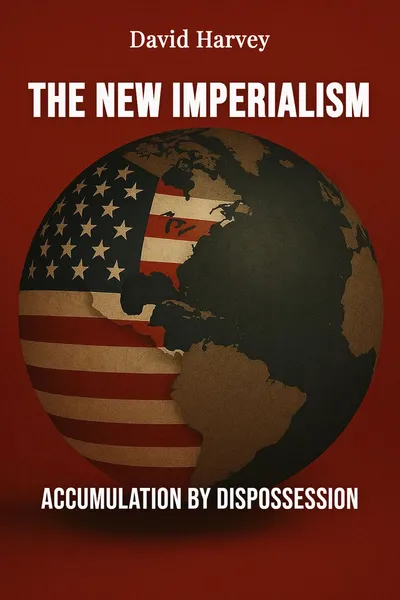
The New Imperialism
Accumulation by dispossession
Description
In March 2003, American and British forces rolled into Iraq, and the official story came in several versions that never quite lined up. Weapons of mass destruction that were never found. A war on terror bolted onto a country with no established link to the attacks it was meant to answer. The spread of democracy. For David Harvey, a Marxist geographer watching from the City University of New York, none of these explanations held on their own — and yet dismissing the whole thing as a war for oil felt too crude, too pat. Something was moving underneath the rhetoric, something that had less to do with a single barrel of crude and more to do with how power and money need each other to survive.
That same year Harvey published a short, dense book trying to name what he was seeing. He called it The New Imperialism. His wager was that the events of the early 2000s were not an aberration, not the private folly of a few neoconservatives in Washington, but a symptom of something structural. Capitalism, he argued, has a spatial problem. It produces more surplus — more money, more goods, more capacity — than it can profitably reinvest inside its own borders, and it must keep finding somewhere else to put it. Empire, in this reading, is what that pressure looks like when it hits the map.
The book's most quoted contribution is a phrase Harvey coined to describe how capital keeps its own crisis at bay: accumulation by dispossession. It sounds academic, and it is, but it points at something we recognize — the sense that value is often not created so much as taken, that someone's gain is quietly built on someone else's loss. Harvey's ambition was to link the tanks in Baghdad to that quiet taking, and to argue they belong to the same story.
The question we’re asking : Why does capitalism keep producing empire, and what is it actually taking when it expands?What we’ll see : How Harvey reads the geopolitics of the early 2000s as the surface of a deeper pressure — capital's constant need for somewhere to go, and the old form of theft it revives to keep moving.
Table of contents
01Chapter 1 — The 2003 invasion and the puzzle of capital
Harvey starts with a refusal. He will not accept that the Iraq invasion can be explained by any of the reasons offered at the time, and he will not accept the counter-explanation — pure greed for oil — either. Both treat the war as a discrete decision made by particular people for particular motives. Harvey wants to read it as an expression of tendencies that run through the whole system, tendencies that would produce something like this war even if the specific personalities in charge had been different. The invasion is his way into a bigger argument.
The bigger argument concerns the United States and its position in the world after the Cold War. By the early 2000s, Harvey observes, American economic dominance was no longer as secure as its military dominance. Production had shifted toward East Asia. Financial power was still concentrated in New York, but the country that had underwritten the postwar order was increasingly a debtor rather than a creditor. Control of the flow of oil — and therefore of the currency in which oil is priced and the economies that depend on it — offered a way to shore up an eroding economic hegemony through the one form of superiority America still held outright: force.

02Chapter 2 — Two logics that don't always agree
Harvey's central analytical move is to separate two forces he says are always braided together in imperialism but never identical. The first he calls the territorial logic of power: the ambition of states and politicians to control territory, secure borders, project influence, and defend a population within a fixed patch of the map. This logic thinks in terms of geography and duration. A state wants to hold ground and endure. Its calculations are strategic, not immediately monetary.
The second he calls the capitalist logic of power: the ambition of money to grow, which recognizes no borders and no loyalty to place. Capital flows wherever the return is highest and abandons wherever it is not, indifferent to whether that helps or harms any particular nation. This logic thinks in terms of flows and returns, not fixed ground. Where the territorial logic wants to plant a flag and stay, the capitalist logic wants to move on the moment a better rate appears somewhere else.
03Chapter 3 — The old trick with a new name
Here Harvey introduces his signature concept. Marx had described what he called primitive accumulation — the violent, one-time process by which peasants were driven off common land, colonies were plundered, and the initial pile of capital was assembled that let industrial capitalism begin. The standard reading treated this as a phase, a brutal but finished chapter that belonged to capitalism's origins. Once the system was up and running, the theory went, it would grow by ordinary reinvestment of profit, no longer needing to seize things by force.
Harvey's argument is that this seizing never stopped. He renames it accumulation by dispossession to signal that it is ongoing, not primitive, not confined to the past. Whenever capital cannot find enough profitable room to reinvest at home, it turns to taking assets that already exist and pulling them into the market — often assets that were previously held in common, publicly, or outside the circuit of profit entirely. Dispossession is theft repackaged as expansion, and it recurs whenever the system runs short of new outlets.
04Chapter 4 — Where the surplus has to go
Step back from Iraq and the argument reveals its spatial core. Capitalism, in Harvey's reading, is haunted by overaccumulation: it regularly produces more capital and labor than it can profitably combine in one place. When that surplus has nowhere to go, the result is crisis — idle money, idle factories, idle people. To avoid this, capital must constantly discover new spaces to absorb what cannot be used at home. Harvey calls the solutions "spatio-temporal fixes": investing in distant places, or in long-term projects that defer the reckoning into the future.
Geopolitics, on this view, is largely the management of that pressure across the map. Building infrastructure abroad, opening foreign markets, financing far-off development — these are ways of parking surplus capital where it can still earn a return. But a fix is only ever temporary. The new space eventually develops its own overaccumulation, its own surplus needing an outlet, and the search begins again, one step further out. Empire is less a project of domination for its own sake than a perpetual hunt for the next place to put the money before it turns toxic at home.
05Conclusion
Harvey wrote The New Imperialism in the heat of 2003, and its immediate target was a war whose official justifications were already fraying. But the book outlasts that moment because it treats the war as a clue rather than a subject. Behind the shifting rationales, Harvey saw a dominant power reaching for territory to shore up an economic position that money alone could no longer defend — the territorial logic and the capitalist logic straining to keep step, and dispossession filling the gap when they couldn't.
Related books