The Master Algorithm
The algorithm that learns everything
Description
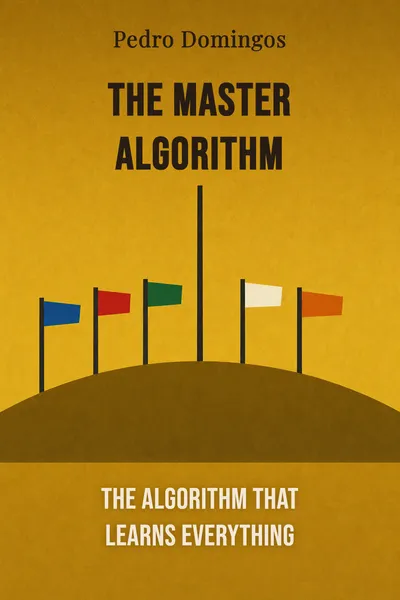
In 2015, a University of Washington computer science professor named Pedro Domingos published a book with an unusually bold title: The Master Algorithm. The claim behind it was even bolder. Somewhere out there, Domingos argued, might sit a single learning algorithm capable of deriving all knowledge — past, present and future — from data. Not a program hand-coded for chess, or spam, or face recognition, but one general-purpose learner that could figure out anything, given enough examples. It was part science, part manifesto, written not for his peers but for the rest of us, the people whose lives were already being quietly reorganized by systems we never chose and mostly never noticed.
That was the wager, and it landed at a strange moment. Machine learning had already slipped into daily life — sorting our mail, ranking our searches, recommending our films — without most of us registering that anything unusual was happening. Domingos wanted to lift the hood. And what he found under it wasn't one field marching toward one answer. It was five rival camps, each with its own philosophy of how learning works, each convinced it held the master key, and mostly ignoring one another. The tidy story of "AI" turned out to be a quarrel.
His book is an attempt to referee that quarrel and, more ambitiously, to end it — to show that the five approaches might be pieces of a larger machine nobody has finished building yet. Along the way it becomes something rarer than a technical primer: a guided tour of how machines actually learn, written by someone who thinks the rest of us deserve to understand the thing that increasingly understands us.
The question we’re asking : Is there a single algorithm that could learn anything at all, and what would it take to build it?What we’ll see : How a working researcher maps the warring schools of machine learning and gambles on their reconciliation.
Table of contents
01 Chapter 1 — The dream of one algorithm to rule them all
The premise of the book sounds almost mystical until Domingos grounds it. Every algorithm we normally write does one narrow thing: it takes an input and follows fixed instructions to produce an output. A learning algorithm is different in kind. You feed it data and examples, and it writes its own instructions — it produces the program. That shift, from coding the answer to coding the thing that finds the answer, is what makes machine learning feel less like engineering and more like cultivation. You don't build the model; you grow it.
From there the leap is natural. If one learner can master spam by seeing enough emails, and another can master medical diagnosis by seeing enough patient records, why should the underlying method differ? Domingos points to a suggestive fact: the brain seems to run on one fairly uniform learning procedure across vision, hearing and language. Evolution, likewise, produced the staggering variety of life from a single mechanism. If nature reuses one algorithm to such effect, the idea of a master algorithm — one universal learner from which every specific application could be derived — stops sounding like science fiction and starts sounding like a research program.

02 Chapter 2 — Five tribes, five ways to learn
The heart of the book is a taxonomy Domingos makes vivid: five tribes of machine learning, each descended from a different intellectual tradition and each staking a claim to the master algorithm. The symbolists come from logic and philosophy. For them, learning is the reverse of deduction — filling in gaps in existing knowledge by inferring rules from facts. Their signature tool is the decision tree, a cascade of if-then questions, and their strength is that the result is legible. You can read why the machine decided what it did.
The connectionists take their cue from neuroscience. Learning, for them, is adjusting the strengths of connections in a network of artificial neurons until the whole thing gets the answer right — the approach that would explode into what we now call deep learning. Their master tool is backpropagation, the technique that lets a network apportion blame across its layers and correct itself. The evolutionaries borrow from Darwin instead. They breed programs, mutating and recombining candidate solutions and letting the fittest survive across generations, discovering structures no human would have designed.
03 Chapter 3 — Where the tribes already run our lives
The tour would stay abstract if Domingos left it in the lab, so he keeps pulling the tribes back down to earth. The recommendations that decide what we watch and buy are analogizers at work, judging that people like us liked this. The spam filter guarding our inbox is, more often than not, a Bayesian weighing the odds word by word. The systems that read medical scans and flag anomalies lean on connectionist networks trained on millions of images. None of these arrive labeled with their intellectual pedigree. They just work, invisibly, until we stop to ask how.
He is especially good on the stakes hiding inside these applications. In medicine, a learner that can predict which treatment suits which patient begins to personalize care in ways no single doctor could. In genetics, algorithms sift the genome for the patterns that link a gene to a disease, doing in hours what would take a career by hand. In economics and finance, learners price risk and spot fraud by finding structure in oceans of transactions. The common thread is scale: these are problems with too much data and too many variables for human intuition, which is exactly the terrain where learning machines outrun us.
04 Chapter 4 — When one learner isn't enough
Step back from the five tribes and the deeper argument of the book comes into focus. Domingos isn't merely cataloguing techniques; he's making a claim about maturity. A field with five rival paradigms that ignore each other is a field still in adolescence, each faction defending its territory rather than building the shared structure the problems actually require. The call for a master algorithm is really a call to grow up — to stop treating logic, neurons, evolution, probability and analogy as competing religions and start treating them as organs of one body.
His own sketch of that unification, a framework he calls Alchemy, tries to fuse the tribes' strengths into a single formalism — logic for structure, probability for uncertainty, and the machinery to learn both at once. Whether or not that particular attempt succeeds, the instinct behind it has aged well. The most powerful systems built since the book appeared are hybrids, stitching together approaches that the old tribal boundaries kept apart. The quarrel, it turns out, was slowing everyone down.
05 Conclusion
The book opened with a dare — that a single algorithm might one day learn everything — and it closes without pretending the dare has been won. What Domingos delivers instead is a map: five ways of learning, each brilliant and partial, and a case that their reconciliation is both the next scientific frontier and the thing most likely to reshape ordinary life. The master algorithm remains a hypothesis. But the pursuit of it turns out to be the clearest lens we have for seeing what machine learning actually is beneath the hype.
Related books