The Legend of Bouvines
One battle, eight centuries of retelling
Description
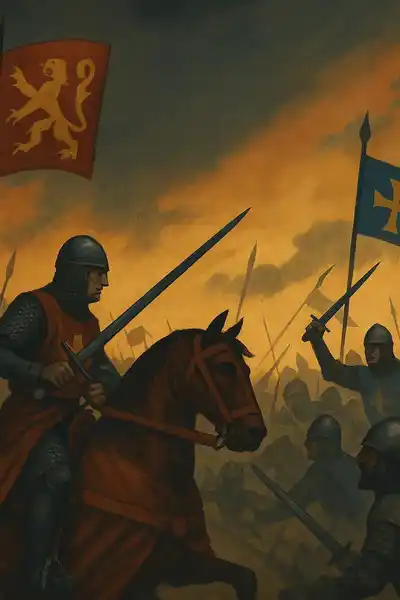
On Sunday, July 27, 1214, in a marshy stretch of Flanders between Lille and Tournai, the king of France, Philip Augustus, met a coalition army led by the Holy Roman Emperor Otto IV and beat it in a single afternoon. The fight was short, confused, and by the standards of great battles, not especially large. A few hours of hacking in the summer heat, a bridge, a broken imperial standard, some captured counts led back to Paris in chains. Medieval battles were rarely decisive, and this one settled a specific quarrel over a specific set of claims. Then everyone went home.
Except the afternoon refused to stay in 1214. Seven hundred years later, French schoolchildren were still learning that Bouvines was the day the nation was born — the moment a young country stood up to a foreign emperor and won. That framing did not come from the mud of Flanders. It was assembled, layer by layer, by clerics, monarchs, republicans and republican textbook-writers, each of whom found in the same short battle exactly what their own century needed. The historian Georges Duby set out to watch that assembly happen.
His book takes a modest event and treats its afterlife as the real subject. What interests Duby is less what the knights did on the field than what was said about it afterward, and how the saying kept changing while the facts stayed put. Bouvines becomes a way of asking how a country decides which of its old days matter, and who gets to decide.
The question we’re asking : How did a brief medieval skirmish become one of the founding dates of France, and who kept rewriting it?What we’ll see : How a single July afternoon was recorded, mythologized, and repurposed across eight centuries of French history.
Table of contents
01Chapter 1 — A Sunday nobody was supposed to fight on
The situation in 1214 was a tangle of overlapping claims. Philip Augustus had spent his reign clawing territory back from the Plantagenets, and John of England — Lackland, the loser of Normandy — had assembled a coalition to reverse the losses. Around him gathered Otto IV, whom the pope had just excommunicated, the count of Flanders, the count of Boulogne, and a scattering of lords with grievances against the French crown. The plan was a pincer: John pressing from the southwest, the emperor and his allies from the north. Philip would be caught between them.
It nearly worked, then unraveled. The armies met near the bridge at Bouvines on a Sunday, which mattered because Sunday was the Lord's day, and fighting on it carried a whiff of sacrilege that the French side worked hard to pin on their enemies. Philip had heard mass that morning. The chroniclers would make much of the fact that he did not choose the day — the coalition forced it — so that God's peace was broken by the excommunicated emperor, not by the anointed king.

02Chapter 2 — The chroniclers who built the first version
The battle we think we know is largely the work of one man writing shortly after it: Guillaume le Breton, a cleric in Philip's own service, who produced both a prose life of the king and a long Latin epic poem, the Philippide, modeled on Virgil. Guillaume was not a war reporter. He was a court propagandist with a classical education, and he shaped the afternoon into a story with a moral spine. In his telling, the French fight reluctantly, on the defensive, provoked by an oath-breaking coalition that had chosen to profane the Sabbath.
Everything in the account is arranged to carry that weight. Philip prays before the fight and offers his crown to any man worthier of it — a gesture that binds the barons to him by consent rather than mere obedience. God, in Guillaume's version, is plainly on the French side; the excommunicated Otto cannot win a battle he began in sin. The victory is not a matter of numbers or tactics but of legitimacy. The right king, blessed by the church, defeats the wrong emperor. What actually happened on the field is refracted entirely through this frame.
03Chapter 3 — Seven centuries of borrowing the same afternoon
For most of the Middle Ages, Bouvines slumbered as one royal victory among others, invoked when the crown needed to remind the barons of their loyalty but rarely central. The monarchy kept it in reserve. The battle mattered because it had once bound king and knights together in a shared triumph, and that binding could be summoned again whenever royal authority felt shaky. It was a monarchical memory, tended by monarchical institutions, in a France that still thought of itself as the king's kingdom rather than a nation.
Then the story's owner changed. The Revolution had little use for a battle that glorified a sacred king, and for a while Bouvines went quiet. But the nineteenth century, hungry for a national past, rediscovered it and stripped out the monarchy. In the hands of Romantic and republican historians — the age of Augustin Thierry and later of the great school textbooks — Bouvines stopped being the king's victory and became the nation's. The peasants and townsmen who fought were promoted from extras to protagonists; the day became the moment when France, as a people, first felt itself against a foreign invader.
04Chapter 4 — A battle is never finished being fought
Step back from the marshes and Bouvines becomes something larger than a battle: a demonstration of how a past gets made. Duby's real subject is the machinery by which an event, once it is over, stops being an event and becomes material — raw stuff that later generations quarry, shape and reshape according to needs the original actors never imagined. Philip Augustus did not fight to found a nation. The nation was assigned to him, retroactively, by people who needed a founding and found his Sunday convenient.
This is why Duby refuses to write a straightforward account of who won and how. He knows that the winning was decided long ago and that the interesting contest happened afterward, in the writing. Each retelling is itself a kind of battle, fought over what the day was allowed to mean. The chronicler defending sacred monarchy, the republican textbook enlisting the common people, the wartime patriot summoning France against Germany — all are combatants in a struggle that the men of 1214 could not have understood, using their afternoon as a weapon.
05Conclusion
Guillaume le Breton finished his account and could not have guessed that seven centuries later French schoolchildren would still be reciting his Sunday, or that his sacred king would be quietly recast as a republic. The afternoon at Bouvines lasted a few hours; its retelling has lasted eight hundred years and shows no sign of stopping. Duby's achievement is to have made the retelling visible — to have shown that the version we inherit was never the only one, and that each age wrote over the last without erasing the parchment underneath.
Related books