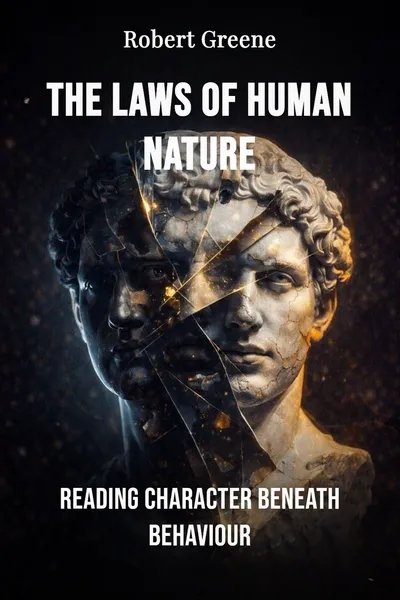
The Laws of Human Nature
Reading character beneath behaviour
Description
Robert Greene published The Laws of Human Nature in 2018, and it opens with a bet that runs against most of how we live: that we spend our days studying nearly everything except the one force that shapes our fate more than any other — the behaviour of the people around us, and our own. We learn markets, spreadsheets, the news cycle. Human nature we assume we already know, because we've been human our whole lives. Greene's claim is that this assumption is precisely the trap. We are the least reliable observers of the thing we're most confident about.
The book is thick — some six hundred pages, eighteen laws, each anchored in a historical figure who embodied it or fell to it. Greene had already spent two decades writing about power and strategy, and he'd noticed a pattern in the people who came undone: they were rarely defeated by outside forces. They were defeated by their own blind spots, by a rival's envy they refused to see, by a charm they mistook for substance, by a mood they let steer a decision it had no business steering. The laws are his attempt to name those forces before they name us.
What makes the book unusual is where it eventually turns the lens. It reads at first like a manual for decoding other people — spotting the manipulator, the narcissist, the aggressor wearing a smile. But the deeper argument keeps circling back to a harder subject, one we'd rather not examine at close range.
The question we’re asking : Why are we so bad at reading the people around us — and even worse at reading ourselves?What we’ll see : How character hides beneath behaviour, how self-deception quietly runs the show, and where Greene finally points the lens.
Table of contents
01Chapter 1 — The mask and the person under it
Greene starts from a distinction most of us blur: the difference between someone's behaviour in a single moment and their character across a lifetime. Behaviour is what we react to — the warm greeting, the generous offer, the flash of temper. Character is the pattern underneath, the deeper grain that produces those moments and will keep producing them long after we've decided the person is who they seemed to be on day one. We judge on the surface because the surface is what's in front of us. Character only reveals itself over time, and usually under pressure.
The mask, in Greene's telling, isn't necessarily a lie. Everyone wears one — the composed face we present to the world, curated to win approval and hide what we'd rather not show. The point isn't to condemn the mask but to remember it exists, and to stop treating the performance as the whole person. A candidate who dazzles in an interview, a partner who is all charm at the start, a boss who preaches loyalty — the presentation tells us what they want us to believe about them, which is its own kind of information, but not the same information as how they behave when things go wrong.

02Chapter 2 — The stories we tell ourselves
If reading others is hard, Greene argues, reading ourselves is nearly impossible — and not by accident. Self-deception isn't a flaw in the machine; it's one of the machine's core functions. We run a constant internal narrative in which we are reasonable, generous, and right, and the mind works overtime to keep that story intact. When we act badly, we don't usually feel we've acted badly; we feel we were provoked, misunderstood, or left with no choice. The self-image is defended more fiercely than almost anything else we own.
The engines Greene identifies are old and familiar once named. Envy, which we almost never admit to feeling, gets recoded as moral disapproval — we don't resent someone's success, we've simply noticed they don't deserve it. Grandiosity inflates our sense of our own importance and quietly demands that reality confirm it. Aggression we don't recognize as aggression when it's ours; it's just standing up for ourselves. Each of these operates below the line of awareness, which is exactly what makes it powerful. A force you can't see is a force you can't manage.
03Chapter 3 — Reading the tells that leak out
Since people don't announce their true state, Greene devotes real attention to what leaks past the mask. Most of human communication, he notes, isn't in the words — it's in the register underneath: the microexpression that flickers before the composed smile arrives, the tone that contradicts the reassurance, the body that leans away while the mouth says yes. These signals are involuntary, which is what makes them valuable. People can control their script far more easily than they can control the involuntary reactions that leak around it.
He draws on the research tradition around nonverbal behaviour — the work associated with Paul Ekman and others on facial expression — but stays close to the practical. The goal isn't to become a lie detector; it's to become a better baseline reader. Watch someone across several encounters to learn their normal, then notice the deviations. A sudden burst of over-friendliness can signal discomfort. Excessive detail in an account can signal something being covered. The dismissive gesture that accompanies a compliment tells you more about the real feeling than the compliment does.
04Chapter 4 — The animal we keep forgetting we are
Step back from the individual laws and a single argument holds the book together. We like to think of ourselves as rational creatures who occasionally get emotional. Greene insists it's the reverse: we are emotional creatures who occasionally, with great effort, manage to be rational. Beneath the modern surface runs an older wiring — the pull toward the group, the reflex to defend the self-image, the moods that colour a decision and then hide their fingerprints on it. The laws aren't eighteen separate lessons so much as eighteen angles on one uncomfortable fact about what kind of animal we are.
What follows from this is less a technique than a stance. If our reactions are so often driven by forces we didn't choose and can't fully see, then the first move of any real self-mastery is to stop identifying with them. Greene's most demanding suggestion is to treat one's own anger, envy, defensiveness or elation as events to be observed rather than truths to be obeyed. The feeling arrives; instead of acting on it or being it, we note it, ask where it came from, and buy a few seconds of distance. In that gap sits whatever freedom we actually have.
05Conclusion
Greene's laws end up pointing in an unexpected direction. A book that opens by promising to help us decode the difficult people around us quietly turns into a book about the difficult person we can never quite escape — ourselves. The manipulator, the envious rival, the leader lost in his own reflection: they're real, and Greene wants us to see them clearly. But he keeps handing back the mirror, because the currents that run through them are the same ones running through us, only harder to spot from the inside.
Related books